
Washing Machine Drain Overflowing Council Bluffs: What to Do First
A washing machine drain overflowing Council Bluffs homeowners often report is one of those plumbing problems that goes from “slightly annoying” to “soaked laundry room floor” in about thirty seconds. The washer hits its drain cycle, the pump fires, and instead of disappearing down the wall, a gush of gray, lint-filled water climbs the standpipe and spills onto the floor.
The good news is that the cause is usually easy to narrow down. In most Council Bluffs homes, an overflowing washer drain comes down to one of three things: a clog in the standpipe or trap right behind the machine, a setup problem such as a hose that was pushed in too far or a standpipe that is too small, or a blockage farther down the branch or main line. This guide shows you how to tell which one you have, what you can safely fix yourself, and when it is time to call a licensed plumber.
- Only the washer standpipe overflows; every other drain works fine: the clog or setup problem is local to the laundry drain.
- Sinks, tubs, or the basement floor drain gurgle, bubble, or back up too: the blockage is in the branch or main line, not the washer.
- Water stays in the drum and never reaches the standpipe: the problem is the machine (pump or filter), not the plumbing.
Laundry Drain Overflowing Right Now?
Our licensed Council Bluffs plumbers clear washer standpipe and main line clogs fast. Call now and we will get you on the schedule.
Call (712) 355-9187Stop the Water First: What to Do in the First 5 Minutes
Before you diagnose anything, limit the damage. A single overflow can soak drywall, flooring, and stored boxes in a basement laundry area faster than most people expect.
- Pause or cancel the cycle. Hit pause or power the washer off so the pump stops pushing water into a blocked drain.
- Unplug the washer if the floor is wet. Never stand in standing water while the machine is plugged in.
- Close the hot and cold supply valves behind the machine so no more water enters the drum.
- Soak up the water. Towels and a wet/dry vac work. Move anything stored on the floor out of the way.
- Look at the other drains. If the floor drain, utility sink, or a bathroom fixture is also backing up, stop using all water in the house and read the sewage backup section below.
If water is reaching an electrical outlet, a furnace, or a finished basement, treat it as an emergency. Our emergency plumber in Council Bluffs team answers calls around the clock, and our guide to the first hour of basement flooding walks through what to protect first.
How Your Washer Drain Is Supposed to Work
It helps to picture the path the water takes. At the end of each cycle, the washer’s pump pushes water out through a flexible drain hose. That hose hangs into a vertical pipe called a standpipe. At the bottom of the standpipe sits a P-trap, a U-shaped bend that holds a little water to keep sewer gas out of the house. From the trap, the water runs into a branch drain, which joins the home’s main drain and then the city sewer or your private line. A vent connected near the trap lets air in behind the water so it flows smoothly instead of gulping and backing up.
The hose is intentionally not sealed into the standpipe. The gap around it is an air break. It lets air move freely and prevents wastewater from being siphoned back into your machine. When anything in that chain restricts flow, the washer pump keeps pushing and the standpipe becomes the overflow point, because it is the only open top in the system.
Standpipe or Main Line? How to Tell the Difference
This is the question that decides whether you have a ten-minute fix or a professional drain cleaning in Council Bluffs job. Use the table below, then confirm with the simple bucket test that follows.
| What You Notice | Most Likely Cause | Who Fixes It |
|---|---|---|
| Standpipe fills slowly and overflows only when the washer drains | Lint and soap clog in the standpipe or trap | Often DIY |
| Overflow started right after a new washer or a moved hose | Hose pushed too far in, sealed, or kinked | DIY |
| Overflow happens even with a small load | Standpipe too small or too short, or a partial clog | DIY check, plumber to correct |
| Gurgling from nearby drains while the washer empties | Blocked or restricted vent | Plumber |
| Basement floor drain bubbles or sinks drain slowly too | Branch or main line clog | Plumber |
| Dirty water or odor coming from the floor drain during washing | Main line or sewer blockage | Plumber, quickly |
| Water stays in the drum, standpipe never fills | Washer pump, filter, or clogged hose | Appliance repair |
The Simple Bucket Test
Run a drain-and-spin cycle with the drain hose placed in a large utility sink or a bucket you can empty. If the machine empties quickly and cleanly, the washer is fine and the restriction is in the standpipe, trap, or line behind it. If it still drains slowly or throws error codes, the problem is on the machine side. The bucket will fill quickly, so stay beside it and stop the cycle before it overflows.
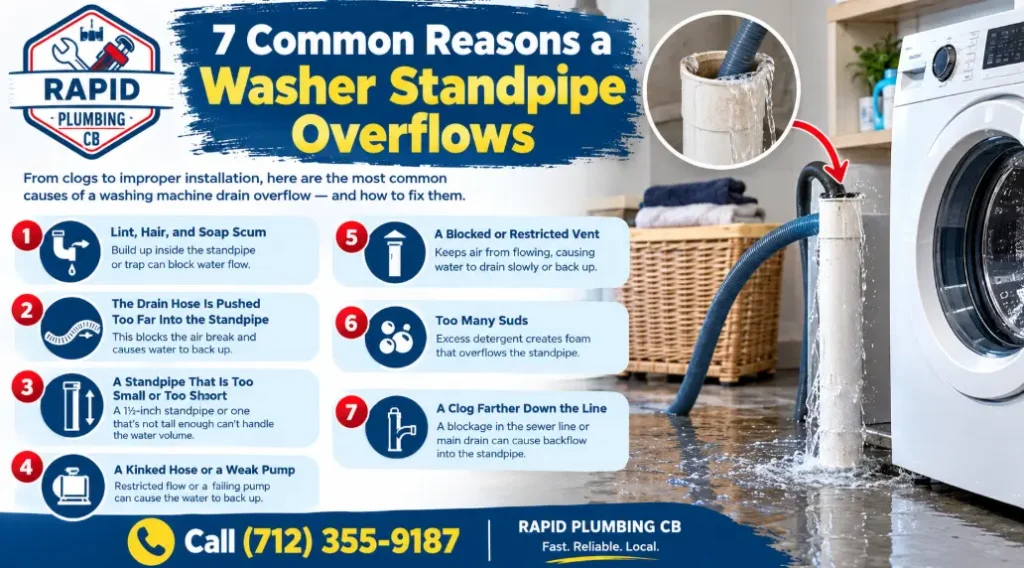
7 Common Reasons a Washer Standpipe Overflows
1. Lint, Hair, and Soap Scum in the Standpipe or Trap
Washers shed more than you would think: lint, pet hair, sand, and a waxy buildup of detergent and fabric softener. Over months, that material coats the inside of the trap and standpipe until the opening is half its original size. This is by far the most common cause of a washing machine drain overflowing Council Bluffs plumbers are called out for.
2. The Drain Hose Is Pushed Too Far Into the Standpipe
If the hose runs deep into the pipe or has been wrapped with tape or rags to “stop splashing,” it blocks the air break. The water has nowhere for air to go, so it backs up and spills. Only a few inches of hose should enter the standpipe, loosely, with a gooseneck bend or hose holder at the top.
3. A Standpipe That Is Too Small or Too Short
Older homes often have a 1½-inch standpipe from the era of slower, lower-volume machines. Modern washers pump water out faster, and a narrow pipe cannot keep up. A standpipe that is too short can also be overrun or siphon. As a general rule, a laundry standpipe is a 2-inch pipe with its top sitting roughly 18 to 42 inches above the trap, but always confirm against your washer’s installation sheet and local code.
4. A Kinked Hose or a Weak Drain Pump
A hose pinched behind the machine, or a drain pump that is losing strength, can produce surging flow that overshoots the standpipe even when the pipe itself is clear. If the standpipe looks clean and the hose is crushed or cracked, replace the hose before blaming your plumbing.
5. A Blocked or Restricted Vent
A vent that is partly blocked leaves the drain starved for air, which slows the flow and can make the standpipe gulp and burp. Gurgling in other fixtures during the drain cycle is the classic clue. Winter ice or snow can also cap a vent stack on the roof. Our guide to a clogged plumbing vent explains the signs in detail.
6. Too Many Suds
Standard detergent in a high-efficiency machine, or simply too much detergent, creates foam that rides up the standpipe and out of the top. If you see suds rather than clear water, cut the detergent dose, make sure you are using the right type for your machine, and run an empty rinse cycle.
7. A Clog Farther Down the Branch or Main Line
If the standpipe is clear and the setup is correct but water still backs up, the blockage is downstream. Grease, roots, a collapsed section, or years of buildup in an older pipe can all slow the line until the washer’s burst of water overwhelms it. This is common in older Council Bluffs homes, where the laundry often shares a branch with a floor drain, a laundry tub, or a bathroom. Our post on tree roots in sewer lines and our guide to clay and cast iron sewer pipe in older homes cover what typically causes it.
Safe DIY Fixes for a Washing Machine Drain Overflowing Council Bluffs Problem
If your triage points to a local standpipe or setup issue, here is a careful, damage-free way to work through it. Wear gloves and keep the water supply valves closed until you are done.
- Remove the hose from the standpipe and check it for kinks, cracks, and lint packed at the end. Rinse it out in a utility sink or tub.
- Shine a flashlight down the standpipe. If you can see a mat of lint or standing water that does not move, you have found the clog.
- Remove loose debris by hand or with a wet/dry vac set to liquid pickup. Do not push material further down the pipe.
- Use a small hand drain auger gently to break up soft buildup. Stop if you meet hard resistance. Forcing a cable can scratch pipe or jam it at the trap.
- Flush slowly with hot tap water from a bucket to move loosened material through. If the water drops away steadily, the clog is cleared.
- Reinstall the hose correctly. Use a hose guide or gooseneck, leave an open gap around the hose, and do not seal or tape it in place.
- Test with an empty rinse cycle and watch the standpipe through the whole drain phase. It should stay well below the top.
When DIY Stops
Call a plumber if the standpipe overflows again within a few days of clearing it, if other drains are involved, if you hear gurgling, or if the pipe is rusted, cracked, or wrapped in odd repairs. Repeat clogs almost always mean the real restriction is deeper than a hand auger can reach. If you are weighing the cost, our breakdowns of drain cleaning cost and how much a plumber costs in Council Bluffs help you plan.
Standpipe Setup Check: Height, Size, and Air Gap
If your standpipe keeps overflowing even when it is clean, the installation itself may be the problem. This is especially common after a new washer is delivered, after a remodel, or in a home where a previous owner moved the laundry. Here is what to check.
| Item | What It Should Look Like | If It Is Wrong |
|---|---|---|
| Standpipe diameter | 2-inch pipe for a modern washer | A 1½-inch pipe can overflow at the washer’s full pump rate |
| Standpipe height | Typically about 18 to 42 inches above the trap, within your washer’s instructions | Too short invites siphoning and overrun; too tall can strain the pump |
| Hose depth | A few inches into the pipe, loosely held with a gooseneck | A deep or sealed hose blocks air and causes backups |
| Trap | A P-trap below the standpipe that keeps a water seal | A missing or dry trap lets sewer gas into the room |
| Vent | Properly vented so air reaches the drain behind the water | Slow drains, gurgling, and overflow during the drain cycle |
| Access | Reachable for cleaning or rodding | Hidden or boxed-in pipe makes every clog a bigger job |
Plumbing rules vary, and Iowa’s plumbing code is based on the Uniform Plumbing Code. If you need to change a standpipe, trap, or any drain piping, check requirements with the City of Council Bluffs Building Division and review the permit applications page first. Work on drain piping should be done by a licensed professional, and the city’s contractor licensing information explains what to look for. Our guides on Council Bluffs plumbing permits and keeping plumbing up to code in Iowa cover the basics.
Why Council Bluffs Laundry Drains Back Up
Local housing stock plays a bigger role than most homeowners realize. Many Council Bluffs homes have their laundry in the basement, tied to a floor drain, a laundry tub, or a shared branch that runs through older pipe. Several factors make a washing machine drain overflowing Council Bluffs call more likely than you might expect.
- Older drain materials. Clay and cast iron pipe develop rough interior surfaces and joints where lint and roots catch. See our guide to plumbing in older Council Bluffs homes.
- Mature trees. Roots find tiny cracks in lateral lines and can restrict flow long before a full blockage.
- Heavy rain events. When the lowest drain in the house, often a basement floor drain or laundry standpipe, is the first place water appears during or after storms, the cause may be a backup from the sewer side rather than your washer. A backwater valve for basement sewer backup is the long-term defense.
- Shared branch lines. If your floor drain gurgles when the washer runs, read basement floor drain backups to see how the two problems connect.
Knowing who is responsible for which part of the line also matters. Our explainer on who is responsible for the sewer line in Council Bluffs helps you decide whether to call the city or a plumber, and the City of Council Bluffs Sewer Division is the right place to ask about problems in the public main. For account and service questions, start with the city’s Utilities page. A sewer cleanout is also the access point a plumber will use to clear the line, so knowing where yours is saves time.
Washer Overflow or Sewage Backup? Know the Difference
A washer overflow is mostly laundry wash and rinse water, which is dirty but not sewage. A sewage backup is different: wastewater coming up from the main line through the lowest drain, often with a strong odor and dark water.
Sewage-contaminated water can carry bacteria, so keep children and pets out of the area, wear gloves and boots if you must enter, and do not try to dry out porous items yourself. Our sewer smell in the bathroom guide can help you sort out odors that are not coming from a backup.
What a Professional Plumber Does Differently
When a standpipe keeps overflowing, we do not just push a cable down and hope. A proper diagnosis usually includes:
- Testing other fixtures to see whether the clog is local or on the main line.
- Clearing the standpipe, trap, and branch with the right size cable, or hydro jetting versus snaking when grease, scale, or heavy buildup calls for it.
- Running a camera inspection when clogs return, to find roots, bellies, or breaks. Learn how it works in our guide to camera inspection for sewer repair.
- Checking venting and standpipe size against the washer’s needs and correcting what does not fit.
- Explaining repair options if a section of pipe is failing, from spot repair to trenchless pipe lining or full sewer line repair.
Rapid Plumbing CB provides drain cleaning in Council Bluffs, sewer line repair, and a full range of residential plumbing services, all with upfront pricing. See our transparent pricing promise for how we quote.
How to Keep Your Washer Drain From Overflowing Again
- Add a lint trap. A small mesh filter on the end of the drain hose or a laundry-tub lint catcher stops a surprising amount of debris.
- Use the right amount of the right detergent. Less is usually better, and high-efficiency machines need HE detergent.
- Flush the line quarterly. Slowly run hot water from a bucket down the standpipe to loosen soap film before it hardens.
- Check the hose when you move the machine. Make sure it is not kinked, crushed, or pushed down too deep.
- Do not run back-to-back loads if the drain is already slow. Give the line time to clear.
- Know your shut-off. If a supply valve is stuck, fix it before you need it. See a water shut-off valve that won’t work.
- Schedule a line cleaning if you have an older home with repeat clogs, and review our weather-based plumbing checklist each season.
Renting out a property? A tenant’s overflowing washer can turn into a costly claim. Our plumbing maintenance checklist for landlords shows how to catch laundry drain problems early.
Stop the Overflow for Good
Licensed, local, and ready to clear the clog or correct the standpipe the first time. Call Rapid Plumbing CB today.
Call (712) 355-9187Frequently Asked Questions About Washing Machine Drain Overflowing Council Bluffs
Why does my washing machine drain overflow only during the drain cycle?
The drain cycle is when the pump pushes out the entire tub of water in a short burst. A partial clog, a small standpipe, or a hose pushed in too far can handle a trickle but not that surge, so the overflow only shows up when the machine empties.
How do I unclog a washing machine standpipe?
Remove the drain hose, clear visible lint by hand or wet/dry vac, work a small hand auger gently through the standpipe and trap, and flush with hot water. If it overflows again soon after, the blockage is probably farther down the line and needs professional cleaning.
Can I pour drain cleaner down a washer standpipe?
We advise against it. Standing water in the pipe can splash back, chemicals do little to lint and soap clogs, and they can be hard on older pipe. Mechanical clearing is safer and works better.
Is my overflowing washer drain a main line problem?
It can be. If sinks, tubs, or the basement floor drain also gurgle, back up, or smell when the washer runs, the main or branch line is likely restricted. Stop using water and call a plumber.
How tall should a washing machine standpipe be?
A common range is roughly 18 to 42 inches above the trap, with a 2-inch pipe, but requirements depend on your washer’s instructions and local code. If you plan to change the pipe, check with the City of Council Bluffs Building Division and use a licensed plumber.
Does a blocked vent cause a washing machine drain to overflow?
Yes, it can. A restricted vent slows drainage and causes gurgling, and a washer’s fast discharge can overwhelm the line. A plumber can test the vent and clear it.
How much does it cost to fix an overflowing washer drain in Council Bluffs?
It depends on whether the clog is in the standpipe, the branch, or the main line, and whether a camera inspection or jetting is needed. Our drain cleaning cost guide explains typical pricing factors, and we provide upfront pricing before work begins.
Need Help With Washing Machine Drain Overflowing Council Bluffs?
If your laundry drain keeps backing up, do not wait for the next flood. Rapid Plumbing CB serves homes and businesses across Council Bluffs, from downtown to North Broadway, Lake Manawa, and The Heights. Contact us online or call (712) 355-9187, and see about our family-owned team.
Rapid Plumbing CB · 112 S 18th St, Council Bluffs, IA 51501 · (712) 355-9187 · contact@rapidplumbingcb.com