
Water Service Line Replacement Council Bluffs: Who Owns Which Pipe?
If you are searching for water service line replacement Council Bluffs, the first question is rarely “how much does it cost?” It is “whose pipe is this, and who pays?” The buried line that brings water from the street to your house is split between Council Bluffs Water Works and you, and that split decides who calls whom when something goes wrong.
This guide explains where the public part ends and your part begins, how to tell if your line is failing, what a replacement involves, and what Iowa homeowners typically pay. We are a local plumbing team, so we also cover the Council Bluffs details that national articles skip.
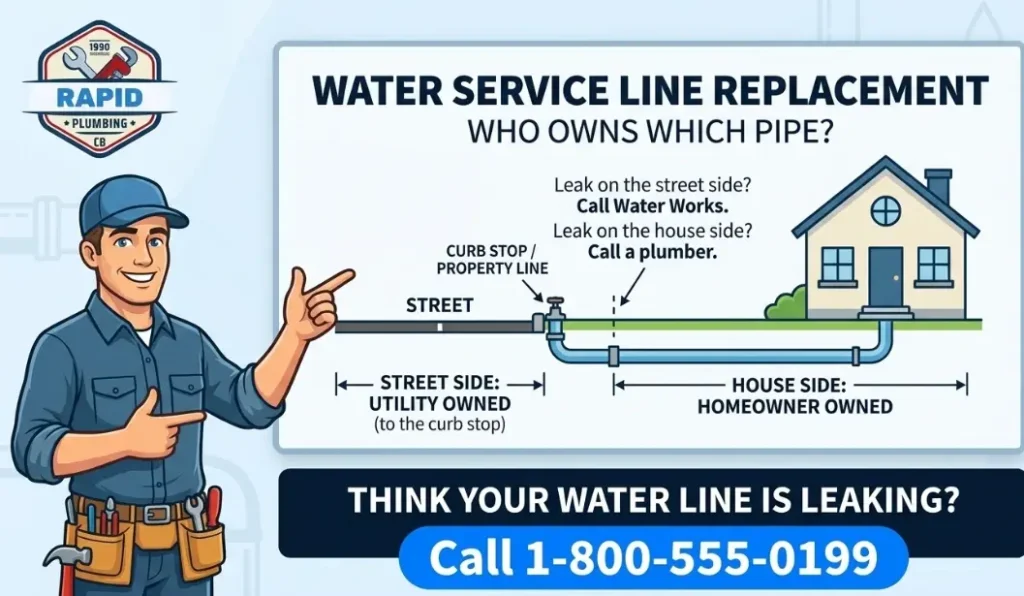
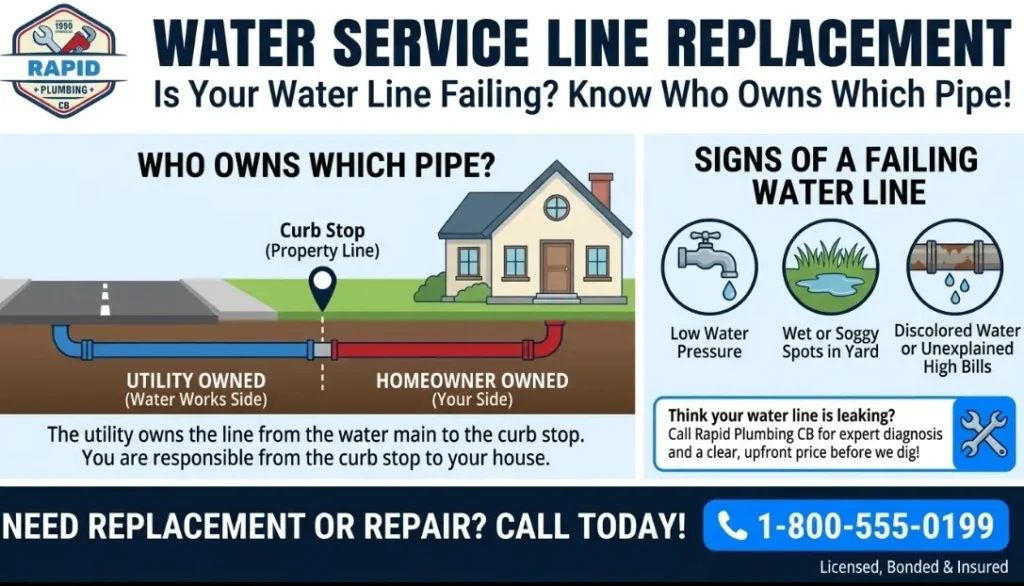
Quick answer: According to Iowa State Revolving Fund coverage of Council Bluffs Water Works, the utility owns the line from the water main to the curb stop at the property line, and the homeowner owns the line from the curb stop to the house. Leak on the street side? Call Water Works. Leak on the house side? That is your line, and a licensed plumber handles it.
Think your water line is leaking?
Our Council Bluffs plumbers diagnose the line, tell you which side it is on, and give you a clear price before any digging starts.
Call (712) 355-9187What Is a Water Service Line?
A water service line is the underground pipe that connects the city water main under the street to the plumbing inside your home. Every drop you use for showers, laundry, and drinking passes through it. It is different from the pipes inside your walls, and it is different from your sewer line, which carries wastewater out. If you want the sewer side explained, read our guide on who is responsible for the sewer line in Council Bluffs.
Along the way the service line passes three points that matter for ownership:
- The water main under the street, owned and maintained by the utility.
- The curb stop, a buried shut-off valve near the property line, usually under a small metal lid.
- The meter and your main shut-off, normally in the basement, crawl space, or utility room where the line enters the house.
Who Is Responsible for the Water Service Line in Council Bluffs?
Ownership of the service line varies from city to city, so general advice from other states can mislead you. For Council Bluffs, the Iowa Environmental Council’s write-up on the state revolving fund describes the split this way: Water Works owns the piping between the main and the curb stop, and homeowners own the piping between the curb stop and the home.
| Section of the line | Typically owned by | Who you call |
|---|---|---|
| Water main under the street | Council Bluffs Water Works | Water Works |
| Main to the curb stop | Council Bluffs Water Works | Water Works |
| Curb stop to the house | Homeowner | A licensed plumber |
| Meter area, main shut-off, and everything inside | Homeowner (meter is utility equipment) | A licensed plumber |
Always confirm your exact boundary. The curb stop is not in the same spot on every lot, and older properties can differ. Before you pay for any dig, call Council Bluffs Water Works and ask where their responsibility ends at your address.
Why this matters before you hire anyone
If the leak is on the utility side, the repair should not land on your bill. If it is on your side, you want a plumber who can locate the line, handle the excavation, and make the connection correctly. Calling a contractor first and finding out afterward that the leak was the utility’s pipe is an expensive way to learn the boundary.
Signs Your Water Service Line Is Failing
Because the pipe is buried, most people notice the symptoms before they see the problem. Watch for these warning signs:
- Sudden or gradual drop in water pressure at every fixture, not just one faucet. Our page on low water pressure in Council Bluffs homes helps you rule out simpler causes first.
- A higher water bill with no change in how your household uses water.
- A wet, soft, or unusually green patch in the yard between the street and the house, even in dry weather.
- The meter moving when every tap, appliance, and ice maker is off.
- Brown, rusty, or cloudy water, especially in older houses with galvanized steel pipe.
- The sound of running water when nothing is on.
A line leak can look a lot like other problems. Our guide to the signs of a hidden water leak shows how to separate a yard-side leak from one inside the walls, and if the leak is under the foundation, our slab leak signs and cost guide is the better fit.
Is It the Service Line or Just a Bad Shut-Off Valve?
Homeowners often blame the service line when the real problem is a worn valve. If a valve will not turn, drips at the handle, or fails to stop the flow, start with our guide on a water shut-off valve that is not working in Council Bluffs. If the valve works and water still shows up in the yard or your meter keeps spinning, the buried line is the likelier suspect.
How to find your shut-offs
- Locate the main shut-off where the line enters the house, usually near the water heater or meter.
- Find the curb stop lid near the property line or sidewalk. Keep it clear of mulch, soil, and snow.
- Ask Water Works before you operate or dig around the curb stop. It is tied to the utility’s side of the system.
Materials Used in Older Water Service Lines
The pipe material affects both safety and cost. In Council Bluffs you can run into several types:
- Lead. Council Bluffs banned lead service lines in 1959, and a national ban followed in 1986. The same Iowa Environmental Council article notes that the lead lines still in the ground are clustered in older neighborhoods with older homes.
- Galvanized steel. Common in mid-century houses. It corrodes from the inside, which causes low pressure and rusty water.
- Copper. Long-lasting and widely used on the house side.
- PEX or plastic. Used in newer installs where local code allows.
We are not able to tell you what your line is made of without looking at it, and we do not assume anything based on your address. Under the federal Lead and Copper Rule Revisions, Iowa water systems had to submit a service line inventory to the state, and the Iowa DNR’s inventory quick reference guide explains that these inventories must be made publicly available. Ask Water Works how to see what is recorded for your address. If you live in a historic area, our guide to plumbing in an older Council Bluffs house covers what else to inspect while the yard is open, and homeowners in Old Town Council Bluffs will recognize many of those older-pipe issues.
How Water Service Line Replacement Works
A proper replacement follows a clear order. Skipping steps is how lines get damaged, inspections fail, or the wrong side gets dug up.
- Diagnose and confirm the problem. We check pressure, test for leaks, and verify the line is the cause before recommending a dig.
- Confirm ownership with Water Works. We locate the curb stop and settle which section is yours.
- Call 811 before any digging. Utility locates are a safety step. Iowa One Call marks buried lines so nobody hits gas, electric, or communication cables.
- Check permit and inspection needs. Contact the City of Council Bluffs Building Department to confirm what applies to work on your private line. Our Council Bluffs plumbing permit guide explains when permits usually come into play.
- Excavate or use a trenchless method. Open trenching is the most common. Depending on the yard, driveway, and trees, a trenchless approach can cut surface damage.
- Install the new line. The new pipe runs from the curb stop to the meter connection using approved materials and fittings.
- Pressure test, backfill, and flush. We test the line before covering it and flush the system so debris does not clog your fixtures.
Frost matters here. Iowa lines are buried deeper than the national average because the ground freezes deep, which makes digging slower and raises labor. For winter protection tips, see how to prepare your plumbing for Iowa and Nebraska winters.
If a lead line is found: talk to Water Works before you replace only your section. They are replacing their side under a state loan program, and coordinating both sides avoids leaving a mismatched pipe in the ground.
How Much Does Water Service Line Replacement Cost in Iowa?
No honest number exists without seeing the line. Length, depth, soil, concrete, trees, and the method used all change the price. For a rough benchmark, HomeServe’s contractor data for Iowa reports an average of about $3,021 to replace a water service line, about $861 to repair one, and about $184 to diagnose a problem, with Iowa lines averaging nearly six feet deep.
| Cost factor | How it changes the price |
|---|---|
| Line length | A longer run from the curb stop to the house costs more in labor and pipe. |
| Depth | Deeper trenches take longer and may need shoring. |
| Driveway, sidewalk, or patio in the path | Cutting and restoring hard surfaces adds cost. |
| Trees and landscaping | Roots and mature plantings slow the dig and can raise restoration costs. |
| Trenchless vs. open trench | Trenchless can reduce restoration but is not suitable for every site. |
| Lead or galvanized pipe removal | Replacement projects involving lead lines can be far more expensive. One Iowa estimate puts a single lead line at $10,000 to $15,000 for the homeowner. |
Treat these as averages from other sources, not a quote from us. Ask any contractor for a written, itemized estimate that spells out what is included for excavation, materials, permits, and restoration. Also check your homeowner’s insurance: many standard policies do not cover wear-and-tear failures on a buried service line, though some offer an optional endorsement.
Repair or Replace the Water Service Line?
A spot repair makes sense for one clean leak on an otherwise healthy pipe. Replacement is the smarter move when:
- The line has already been repaired several times.
- The pipe is galvanized steel and pressure keeps dropping.
- The material is lead or unknown on your side of the curb stop.
- Multiple leaks or corrosion show up when the line is exposed.
If the pipes inside the house are also corroded, replacing only the outside line will not fix your pressure for long. In that case, review the signs you need whole-home repiping and our whole-home repiping service. If you are unsure whether this is a job for you, read when to call a plumber instead of fixing it yourself. Water quality questions after a replacement are covered in our Council Bluffs water quality guide.
Why Council Bluffs Homeowners Call Rapid Plumbing CB
We handle the part homeowners dread: figuring out where the problem is and what it will take to fix. We serve both ZIP code 51501 and ZIP code 51503, along with neighborhoods such as Downtown Council Bluffs and The Heights. You can see every area on our Council Bluffs service area page, and the full list of what we do is on our plumbing services page.
If water is actively flooding a yard or basement, do not wait: use our emergency plumber in Council Bluffs service and close your main shut-off right away.
Get a clear answer on your water line
Call now for a diagnosis, a straight answer on which side of the curb stop the problem is on, and an upfront estimate.
Call (712) 355-9187Water Service Line Replacement FAQs
Who pays for water service line replacement in Council Bluffs?
Based on how Council Bluffs Water Works describes ownership, the utility is responsible for the line from the main to the curb stop, and you are responsible for the section from the curb stop to your house. Confirm your exact boundary with Water Works before work begins.
Who do I call if I think my water line is leaking?
Start by checking your meter with everything turned off. If the leak looks like it is near the street side, call Council Bluffs Water Works. If it is between the curb stop and your house, call a licensed plumber.
How long does a water service line replacement take?
Many straightforward residential replacements can be completed in about a day, but deep lines, concrete, utility conflicts, or restoration work can extend the timeline. Your plumber should give you a schedule after seeing the site.
Do I need a permit to replace my water service line?
Requirements depend on the work and the connection point. Contact the City of Council Bluffs Building Department to confirm what applies to your project before digging begins.
Does homeowner’s insurance cover a broken water line?
Often it does not cover wear, corrosion, or age-related failure on a buried service line. Check your policy for service line coverage or ask your agent about an endorsement.
Should I replace only my side if the utility’s side has lead?
Talk to Water Works first. Coordinating both sides is usually better than leaving a mismatch, and the utility can tell you how their own replacement work is scheduled.