
Gas Line for Outdoor Grill Fire Pit Council Bluffs: What to Expect
Planning a gas line for outdoor grill fire pit Council Bluffs projects? It looks simple: a pipe, a valve, a hose. In reality, outdoor gas work in Council Bluffs has to handle freezing winters, shifting clay soil, digging near buried utilities and appliances that can pull far more gas than a kitchen range. This guide explains what to expect for a grill, a fire pit or a standby generator, so you can plan the project before anyone breaks ground.
This post covers outdoor appliance lines only. For general home piping, see our page on gas line installation in Council Bluffs.
Want an outdoor gas line done right?
Talk to a local plumber about your grill, fire pit or generator.
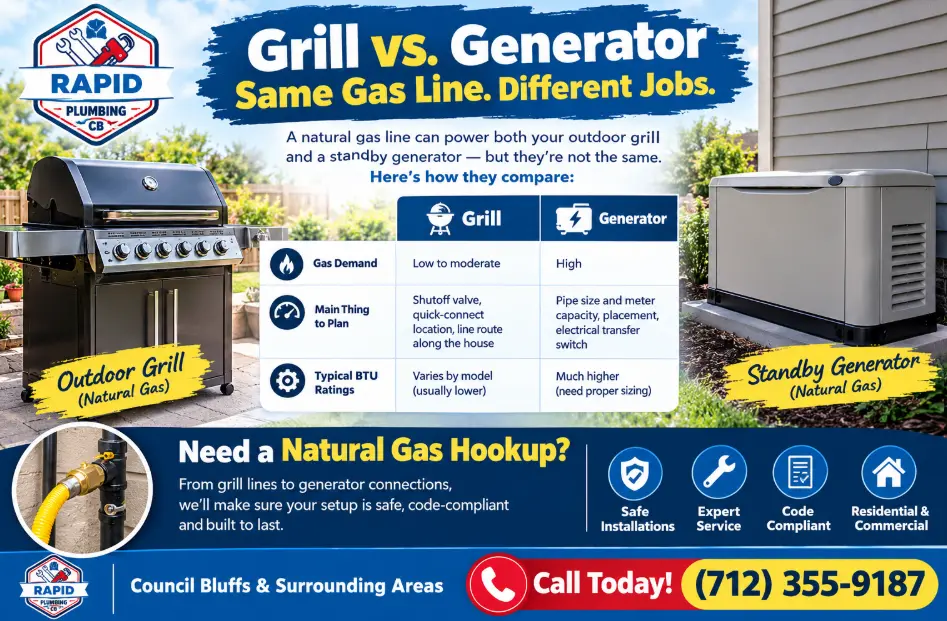
Quick Comparison: Grill vs. Fire Pit vs. Generator
| Appliance | Gas demand | Main thing to plan |
|---|---|---|
| Outdoor grill | Low to moderate | Shutoff valve, quick-connect location, line route along the house |
| Fire pit | Moderate to high | Pit rated for natural gas, clearances, buried line, key valve |
| Standby generator | High | Pipe size and meter capacity, placement, electrical transfer switch |
Exact BTU ratings differ by model, so always check the nameplate or manual before sizing any pipe.
Gas Line for Outdoor Grill: Natural Gas Hookup Basics
A natural gas grill hookup lets you stop swapping propane tanks. A typical install runs a branch line from an existing gas supply to a spot near the grill, ending in a shutoff valve and a quick-connect fitting rated for outdoor use. A few details matter:
- Grill type: Many grills ship as propane and need a manufacturer conversion kit for natural gas. Never force a propane grill onto a natural gas line.
- Location: Keep the connection close to where the grill will sit, and away from doors, windows and vents.
- Pipe size: Longer runs need larger pipe to deliver enough gas. Size depends on total load and distance.
- Weather protection: Outdoor valves and fittings should be weather-rated and protected from damage.
Fire Pit Gas Line Installation: Placement and Safety
A gas fire pit usually needs more gas than a grill and often sits farther from the house, so the line is commonly buried. That means digging, which is where planning pays off.
- Call before you dig: Contact Iowa One Call (811) so buried utilities are marked first.
- Use a rated burner kit: The burner and pit must be designed for the fuel you are using.
- Mind the clearances: Keep the pit away from fences, decks, overhangs and tree branches, following the manufacturer’s instructions.
- Add a shutoff: An accessible shutoff valve near the pit lets you cut gas quickly.
Yards in neighborhoods like Lake Manawa and The Heights often have slopes, mature trees and drainage to work around, so the route should be walked on site before pricing.
Gas Line for a Generator: Capacity Comes First
A standby generator is the biggest gas consumer of the three. Before anything else, someone needs to confirm that your existing piping and gas meter can supply the generator and everything else in the house running at the same time. If they cannot, the line may need to be upsized, and the gas utility may need to be involved.
- Gas load check: Add the generator’s rated consumption to your existing appliances, such as the furnace and gas water heater.
- Placement: Generators must sit where the manufacturer and local code allow, with required clearances from the house and openings.
- Electrical side: The transfer switch and wiring are electrician work. We handle the gas piping, and we can coordinate timing with your electrician.
Do You Need a Permit for an Outdoor Gas Line?
Permit rules can depend on the type of work, so confirm before you build. The City of Council Bluffs Building Division lists plumbing and mechanical inspectors on staff and can tell you what applies to your address. Our Council Bluffs plumbing permit guide explains the general process. Gas work should be done by a qualified, licensed contractor, and a proper job ends with a pressure test and inspection where required.
For city information in general, start at the City of Council Bluffs website.
How an Outdoor Gas Line Installation Goes
- Site visit: We look at your appliance, the gas source, and the best route.
- Load and sizing check: We confirm the pipe size needed for the appliance and the run length.
- Permit and utility marking: Permit steps are handled where required, and utilities are marked before digging.
- Install: The line, valves and fittings are installed with approved materials.
- Pressure test and leak check: The system is tested before gas is put into service.
- Final walkthrough: You see where the shutoff is and how to operate it.
What Affects the Price of an Outdoor Gas Line?
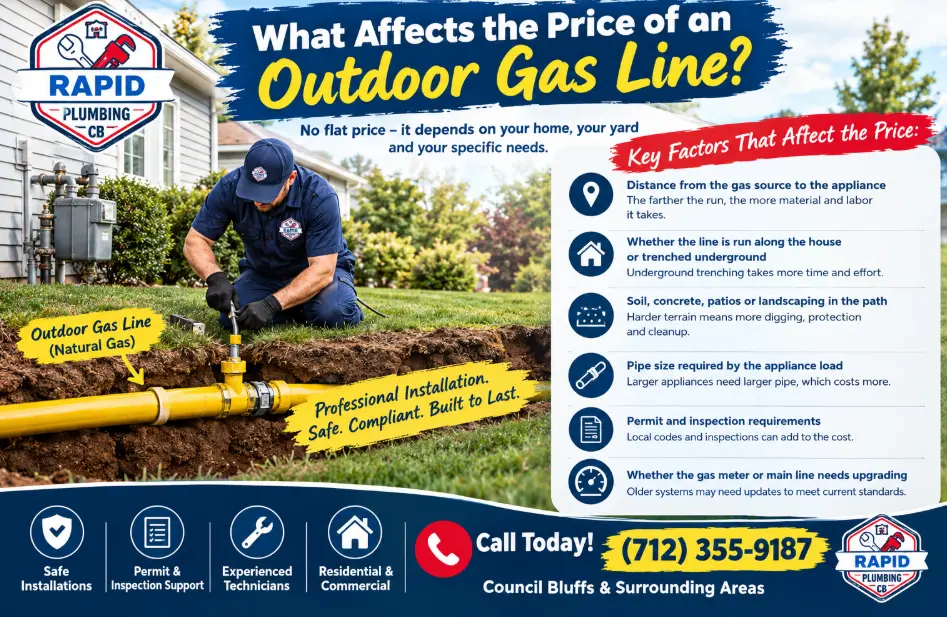
There is no honest flat price without seeing the yard. These are the factors that move the number most. For general pricing context, read how much a plumber costs in Council Bluffs.
- Distance from the gas source to the appliance
- Whether the line is run along the house or trenched underground
- Soil, concrete, patios or landscaping in the path
- Pipe size required by the appliance load
- Permit and inspection requirements
- Whether the gas meter or main line needs upgrading (common with generators)
Smell gas? Act first, call us second. Leave the area right away, do not use switches, flames or phones near it, and call 911 and your gas utility from outside. Learn the warning signs in what a gas leak smells like. Gas utility contact details are on the MidAmerican Energy website.
Frequently Asked Questions
Can any plumber run a gas line for an outdoor grill?
Gas piping should only be done by a qualified, licensed professional. Ask for proof of licensing and insurance, and confirm any permit and inspection steps.
Can I convert my propane grill to natural gas?
Only if the manufacturer offers a conversion kit for your exact model. Never modify a grill without one.
Does a fire pit gas line need to be buried?
Not always, but pits away from the house usually use a buried line. Local code and the manufacturer’s instructions decide what is allowed.
Will my gas meter handle a whole-home generator?
That depends on your total load and meter capacity. It needs to be checked before installation, and the gas utility may need to upgrade service.
Is a plumber or an electrician needed for a generator?
Both. A plumber handles the gas piping, and an electrician handles the transfer switch and wiring.
Ready to plan your outdoor gas line?
Rapid Plumbing CB serves Council Bluffs homeowners. Share what you want to hook up and we will walk you through the next steps. See all our plumbing services or reach a 24/7 emergency plumber.