Sump Pump Impeller Replacement: Fix the Part or Replace the Pump?
Your pump hums, the motor clearly has power, but no water is moving — a bad impeller is almost always the reason, and it forces a very specific decision most homeowners haven’t had to make before.
The impeller is the small, fan-like wheel inside your sump pump that actually pushes water out — everything else in the pump exists to spin it. When it fails, you get a very particular symptom: the motor runs, you can hear it working, but the water level in the pit doesn’t drop. This guide focuses specifically on that part: what a sump pump impeller replacement actually involves, whether it’s worth doing versus replacing the whole pump, and what it takes to do it yourself.
Sump Pump Impeller Replacement: The Quick Answer
Whether sump pump impeller replacement makes sense depends entirely on the pump underneath it. On a budget thermoplastic pump — the kind most commonly sold at hardware stores — individual parts are often not sold separately, or cost nearly as much as a brand-new pump when you account for your own labor and the risk of getting it wrong. On a higher-end cast iron or commercial-grade submersible pump, a replacement impeller is a real part with a real price, and swapping just that component can be significantly cheaper than replacing the entire unit.
What Does a Sump Pump Impeller Actually Do?
The impeller sits at the base of the pump housing and spins rapidly when the motor is running, using centrifugal force to fling water outward and up through the discharge line. It’s the only part of the pump that physically touches and moves the water — the motor just supplies the spin. When the impeller is blocked, cracked, or worn down, the motor keeps running exactly as designed, but the actual water-moving function stops.
Signs Your Impeller Has Failed
What Causes Impeller Damage
A few things account for nearly every impeller failure we see: sediment, gravel, or debris in the sump pit getting pulled into the intake and jamming the blades; sustained exposure to “bacterial iron” — a reddish, slimy buildup common in groundwater with high iron content — that coats and eventually clogs the impeller; and simple mechanical wear after years of regular cycling, especially on lower-quality plastic impellers that weren’t built for heavy, repeated use.
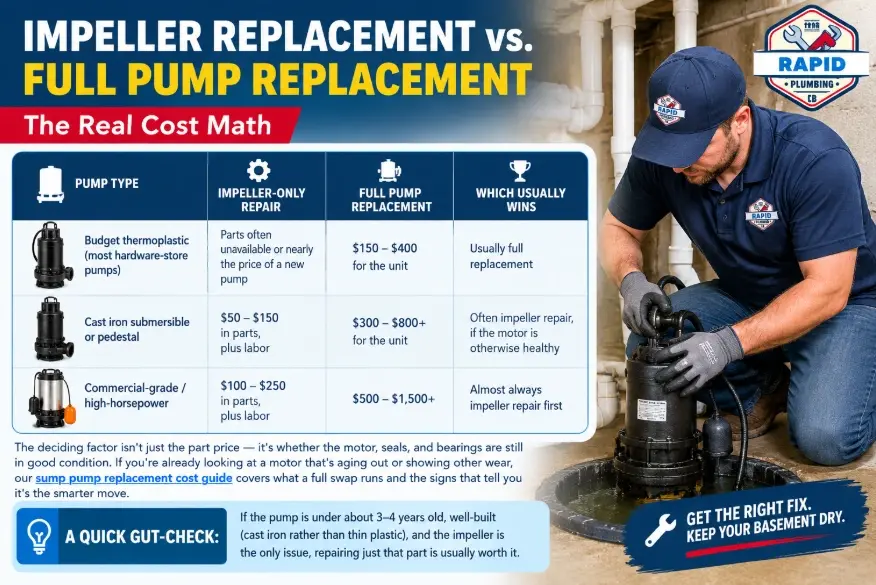
Impeller Replacement vs. Full Pump Replacement: The Real Cost Math
| Pump Type | Impeller-Only Repair | Full Pump Replacement | Which Usually Wins |
|---|---|---|---|
| Budget thermoplastic (most hardware-store pumps) | Parts often unavailable or nearly the price of a new pump | $150 – $400 for the unit | Usually full replacement |
| Cast iron submersible or pedestal | $50 – $150 in parts, plus labor | $300 – $800+ for the unit | Often impeller repair, if the motor is otherwise healthy |
| Commercial-grade / high-horsepower | $100 – $250 in parts, plus labor | $500 – $1,500+ | Almost always impeller repair first |
The deciding factor isn’t just the part price — it’s whether the motor, seals, and bearings are still in good condition. If you’re already looking at a motor that’s aging out or showing other wear, our sump pump replacement cost guide covers what a full swap runs and the signs that tell you it’s the smarter move.
A quick gut-check: if the pump is under about 3-4 years old, well-built (cast iron rather than thin plastic), and the impeller is the only issue, repairing just that part is usually worth it. If the pump is older, cheaper, or this isn’t its first problem, the labor and part cost of an impeller repair often gets you close enough to a new pump’s price that replacement is the better long-term move.
Can You Replace a Sump Pump Impeller Yourself?
It’s more involved than a simple pump swap, but within reach for a homeowner comfortable with basic mechanical work. The general process: unplug the pump completely, remove it from the pit, take off the base plate or housing covering the impeller, inspect and clear any debris, and either clean the existing impeller or replace it with a manufacturer-matched part. The tricky parts are making sure the replacement impeller is the exact model match — an incorrect fit can throw off the pump’s balance and cause premature motor wear — and reassembling the housing with a proper seal so water doesn’t bypass the impeller entirely.
Safety note: always fully unplug the pump before touching the impeller housing, even if you’re just inspecting it. Never reach into the pit or the pump housing while it’s connected to power.
When to Call a Plumber Instead
If you’re not confident matching the exact impeller model, if the pump has any electrical damage beyond the impeller itself, or if this is a recurring problem on the same unit, it’s worth having a professional handle it rather than risk a mismatched part or an improperly sealed housing. Electrical work on equipment sitting in a wet pit is one of the areas where the risks of DIY or unlicensed work are highest — plumbers performing this kind of repair are licensed through the Iowa Plumbing and Mechanical Systems Board, which is worth confirming before anyone takes on wiring or motor work near standing water.
Why Choose Rapid Plumbing CB
We check the whole pump — not just the impeller — before recommending a repair, so you’re not paying for a part swap on a motor that’s about to fail anyway. If your pump is humming without moving water, our sump pump troubleshooting guide covers what to check first, and our sump pump repair and installation team handles everything from a single-part fix to a full replacement across Council Bluffs.
Frequently Asked Questions
How much does sump pump impeller replacement cost?
Parts typically run $50-$250 depending on the pump model, plus labor if you hire it out. On cheaper thermoplastic pumps, individual impellers are often unavailable or priced close to a whole new pump, making full replacement the more practical option.
Is it worth replacing just the impeller instead of the whole pump?
Usually yes on a well-built cast iron or commercial-grade pump with an otherwise healthy motor. On a budget plastic pump, or one that’s already several years old, the cost often ends up close enough to a new pump that full replacement makes more sense.
Can a clogged impeller be cleaned instead of replaced?
Yes, if the blades themselves aren’t cracked or worn — clearing debris and buildup can fully restore function. Replacement is only necessary when the impeller itself is physically damaged.
What does it mean if my sump pump hums but doesn’t pump water?
This is the classic sign of a jammed or failed impeller — the motor has power and is trying to spin, but something is blocking or has damaged the part that actually moves water.
Is impeller replacement a DIY-friendly repair?
It’s more involved than a simple pump swap but doable for a homeowner comfortable with basic mechanical work, as long as you can match the exact impeller model and reseal the housing properly. If you’re not confident on either point, a professional repair avoids a mismatched part or a leak-prone reassembly.
Not Sure If It’s Just the Impeller?
Free diagnosis before any repair recommendation — licensed local plumbers, available 24/7 across Council Bluffs, IA.
Call (712) 355-9187