Do You Need a Drainage Contractor Council Bluffs? Commercial & Residential Solutions Explained
A soggy backyard, a basement that dampens after every heavy rain, or a commercial parking lot that ponds water near the entrance — these are the calls we get most after a wet spring in Council Bluffs. And almost every one of them starts with the same question: “Do I need a plumber, or do I need a drainage contractor Council Bluffs?” Because our city sits close to the Missouri River with heavy clay soil underneath, standing water isn’t just an inconvenience here — it’s one of the most common causes of foundation and basement damage we see.
Short answer: If water is pooling in your yard, along a foundation, or across a commercial lot, you likely need a drainage contractor to install a French drain, dry well, or regrading solution that redirects the water at the surface. If water is already getting inside your basement or crawl space, that’s a job for a licensed plumber and a sump pump system. Many Council Bluffs properties — especially older homes near the river and clay-heavy lots — actually need both working together.
Rapid Plumbing CB handles the plumbing side of drainage: sump pump systems, interior drain tile, sewer-connected discharge lines, and basement drain backups. Below, we’ll break down exactly when you need a drainage contractor versus a plumber, what commercial properties in Council Bluffs need to know about stormwater compliance, and the drainage solutions that actually work for our local soil and flood risk.
Drainage Contractor vs. Plumber: Who Handles What?
Drainage Contractor Handles
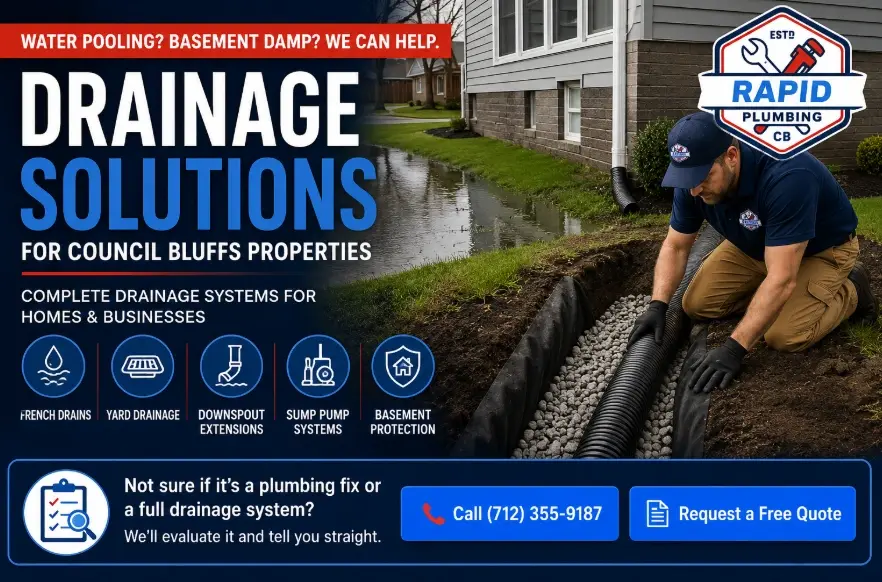
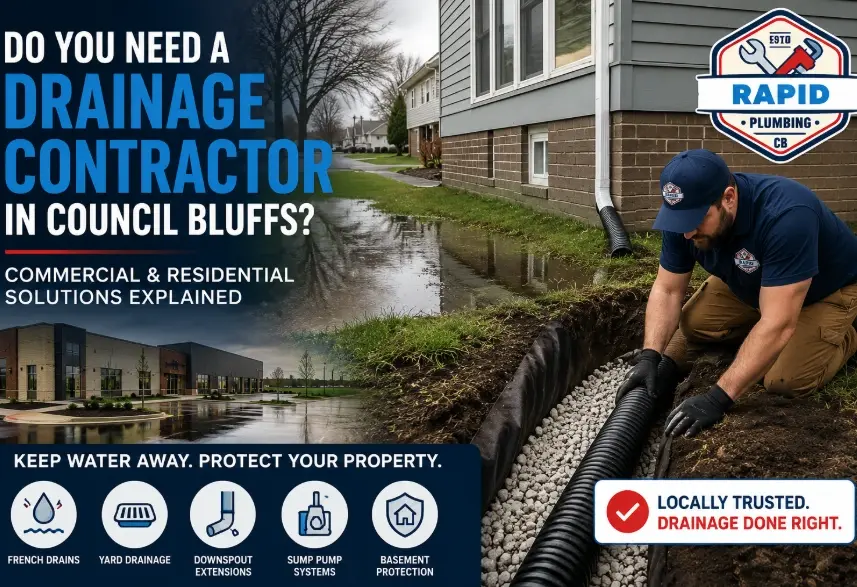
Exterior French drains, yard regrading, dry wells, trench drains, downspout extensions, and surface water diversion — all passive systems that redirect water before it reaches your home.
Licensed Plumber Handles
Sump pump installation and repair, interior drain tile connected to a discharge line, basement floor drain backups, and any drainage system that ties into your home’s plumbing or sewer connection.
Where They Overlap
A sump pump’s discharge line often needs to tie into a yard drainage system so water doesn’t just pool ten feet from your foundation and flow right back. This is where the two trades coordinate.
If your basement is already taking on water, start with a plumber — we can evaluate whether a sump pump installation solves the immediate problem, and refer you to a drainage contractor if the root cause is exterior grading or groundwater that needs a French drain to intercept it before it ever reaches the foundation.
French Drain vs. Sump Pump: Which Does Your Council Bluffs Property Need?
| Factor | French Drain | Sump Pump |
|---|---|---|
| How it works | Passive — gravel-filled trench redirects water by gravity | Active — motorized pump ejects water that’s already collected |
| Best for | Yard pooling, surface water, sloped-lot runoff | Basement/crawl space water already inside the structure |
| Power needed | No — works during outages | Yes — battery backup recommended for Iowa storms |
| Installed by | Drainage/waterproofing contractor | Licensed plumber |
| Council Bluffs fit | Great for clay-soil lots with poor natural drainage | Essential for homes near the river or with a history of basement seepage |
Many of the wettest properties we see in Council Bluffs — particularly older homes in low-lying areas — end up needing both: a French drain to stop groundwater before it reaches the foundation, and a sump pump to handle whatever still makes it inside. If your sump pump is running constantly even after dry weather, that’s often a sign the exterior drainage isn’t doing its job.
Commercial Drainage Solutions in Council Bluffs
Commercial properties face a different set of drainage problems than homes — parking lot ponding, roof drain overload, and stormwater runoff that has to meet City compliance standards before it leaves your property. Under the City of Council Bluffs Storm Water Management program, commercial and multi-family properties are required to manage stormwater runoff on-site in ways that don’t negatively impact neighboring properties or the public storm sewer system — which makes proper drainage design a compliance issue, not just a maintenance one.
- Parking lot & lot drainage: Trench drains and catch basins that route water to the municipal storm system without ponding at entrances or loading areas.
- Roof drain discharge: Properly sized downspout extensions and underground piping so roof runoff doesn’t erode landscaping or flood a building’s perimeter.
- Backflow prevention on drainage lines: Commercial properties tying drainage into the sewer system often need a backflow preventer to meet code and protect the public water supply.
- Basement/lower-level commercial space: Businesses with below-grade space need the same interior drain tile and sump pump protection as a residential basement — often at commercial scale.
Signs Your Council Bluffs Property Needs Drainage Work
Standing Water After Rain
Water that takes more than 24 hours to soak into your yard is a sign the grading or soil can’t keep up — common with our area’s clay-heavy soil.
Damp or Musty Basement
Persistent basement humidity even without visible flooding often points to groundwater pressure that a French drain or sump pump needs to relieve.
Water Near the Foundation
Any pooling within a few feet of your foundation walls should be addressed quickly — it’s one of the leading causes of the basement floor drain backups we get called out for.
Eroded Landscaping
Visible channels or washed-out mulch/soil after storms usually mean water isn’t being redirected the way your yard’s original grading intended.
Why Council Bluffs Homes Are Especially Prone to Drainage Problems
Council Bluffs’ location along the Missouri River floodplain, combined with dense clay soil across much of Pottawattamie County, means water doesn’t drain away naturally the way it does in sandier soil. Older neighborhoods with decades-old grading are especially prone to standing water and basement seepage after heavy spring rain or fast snowmelt — which is exactly why so many local homes eventually need either a sump pump, a French drain, or both.
Why Council Bluffs Homeowners & Businesses Trust Rapid Plumbing CB
- ✅ Licensed, insured plumbers for every sump pump and interior drainage tie-in
- 💲 Transparent, upfront pricing — no surprise charges once work begins
- 🕐 24/7 emergency service when a storm overwhelms your system
- 🏘️ Deep familiarity with Council Bluffs’ clay soil, flood zones, and City stormwater requirements
- 🎖️ 10% off for seniors and veterans
Not sure if it’s a plumbing fix or a full drainage system? We’ll evaluate it and tell you straight.
📞 Call (712) 355-9187 Request a Free QuoteFrequently Asked Questions
Do I need a drainage contractor or a plumber for standing water in my yard?
If the water is pooling in your yard or near your foundation but hasn’t entered your home, a drainage contractor typically handles it with a French drain, regrading, or a dry well. If water is already getting into your basement or crawl space, start with a licensed plumber to evaluate a sump pump system.
What’s the difference between a French drain and a sump pump?
A French drain is a passive, gravity-fed trench system that intercepts and redirects groundwater before it reaches your foundation. A sump pump is an active system that removes water that has already collected inside your basement or crawl space using a motorized pump. Many Council Bluffs properties need both working together.
Does my commercial property need to meet City drainage requirements in Council Bluffs?
Yes. Under the City of Council Bluffs Storm Water Management program, commercial and multi-family properties are required to manage stormwater runoff on-site so it doesn’t negatively affect neighboring properties or the public storm sewer system. Proper drainage design is a compliance requirement, not just a maintenance choice.
Why does my Council Bluffs basement stay damp even without visible flooding?
Persistent basement dampness, even without standing water, usually points to groundwater pressure building up against your foundation — common in Council Bluffs due to heavy clay soil. This is often resolved with a French drain, improved grading, or an interior drain tile system feeding a sump pump.
Can a sump pump alone fix a drainage problem?
A sump pump handles water that’s already inside your basement, but if the root cause is poor exterior grading or groundwater intrusion, a sump pump alone may run constantly without solving the underlying issue. Pairing it with exterior drainage work often gives the most reliable, long-term fix.
Sources: City of Council Bluffs Storm Water Management · City of Council Bluffs Engineering Department. This guide is general information for Council Bluffs, IA property owners and is not a substitute for an on-site evaluation.