
Clogged Dishwasher Council Bluffs? Here’s What’s Actually Happening
An inch of cloudy water sitting at the bottom of your dishwasher after a full cycle is one of the most common kitchen complaints we hear from Council Bluffs homeowners. A Clogged Dishwasher Council Bluffs is almost never a mystery once you know where to look — the culprit is usually one of a handful of specific spots along the drain path, and most of them are fixable without a service call. This guide walks through the real causes, how to safely clear a clog yourself, when a “clog” is actually a leak or something bigger, and how to know if it’s time to repair or replace the unit altogether.
Signs Your Dishwasher Is Clogged (Not Just a Dirty Cycle)
- Standing water — more than an inch — pooled at the bottom after a completed cycle
- Dishes coming out dirty or with a filmy residue despite a normal wash
- A gurgling sound coming from the sink while the dishwasher runs
- Water backing up into the sink during or after the dishwasher cycle
- A sour or musty smell coming from inside the unit
What’s Actually Causing Your Dishwasher to Clog
- A dirty filter. Most dishwashers made in the last several years have a removable filter at the bottom of the tub that catches food particles — this is the single most common cause of drainage problems, and the easiest to fix yourself.
- A kinked or clogged drain hose. The hose connecting your dishwasher to the sink drain or disposal can develop a kink, or accumulate grease and food debris over time that narrows the passage.
- A blocked air gap. If your kitchen has a small cylindrical fitting on the countertop near the sink, that’s the air gap — it can clog with food debris and stop drainage even when everything else is clear.
- A full or clogged garbage disposal. Most dishwashers drain through the garbage disposal’s inlet. If the disposal itself is backed up, the dishwasher has nowhere for its water to go.
- A failing drain pump or check valve. If water won’t drain at all and you hear a humming sound during the drain cycle, the pump itself may be the issue rather than a clog. A check valve that’s stuck can also let drained water flow back in.
How to Unclog a Dishwasher Safely (DIY Steps)
- Disconnect the power at the breaker or by unplugging the unit before doing any hands-on work.
- Remove standing water with a cup or towels so you can see and work inside the tub.
- Pull and clean the filter, usually located under the bottom rack — rinse it under running water and clear any trapped debris.
- Run the garbage disposal for 30 seconds to clear anything blocking the shared drain path, since most dishwashers drain through it.
- Check the air gap on your countertop if you have one — twist off the cap and clear any visible debris.
- Inspect the drain hose under the sink or behind the dishwasher for kinks, and clear any visible buildup.
- Run a drain or rinse cycle to test whether the clog is cleared.
If you’ve worked through all of these and water still won’t drain, that usually points to the drain pump, check valve, or a clog further down the line than you can reach — at that point it’s worth a professional look rather than continuing to troubleshoot blind.
When the Clog Isn’t Actually Your Dishwasher
If your kitchen sink is also draining slowly, or you’re seeing water back up in both the sink and the dishwasher at the same time, the real blockage is often in the shared drain line rather than inside the appliance itself. Our kitchen sink keeps clogging guide covers what to check if that’s the pattern you’re seeing — and if you’ve been tempted to pour a chemical drain cleaner down the sink to try to fix both problems at once, our chemical drain cleaner damage guide explains why that’s a bad idea for a shared line feeding an appliance.
Dishwasher Leaking? Here’s What to Check
A leak is a different problem from a clog, though the two sometimes get confused when water shows up somewhere it shouldn’t. Common leak sources include:
- A worn door gasket/seal, which lets water escape around the door during the wash cycle
- A loose or failing water supply line connection, often at the shutoff valve under the sink
- A cracked or disconnected drain hose, letting water leak out before it reaches the sink drain
- Overfilling from a stuck float switch, which can cause water to overflow the tub itself
If you’re not sure whether what you’re seeing is a leak or drainage backing up from a clog, a quick way to tell: leaks usually show up during the fill or wash portion of the cycle, while clog-related pooling shows up after the cycle finishes and the unit should have drained.
Repair or Replace? How to Decide
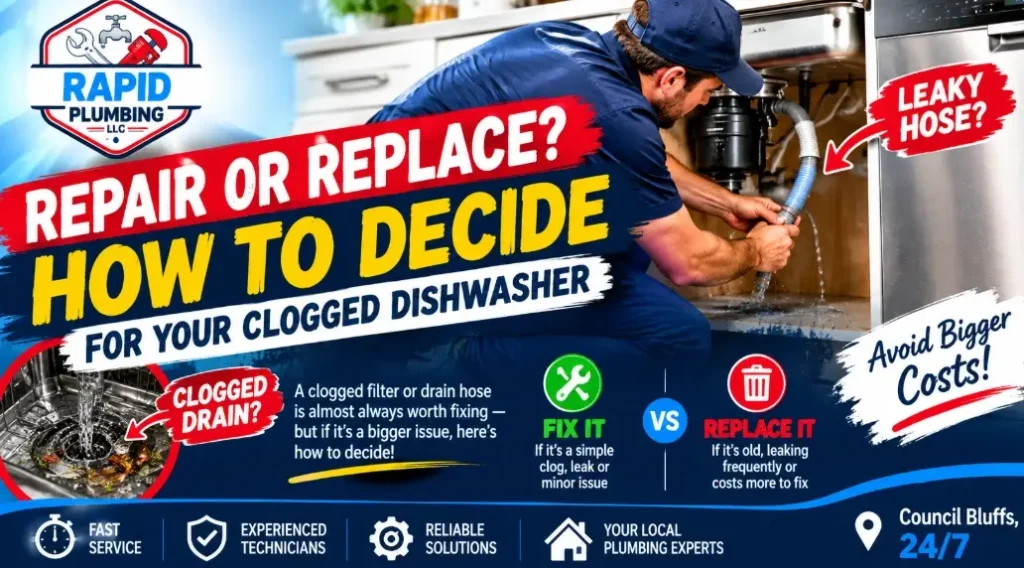
A clogged filter or drain hose is almost always worth fixing — it’s a cheap, quick repair. But a failing drain pump, a unit over 10 years old, or repeated leaks from multiple points start to tip the math toward replacement instead. We walk through this same repair-vs-replace decision for other kitchen fixtures in our garbage disposal repair vs. replacement guide and our leaky faucet repair vs. replace guide — the same general logic (age, repair cost vs. replacement cost, frequency of the problem) applies to a dishwasher as well.
Professional Installation Prevents Most of These Problems
A properly installed dishwasher — correctly connected drain hose, secured air gap, and a garbage disposal knockout plug removed where it’s supposed to be — avoids a large share of the clogs and leaks homeowners deal with down the road. If you’re installing a new unit as part of a kitchen remodel or upgrade, our sink & faucet installation guide covers what proper fixture installation involves more broadly. And if hard water minerals are contributing to buildup inside your dishwasher’s filter and hoses faster than they should, pairing it with a water softener cuts down on that buildup significantly.
Council Bluffs Plumbing & Permitting Resources
Frequently Asked Questions
Why is my dishwasher clogged and not draining?
The most common causes are a dirty filter, a kinked or clogged drain hose, a blocked air gap, or a full garbage disposal blocking the shared drain path. A failing drain pump or check valve is a less common but more serious cause.
How do I unclog my dishwasher myself?
Disconnect power, remove standing water, clean the filter, run the garbage disposal for 30 seconds, check the air gap if you have one, and inspect the drain hose for kinks. Run a drain cycle to test before assuming it needs professional repair.
Why is my dishwasher leaking instead of draining properly?
A worn door gasket, a loose supply line connection, a cracked drain hose, or a stuck float switch causing overflow are the most common leak sources — distinct from a clog, which shows up as standing water after the cycle finishes rather than during it.
Should I repair or replace a clogged dishwasher?
A clogged filter or hose is almost always worth fixing. A failing drain pump, a unit over 10 years old, or repeated leaks from multiple points usually make more financial sense to replace.
Can a clogged kitchen sink cause my dishwasher to back up?
Yes. Dishwashers typically share a drain line with the kitchen sink or garbage disposal, so a blockage in that shared line can cause both to back up at the same time, even if the dishwasher itself has no internal clog.
Still draining slowly? Your kitchen sink may be clogged too. Our drain cleaning service in Council Bluffs can clear both lines in one visit.