Submersible vs Pedestal Sump Pumps: Which Is Right for Your Council Bluffs Home?
Quick answer: A submersible sump pump sits fully underwater inside a sealed sump pit — quieter, more powerful, and the better fit for most Council Bluffs basements, especially finished ones or homes near the Missouri River bottoms and Lake Manawa where groundwater runs high. A pedestal sump pump keeps its motor mounted above the pit on a shaft — cheaper up front, easier to service, and a reasonable choice for a shallow pit, a light-duty unfinished basement, or a tight budget.
Neither type is universally “better” — the right pick depends on your pit depth, how often your basement takes on water, and whether the pump lives in a finished living space or a utility corner. The comparison below breaks down exactly where each one wins.
What Is a Submersible Sump Pump?
A submersible sump pump is a single, sealed unit — motor and pump housed together — designed to sit entirely underwater at the bottom of your sump pit. Because the motor is fully enclosed, it can run submerged without shorting out, and the surrounding water actually helps cool it during long pump cycles. Most newer Council Bluffs homes with a finished or partially finished basement end up with a submersible unit, largely because it disappears under a pit lid instead of standing exposed on the floor.
What Is a Pedestal Sump Pump?
A pedestal sump pump splits the job in two: the pump itself sits low in the pit, while the motor rides above it on a vertical shaft, staying dry and out of the water at all times. That above-water motor is the whole story with a pedestal unit — it’s why the pump tends to be louder (nothing muffles the sound), why it’s easier to reach for a repair, and why the motor typically lasts longer since it never sits in water or debris.
Submersible vs. Pedestal Sump Pump: Full Comparison
Here’s how a submersible vs pedestal sump pump stacks up on the factors that actually matter for a Council Bluffs basement:
| Factor | Submersible | Pedestal |
|---|---|---|
| Noise | Quiet — water muffles the motor | Noticeably louder — motor is exposed above the pit |
| Pumping power | Higher GPH, handles some debris and solids | Lower GPH, best with clear water only |
| Pit size needed | Needs a deeper, wider pit (roughly 18″+ deep) | Works in a narrow or shallow pit |
| Typical lifespan | 7–10 years on average | Often 10–25 years, since the motor stays dry |
| Upfront cost | Higher | Lower |
| Maintenance access | Must lift the unit out of the pit to service | Motor is exposed — easier to inspect and repair |
| Appearance | Hidden under a sealed pit lid | Visible shaft standing above the basement floor |
| Best for | Finished basements, frequent or heavy flooding, quiet living spaces | Unfinished basements, tight budgets, shallow pits, light/occasional water |
Which Type Fits a Council Bluffs Basement Best?
Council Bluffs sits low against the Missouri River, and neighborhoods near Lake Manawa, the Heights, and older sections of Downtown often deal with a higher water table than homeowners expect — especially after the kind of heavy spring rain the metro sees most years. That’s the exact situation where a submersible sump pump tends to earn its higher price tag: more pumping capacity, a sealed pit that helps keep basement humidity and radon down, and quiet enough operation that it won’t be a nuisance under a finished family room.
A pedestal sump pump still makes sense for plenty of Council Bluffs homes — an unfinished basement or utility area where noise isn’t a concern, a pit that’s too shallow or narrow for a submersible unit to fit properly, or a homeowner who wants to glance at the motor and see it’s running rather than trust a sealed unit underwater. If your home has never flooded and only takes on the occasional light seep, a pedestal pump can be the more budget-friendly, longer-lasting choice.
Cost Differences Between Submersible and Pedestal Pumps
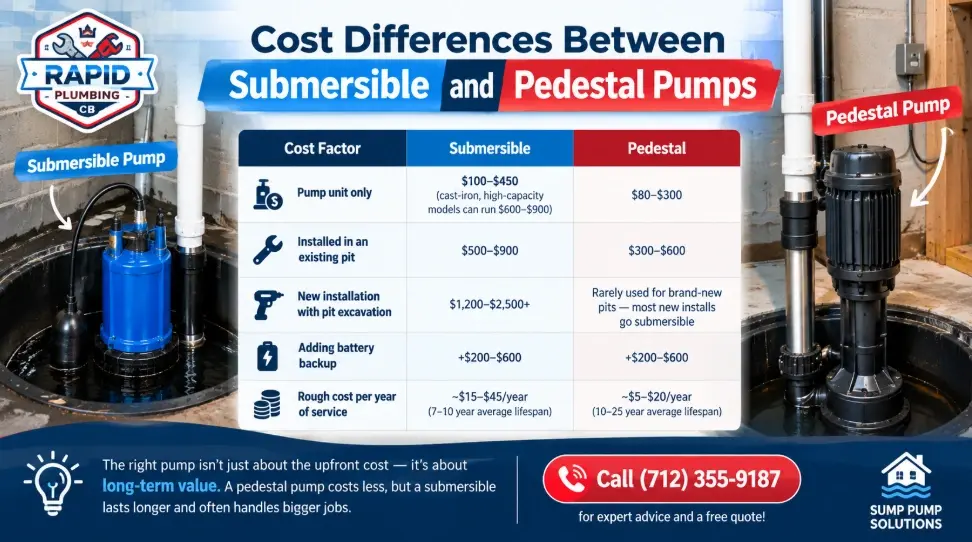
Pedestal pumps generally cost less than submersible units for the equipment alone, but the bigger cost driver for either type is the installation itself — whether you’re swapping a like-for-like unit into an existing pit or starting from scratch. The table below shows where each pump type typically lands, based on national pricing data for both the equipment and the labor:
| Cost Factor | Submersible | Pedestal |
|---|---|---|
| Pump unit only | $100–$450 (cast-iron, high-capacity models can run $600–$900) | $80–$300 |
| Installed in an existing pit | $500–$900 | $300–$600 |
| New installation with pit excavation | $1,200–$2,500+ | Rarely used for brand-new pits — most new installs go submersible |
| Adding battery backup | +$200–$600 | +$200–$600 |
| Rough cost per year of service | ~$15–$45/year (7–10 year average lifespan) | ~$5–$20/year (10–25 year average lifespan) |
That last row is why a pedestal pump can be the smarter long-term value in the right setup: a lower unit cost spread over a much longer lifespan often works out cheaper per year than a submersible, even though the submersible costs more upfront. The trade-off is capacity and noise — a shallow, light-duty pit can lean pedestal and come out ahead financially, while a basement that floods often or is finished living space usually justifies the submersible’s higher price tag. For exact, current pricing in Council Bluffs — including full installation and battery backup packages — see our sump pump installation cost guide for Council Bluffs.
What About Crawl Spaces?
Plenty of Council Bluffs homes rely on a crawl space instead of a full basement, and pump choice matters here too — a shallow or restricted crawl space often can’t accommodate a full-size submersible unit and pit the way a basement can. If that’s your situation, our guide on sump pumps for crawl spaces covers the specific sizing and installation considerations for that setup.
Don’t Forget Battery Backup and Alarms
Whichever pump type you choose, it’s only protecting your basement while it has power and while it’s actually running. Iowa and Nebraska storms that bring heavy rain often knock the power out at the same time — exactly when a sump pump is needed most. A battery backup system keeps either a submersible or pedestal pump running through an outage, and a sump pump alarm alerts you the moment your primary pump falls behind — two separate, complementary layers of protection worth pairing with whichever pump you install.
Signs Your Current Pump Needs Attention
If you already have a sump pump and you’re only now finding out which type it is, watch for the warning signs either style can throw before it fails outright. Our guide on what to do when a sump pump stops working walks through the most common causes, and our sump pump troubleshooting guide covers clogs, stuck float switches, and short-cycling for both pump types. If your existing unit is aging out rather than simply malfunctioning, our breakdown of repair vs. replacement costs can help you decide whether it’s worth fixing or time to switch pump types altogether.
How to Test Either Type of Sump Pump
Submersible and pedestal pumps are tested the same basic way — by raising the float and confirming the motor kicks on and moves water. Our step-by-step sump pump testing guide walks through the full process so you can check your pump before Iowa’s spring rains arrive, regardless of which type sits in your pit.
Frequently Asked Questions
Is a submersible or pedestal sump pump better?
Neither is better in every situation. Submersible pumps are quieter and more powerful, making them the better fit for finished basements and homes with frequent or heavy water intrusion. Pedestal pumps cost less upfront, last longer since the motor stays dry, and work well in shallow pits or light-duty situations.
Can I replace a pedestal sump pump with a submersible one?
Often, yes — but it depends on whether your existing pit is deep and wide enough to accommodate a submersible unit. A licensed plumber can check your pit dimensions and let you know whether an upgrade requires enlarging the pit itself.
Which type of sump pump lasts longer?
Pedestal pumps typically last longer — often 10 to 25 years — because the motor never sits in water. Submersible pumps average closer to 7 to 10 years, though a quality cast-iron unit can last toward the upper end of that range.
Is a submersible sump pump the same as an ejector pump?
No. A submersible sump pump moves clear groundwater out of a basement pit, while an ejector pump handles wastewater containing solids. See our full ejector pump vs. sump pump comparison for the differences.
Do I need a permit to switch from a pedestal to a submersible sump pump in Council Bluffs?
Any change to your pit size, discharge line routing, or added backup power may require a permit through the city’s Building Division. We handle that coordination as part of every installation.
Why People of Council Bluffs Choose Rapid Plumbing CB
Picking the right pump type is only half the job — getting it installed correctly by someone who knows Council Bluffs’ basements is the other half. Here’s what keeps local homeowners coming back to us for sump pump work and beyond:
- Local, family-owned, and familiar with Council Bluffs homes: We know which neighborhoods near the Missouri River bottoms and Lake Manawa run a high water table, and which older Downtown and Heights homes tend to have shallower or narrower pits — that local knowledge shapes the pump recommendation you get. See more on why that matters in our piece on choosing a family-owned local plumber.
- Transparent, upfront pricing: You get a clear price before any work starts — no surprise add-ons once the pit is already open. Read our full pricing promise.
- Licensed, insured, and code-aware: Every installation is handled by a licensed plumber who coordinates permitting with the city when a job touches pit size, discharge routing, or backup power.
- Fast response when a basement is actively flooding: A failed sump pump during a storm doesn’t wait for business hours, and neither do we.
- A reputation built on real local reviews: Our standing with Council Bluffs homeowners is public, not a sales pitch — see why that track record matters when you’re choosing who to trust with your basement.
Not Sure Which Pump Type Your Basement Needs?
Our licensed Council Bluffs plumbers can check your pit, your basement’s water history, and recommend the right pump type — no upsell, just an honest answer.
📞 Call (712) 355-9187