Do You Need a Battery Backup Sump Pump Council Bluffs?
The worst time for your sump pump to lose power is the exact moment it’s needed most — during the storm that knocked the power out in the first place.
Council Bluffs sees the same pattern almost every spring: a fast-moving storm rolls through, dumps an inch or two of rain in under an hour, and knocks out power to a few streets or an entire neighborhood along the way. Your sump pump doesn’t care that the power’s out — the water still needs to go somewhere. Without a way to keep pumping through that outage, a basement that would have stayed dry all storm long can flood in the span of a bad hour. That’s the entire case for a sump pump battery backup Council Bluffs, and it’s worth understanding exactly how one works before you decide whether your home needs one.
Sump Pump Battery Backup: How It Actually Works
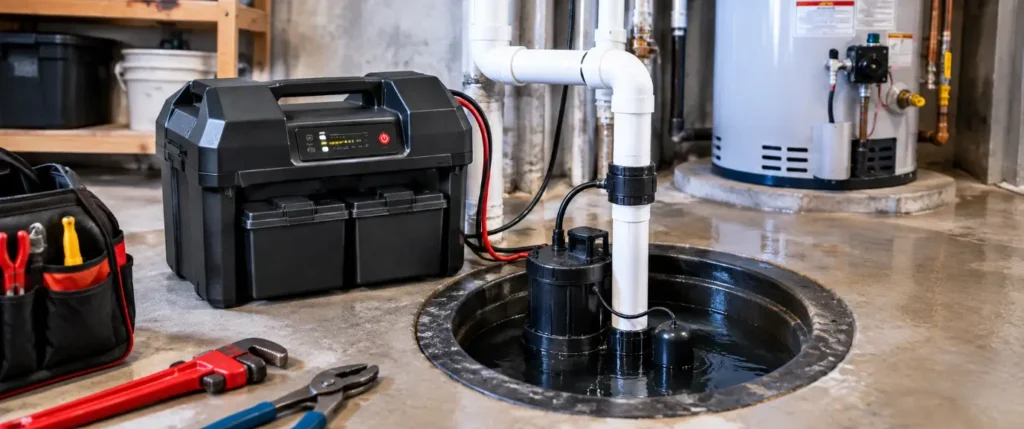
A battery backup isn’t just a battery taped to your existing pump — it’s a complete secondary pumping system, wired independently of your primary pump, sitting in the same sump basin. It has its own pump (usually a lower-horsepower DC unit), its own float switch, and a controller box that constantly monitors your home’s AC power. The moment that power drops — whether from a storm outage or the primary pump simply failing on its own — the controller switches over automatically and the backup pump takes over, drawing power from a dedicated battery rather than your home’s electrical system.
This matters because a backup protects against more than just power outages. A primary pump can fail from a jammed float switch, a burned-out motor, or a tripped breaker — all completely unrelated to whether the power is on. A battery backup covers all of these scenarios, not just the storm-outage one people usually think of first.
Types of Sump Pump Battery Backup Systems
| Type | How It Works | Best For |
|---|---|---|
| Battery-powered (DC pump) | A 12V deep-cycle or AGM battery powers a dedicated backup pump when AC power fails | Most Council Bluffs homes — the standard, most common option |
| Water-powered backup | Uses your home’s municipal water pressure to create suction and remove water — no battery or electricity needed at all | Homes on city water with a strong supply line, as a true no-power-needed failsafe |
| Smart / app-connected backup | Battery-powered system that also sends phone alerts when it activates or the battery runs low | Homeowners who travel or want remote monitoring — pairs well with a sump pump alarm |
Why This Matters More During Council Bluffs Storms
Heavy spring rain and fast snowmelt put more strain on sump pumps at exactly the same time storms are most likely to knock out power across Pottawattamie County — which is the worst possible combination for a home that only has a primary pump. Signing up for Alert Iowa, the county’s emergency notification system, gives you advance warning before severe weather hits, and the National Weather Service Omaha/Valley office tracks the storm systems that move through the metro. Neither of those keeps your basement dry on their own — but knowing a storm is coming is exactly the kind of advance notice that makes a battery backup worth having tested and ready beforehand, rather than finding out it’s dead mid-storm.
The two-part risk homeowners often miss: it’s not just that the power might go out — it’s that primary sump pumps also work hardest during the exact same storms that are most likely to cause an outage. A backup covers you for both problems at once.
How Long Will a Battery Backup Actually Run?
This depends on three things: battery capacity, how often the pump cycles, and battery age. A fully charged deep-cycle battery under moderate, intermittent pumping can often run a backup pump for 6-12+ hours — but under continuous heavy flow during a major storm, that runtime can drop to just a few hours. Batteries also lose capacity as they age; a 3-year-old battery that’s never been tested may deliver a fraction of its original runtime right when you need it most. This is the single most common reason battery backups fail homeowners — not a defective system, but a battery nobody checked in years.
Sizing a Backup to Your Primary Pump
A backup pump is typically lower-horsepower than your primary pump — its job is to hold the water level steady until power returns or someone can intervene, not necessarily to match your primary pump’s full output indefinitely. Undersizing a backup relative to how much water your sump pit actually takes on is a common mistake, especially in homes where the primary pump was upgraded at some point but the backup wasn’t reassessed alongside it. If you’re not sure whether your existing backup is properly matched to your primary pump, that’s worth having checked rather than assumed.
Battery Backup vs. Sump Pump Alarm: They Work Together, Not Instead of Each Other
These two get paired together for good reason, but they’re not interchangeable. A battery backup keeps your pump running through a power outage or primary pump failure. A sump pump alarm tells you the moment something’s wrong — including if the backup itself is struggling or the battery is running low. A backup without an alarm can quietly run down its battery during a long outage with nobody aware until it’s too late; an alarm without a backup tells you about a problem you have no way to actively prevent. Most Council Bluffs homeowners with finished basements end up installing both.
How Much Does a Battery Backup Cost in Council Bluffs?
| Option | Typical Cost |
|---|---|
| Basic battery-powered backup, installed | $600 – $1,200 |
| Smart / app-connected battery backup, installed | $1,000 – $2,000 |
| Water-powered backup system, installed | $800 – $1,600 |
| Replacement battery only (existing system) | $100 – $300 |
If you’re already budgeting for a new primary pump, pairing it with a backup at the same time is worth considering — our sump pump installation cost guide covers primary pump pricing, and our replacement cost guide covers what it looks like when an aging pump needs to be swapped out.
Testing & Maintaining Your Battery Backup
A backup system that’s never been tested is a guess, not a safeguard. A proper check involves briefly disconnecting the primary pump to confirm the backup activates on its own, checking the battery’s charge under load rather than just at rest, and inspecting terminals for corrosion — a surprisingly common cause of backups failing to deliver power even when the battery itself tests fine. Most manufacturers recommend testing every 3-4 months and replacing deep-cycle batteries every 3-5 years regardless of how they test, since capacity fades gradually in ways that aren’t always obvious until the battery is under real load during a storm.
Why Choose Rapid Plumbing CB
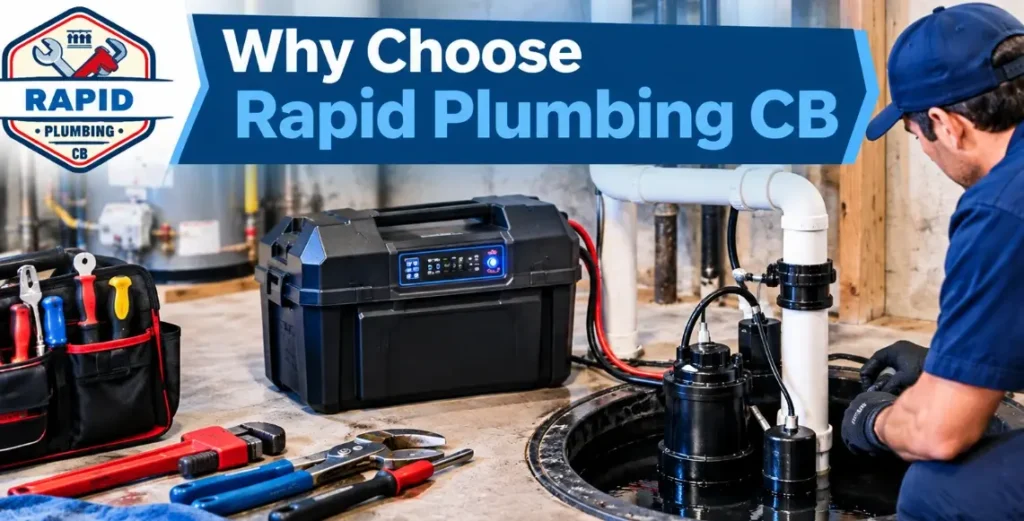
We size, install, and test battery backups as part of full sump pump service — not as an add-on sale. If you already have a backup and aren’t sure it would actually perform during an outage, that’s exactly the kind of thing worth having checked before storm season rather than after a flood. Our sump pump repair and installation team handles primary pumps, backups, and alarms together, and if your home has a crawl space rather than a full basement, our crawl space sump pump guide covers how backup systems fit into that kind of installation.
Frequently Asked Questions
Is a sump pump battery backup really necessary?
If your basement is finished, you’ve lost power during a storm before, or your primary pump is more than a few years old, a backup significantly reduces your flood risk. It protects against power outages and primary pump failures — two separate risks that a backup covers at once.
How long does a battery backup last during an outage?
A fully charged, well-maintained battery can often run 6-12+ hours under moderate pumping, but continuous heavy flow during a major storm can reduce that significantly. Battery age is the biggest factor — an untested, aging battery may deliver far less runtime than expected.
Do I need both a battery backup and a sump pump alarm?
They solve different problems and work well together. The backup keeps water moving; the alarm tells you if something’s wrong — including if the backup itself is struggling. Many homeowners install both.
How often should I test my battery backup?
Every 3-4 months, and replace the battery every 3-5 years regardless of how it tests, since battery capacity fades gradually and isn’t always obvious until it’s under real load during a storm.
What’s the difference between a battery-powered and water-powered backup?
A battery-powered backup runs on a dedicated battery and needs periodic testing and replacement. A water-powered backup uses your home’s municipal water pressure instead of electricity, so it never needs a battery — but it does require a strong, reliable water supply line to work effectively.
Not Sure Your Current Backup Would Actually Work?
Free system check as part of any sump pump visit — licensed local plumbers, available 24/7 across Council Bluffs, IA.
Call (712) 355-9187