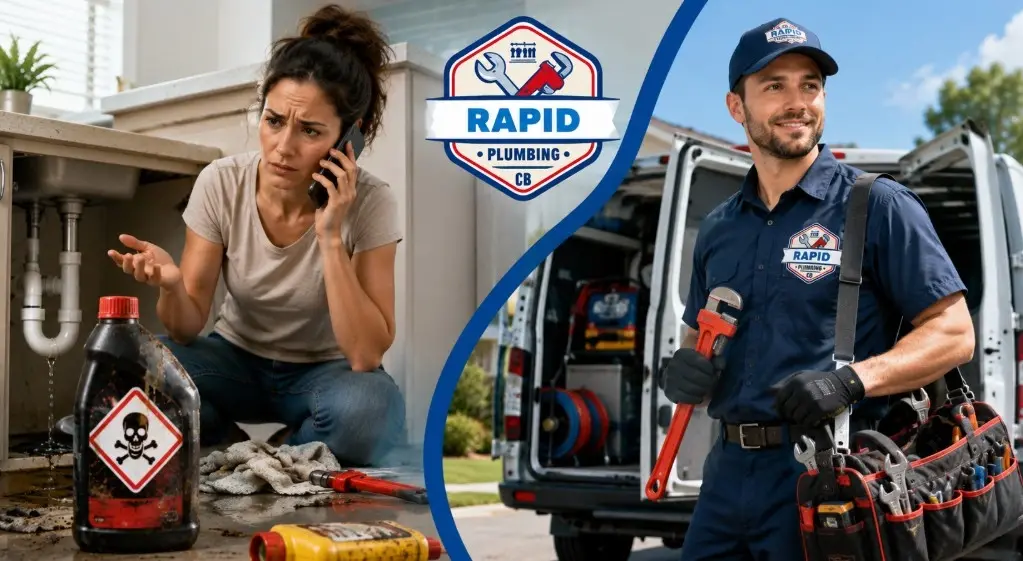
That bottle under the sink promising to blast through any clog in minutes is one of the most common ways homeowners accidentally create a much bigger, more expensive problem. Understanding why chemical drain cleaners damage pipes — and what to reach for instead — can save you from turning a simple clog into a cracked pipe, a corroded line, or a plumbing emergency.
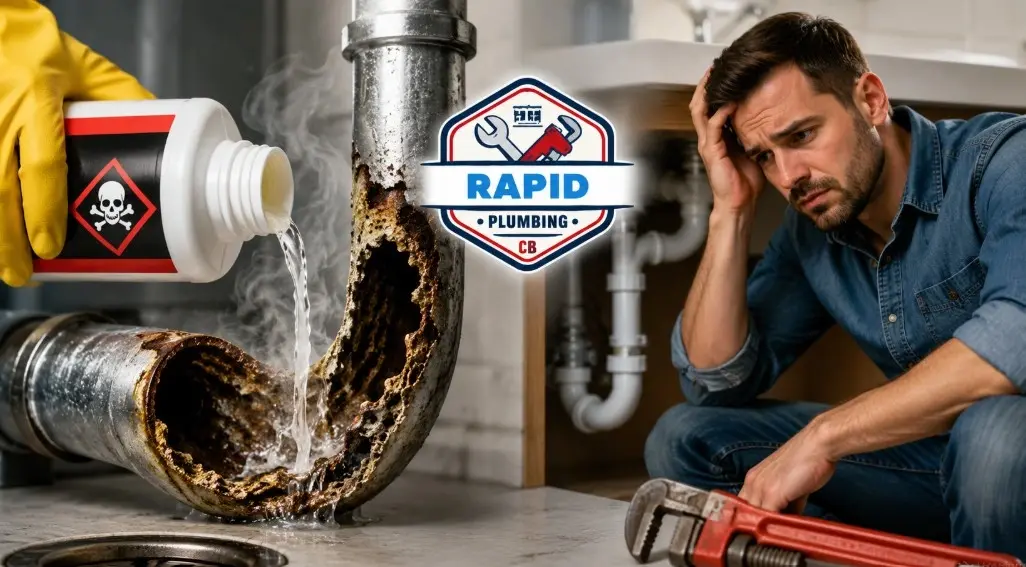
Why Chemical Drain Cleaners Damage Pipes Finding Reasons
It’s one of the most common plumbing problems homeowners face: a slow drain, a quick trip to the store, and a bottle of caustic liquid poured straight down the pipe. The damage isn’t always visible right away — it builds quietly, often over months of repeated use, until a pipe that seemed perfectly fine develops a leak or fails outright. A local plumber who sees this pattern regularly can usually tell right away whether a slow drain is a quick fix or a sign of something bigger.
How Chemical Drain Cleaners Actually Work
Most chemical drain cleaners fall into three categories: caustic (sodium or potassium hydroxide), acidic (typically restricted to licensed professionals), and oxidizing (bleach or peroxide-based). Caustic and acidic formulas generate heat as they react with the clog, which is exactly what breaks the blockage apart — but that same heat and chemical reactivity doesn’t stop at the clog. It also acts directly on the pipe material itself.
Already tried a chemical cleaner and it didn’t work? Don’t add more — call us instead.
Call (712) 355-9187 NowThe Damage They Cause, By Pipe Material
Galvanized Steel and Cast Iron
Common in homes built before the 1970s, galvanized pipe relies on a protective zinc coating to resist rust. Caustic and acidic drain cleaners strip that zinc coating away, exposing the bare steel underneath to corrosion — and on threaded connections, the chemicals can degrade the threads themselves, weakening the joint before any damage is visible from outside.
PVC and ABS Plastic
Plastic drain lines don’t corrode the way metal does, but they aren’t immune either. The heat generated by chemical reactions can soften or warp PVC and ABS over repeated exposure, making the material brittle and more likely to crack under normal pressure changes.
Copper Pipes
Copper isn’t spared either — repeated chemical exposure can lead to pinhole leaks developing over time as the metal reacts with the corrosive compounds, often starting at joints and bends where residue tends to collect. This kind of slow, hidden corrosion is exactly the sort of thing that shows up later as one of the signs of a hidden water leak in your home, and it’s worth remembering when you’re deciding between a tankless or traditional water heater too, since the supply lines feeding either system are just as vulnerable to chemical corrosion over time.
Worried about existing chemical damage in your pipes?
Request Your Free EstimateThey Often Don’t Even Fix the Problem
Chemical cleaners typically burn a narrow opening through the center of a clog rather than removing it completely. That leaves debris coating the inside of the pipe, ready to catch hair, grease, and soap scum again almost immediately — which is why homeowners so often find themselves reaching for another bottle within weeks, compounding the chemical exposure on the same section of pipe each time.
Safety Risks Beyond Your Pipes
Chemical drain cleaners can cause serious skin and eye burns on contact, and the fumes can irritate the eyes, nose, throat, and lungs. Poured into a slow-draining toilet, the caustic liquid can sit and generate enough heat to crack the bowl. Never mix different drain cleaners or combine them with other household cleaning products — the resulting chemical reaction can produce toxic gas.
If a chemical cleaner doesn’t clear the clog and you call a plumber afterward, that residue is still sitting in the pipe — which is part of why it’s worth telling your plumber up front what you’ve already tried.
Where These Chemicals End Up
Chemical drain cleaners don’t disappear once they clear your sink — they flow into Council Bluffs’ municipal wastewater system, where they’re processed at the city’s Water Pollution Control Plant, managed under the city’s Public Works department. You can see exactly how that treatment works on the city’s Treatment Process page. Harsh chemicals entering the system in large or repeated quantities can disrupt the treatment process — the same reason the city’s Storm Water Management program asks residents not to pour chemicals or other pollutants into outdoor drains, which connect to local waterways rather than the treatment plant. Drinking water quality itself is overseen separately by the city’s Board of Water Works Trustees, and you can review the city’s full range of Utilities for more on how both systems work together. If you’re also weighing an in-home filtration system for unrelated water quality reasons, our comparison of reverse osmosis vs. water filter systems may help.
Want to protect both your pipes and the local water system?
Get a Same-Day QuoteSafer Alternatives to Try First
- Plunger: Often enough for a minor sink, tub, or toilet clog
- Baking soda and vinegar: Pour baking soda down the drain, follow with vinegar, let it sit 30 minutes, then flush with hot water
- Drain snake: Manually removes the obstruction without any chemical exposure to your pipes
- Hot water flush: Run periodically to help clear minor buildup before it becomes a full clog
- Enzyme-based cleaners: Use bacteria to break down organic buildup without corrosive chemicals
When to Call a Professional Instead
If a clog doesn’t respond to a plunger or a drain snake, or if it’s a recurring problem in the same drain, it’s time to call a plumber rather than reach for a stronger chemical formula. Our guide on when to call a plumber instead of fixing it yourself covers exactly where that line sits, and our breakdown of what drain cleaning typically costs in Council Bluffs can help you budget for it. This applies just as much in commercial kitchens and grease-heavy drains as it does at home, where the stakes of a chemical-damaged line are even higher.
Let’s clear it the right way — no chemicals, no pipe damage.
Call (712) 355-9187 NowChemical vs. Professional Drain Cleaning: Quick Comparison
| Factor | Chemical Drain Cleaner | Professional Drain Cleaning |
|---|---|---|
| Removes the full clog | Often just burns a narrow path through it | Fully clears the obstruction |
| Risk to pipes | Corrosion, warping, weakened joints | None — mechanical or hydro jetting methods |
| Safety | Burns, fumes, toilet-cracking risk | Handled by a trained professional |
| Long-term cost | Repeat purchases, possible pipe replacement | One-time cost, longer-lasting result |
Why Homeowners Trust Rapid Plumbing CB With Their Drains
At Rapid Plumbing CB, our licensed team clears clogs using mechanical and hydro jetting methods that fully remove blockages without corroding or weakening your pipes — a standard you can count on any licensed plumber to follow, unlike the shortcuts a chemical bottle promises. If you’re already dealing with older plumbing showing signs of wear, or planning ahead for Iowa winter conditions that make brittle, chemically-weakened pipes even more likely to crack, it’s worth having a professional take a look before reaching for another bottle. Before hiring anyone for drain work, our guide on what to ask before hiring a plumber can help you vet the right team. Learn more about ours on our About page.
Skip the chemicals — get your drain cleared the right way.
Request Your Free EstimateFrequently Asked Questions
What’s the best drain opener for hair clogs?
Skip the chemical bottles — a drain snake or a plastic hair-removal tool (a flexible, barbed strip you pull straight up through the drain) clears hair clogs more completely than any chemical opener, without the corrosion risk covered above. For a milder buildup, an enzyme-based cleaner works well too, since it breaks down hair and soap scum biologically rather than chemically. If hair clogs keep coming back in the same drain despite these, that usually points to a deeper obstruction our professional drain cleaning can clear for good.
Are chemical drain cleaners safe for PVC pipes?
Not entirely. While PVC doesn’t corrode the way metal pipe does, the heat generated by chemical drain cleaners can soften and weaken the plastic over repeated use, making it more prone to cracking over time.
Can chemical drain cleaners damage a septic system?
Yes. The harsh chemicals in drain cleaners can disrupt the natural bacterial balance a septic system relies on to break down waste, reducing its effectiveness over time.
What should I use instead of a chemical drain cleaner?
A plunger, a drain snake, or a baking soda and vinegar solution followed by hot water are all safer first options. For recurring or stubborn clogs, a professional drain cleaning is more effective and won’t risk damaging your pipes.
Is it safe to call a plumber after already using a chemical drain cleaner?
Yes, but let the plumber know beforehand. Chemical residue may still be present in the pipe, and your plumber will take appropriate precautions when clearing the line.
Protect your pipes — leave the tough clogs to a professional.
Contact Rapid Plumbing CB Today