
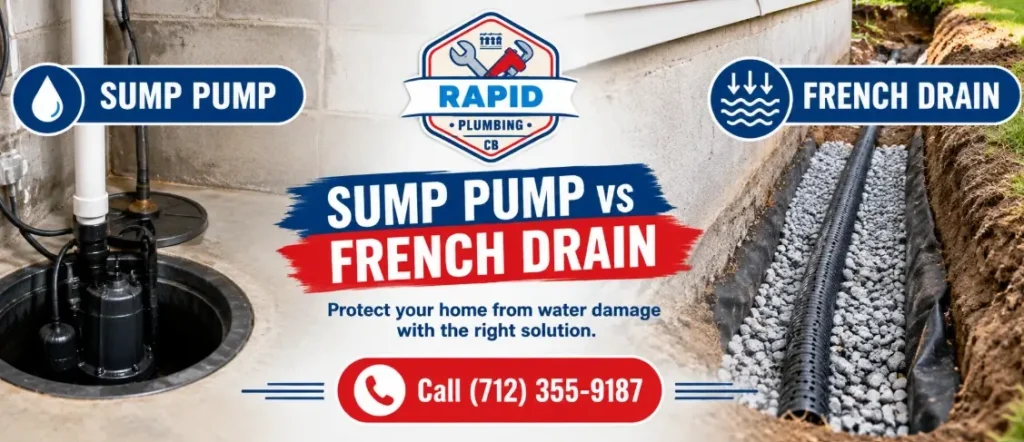
If your basement gets wet after heavy rain, you have probably heard two names: a sump pump and a French drain. Both move water away from your foundation, but they do it in different ways and solve different problems. A French drain is a passive trench that uses gravity. A sump pump is an active machine that lifts water out of a pit. Many Council Bluffs homes need one, the other, or both, and the right choice depends on where the water comes from and where it can go.
Sump Pump vs French Drain: Quick Answer
Use a French drain to collect water from the soil around your home and carry it away by gravity, when the ground has a downhill outlet. Use a sump pump when water collects in a low spot, such as a basement pit, and must be pumped uphill or out to the yard or storm drain. Many projects combine them: the French drain feeds water into a sump pit, and the pump sends it outside.
How a French Drain Works
A French drain is a trench filled with gravel, with a perforated pipe set near the bottom. Surface water and shallow groundwater seep into the gravel, flow into the pipe, and drain to an outlet that sits lower than the trench. There are no motors and no electricity involved, so once it is installed and graded correctly, it has very few moving parts to fail. Its main job is to intercept water before it reaches your foundation, which is why it is often installed along the outside of a basement wall or across a yard that slopes toward the house.
How a Sump Pump Works
A sump pump sits in a pit, usually in the lowest part of a basement or crawl space. When water rises to a set level, a float switch turns the pump on, and the pump pushes the water through a discharge pipe to a safe location away from the house. The pump does not stop water from getting into the pit. It only removes water after it arrives. That is why a sump pump needs a reliable power supply, a working float switch, and a discharge line that does not freeze or clog. You can learn more about common failures in our guide on why a sump pump runs constantly.
Key Differences at a Glance
| Feature | French Drain | Sump Pump |
|---|---|---|
| How it moves water | Gravity, through a trench and pipe | Mechanical pump, through a discharge line |
| Needs electricity | No | Yes, usually with a battery backup option |
| Where it works best | Yards and soil that slope or drain to an outlet | Basements and low spots that cannot drain by gravity |
| Main maintenance | Keep the outlet clear and the grading correct | Test the float switch, check the pit and discharge line |
| Typical failure point | Clogged pipe or silted gravel | Power outage, stuck float, or a burned-out motor |
Which One Does Your Council Bluffs Home Need?
Start by finding out where the water comes from. If puddles form on the lawn and water runs toward the foundation, a French drain or better grading may be the right fix. If water rises through the basement floor or collects in a floor drain, a sump pump is usually needed. Heavy spring rain and snowmelt can overwhelm both systems, so a professional assessment helps you avoid paying for the wrong fix. Our team can look at your yard, your basement, and your existing drainage before recommending a solution. If the problem is more general, our drainage contractor guide explains when you need a drainage specialist and when a plumber is the right call.
Water in the basement can also come from a backup in the floor drain, not only from the outside. If that is your situation, read about basement floor drain backups in Council Bluffs before you choose a system.
Can You Use a Sump Pump and a French Drain Together?
Yes, and in many cases this is the most effective setup. A French drain collects water around the foundation and channels it toward a collection point, typically a sump pit. The sump pump then removes the water from the pit and discharges it away from the house. Each system covers the weakness of the other: the French drain handles the water before it reaches the foundation, and the pump handles water that still collects in the basement.
What Each Option Typically Costs
Costs depend on the length of the trench, how deep it has to go, the type of pump, access to the yard, and whether a new discharge line is needed. Before you decide, compare the installation costs in our sump pump installation cost guide and our sump pump replacement cost guide. For a French drain, the price is driven mostly by excavation and the amount of gravel and pipe needed. The most accurate number comes from an on-site inspection, not from a general estimate.
Permits and Local Rules in Council Bluffs
Some drainage and pump work may need a permit, and rules can change. Before you start any digging or connect a discharge line to a storm or sewer system, check with the City of Council Bluffs Building Division. A licensed plumber can also confirm what applies to your property.
Why Choose Rapid Plumbing CB
Rapid Plumbing CB serves Council Bluffs homeowners with sump pump repair, sump pump installation, and drainage solutions. We inspect the problem first, explain the options in plain language, and recommend only what your home needs. If you are not sure whether you need a French drain, a sump pump, or both, request a free quote or call us at (712) 355-9187. You can also start with our sump pump repair services if your current pump is not working.
Not sure which system your home needs?
Get an honest assessment from a local team that knows Council Bluffs soil and drainage.
Frequently Asked Questions
Is a French drain better than a sump pump?
Neither is better in every case. A French drain is best when water can flow downhill to an outlet. A sump pump is needed when water collects in a low spot and cannot drain by gravity. Many homes benefit from both.
Can a French drain replace a sump pump?
Only if the yard has a reliable downhill outlet and the basement water is coming from outside, not from groundwater that rises beneath the slab. If water still collects in a pit or floor drain, a sump pump is usually still needed.
Does a French drain need electricity?
No. A French drain works by gravity, so it does not depend on power. A sump pump does need power, which is why many homeowners add a battery backup.
How do I know if my sump pump is failing?
Signs include a pump that runs constantly, a loud or grinding motor, water rising in the pit, or a musty smell. Our team can test the pump and check the discharge line during a service visit.