What Is a Sump Pump Pit? Council Bluffs Homeowner’s Guide
It’s the part of your basement most homeowners never think about — until they notice water in it, or notice there isn’t any, and aren’t sure which one is the actual problem.
If you’ve ever lifted the lid off the basin in the corner of your basement and wondered exactly what you’re looking at, or worried about how much water is sitting in there, you’re not alone. A sump pump pit is one of the most misunderstood parts of a home’s plumbing system — mostly because it sits quietly out of sight until something seems off. Here’s what it actually is, what’s normal, and when water (or the lack of it) is trying to tell you something.
Sump Pump Pit: The Basics
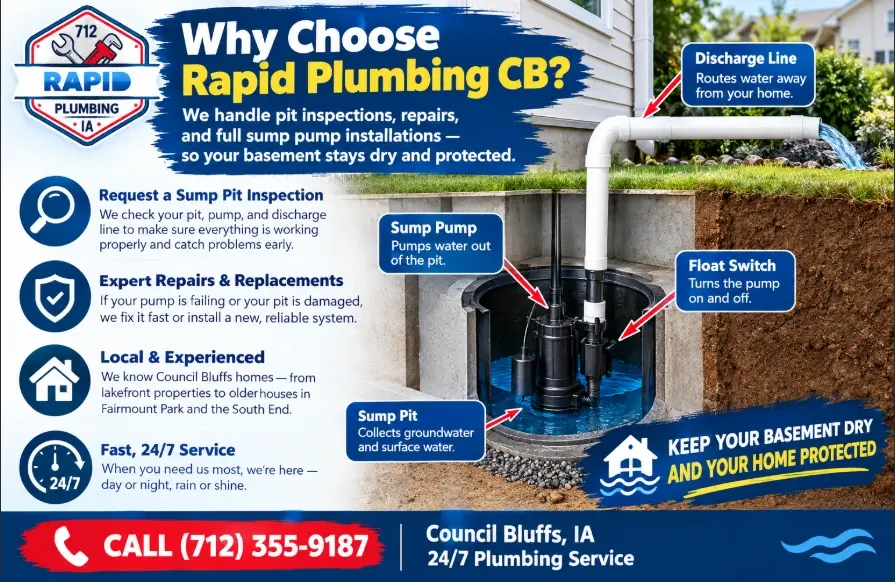
A sump pump pit is a basin, usually 18-24 inches wide and about 24-30 inches deep, installed at the lowest point of a basement or crawl space. Your basement floor is subtly sloped toward it, so any groundwater, rainwater, or moisture that seeps through the foundation naturally drains into the pit rather than spreading across the floor. Once water in the pit reaches a certain level, a float switch activates the sump pump, which pushes that water out through a discharge line and away from your home.
Think of it as a funnel, not a flaw. The pit’s entire job is to collect water in one controlled spot instead of letting it pool randomly across your basement floor. Seeing water in it isn’t a sign something’s wrong — it usually means the system is doing exactly what it was designed to do.
Should There Be Water in My Sump Pump Pit?
Yes — a small amount of water in the pit is completely normal, especially after rain, snowmelt, or during Council Bluffs’ wetter spring months. A healthy water level sits a few inches below the pump’s intake, rising and falling as the pump cycles on and off. That water actually serves a purpose beyond just waiting to be pumped out: it helps lubricate and cool the pump’s moving parts, particularly on submersible models. A pit that’s bone dry between rains isn’t necessarily a bad sign, but a pit that’s consistently, noticeably wet is simply your system working as intended.
No Water in the Pit — Is That a Problem?
Usually not, and it’s often good news: it means your home isn’t currently dealing with a groundwater or drainage issue. That said, a dry pit is only reassuring if the rest of your basement is dry too. If you’re seeing dampness or standing water elsewhere on the floor while the pit itself stays dry, that points to a different issue entirely — the floor may not be sloped correctly toward the pit, or the pit may have been positioned in the wrong spot relative to where water is actually entering. In older Council Bluffs homes where a pit was added well after original construction, this kind of mismatch is more common than people expect.
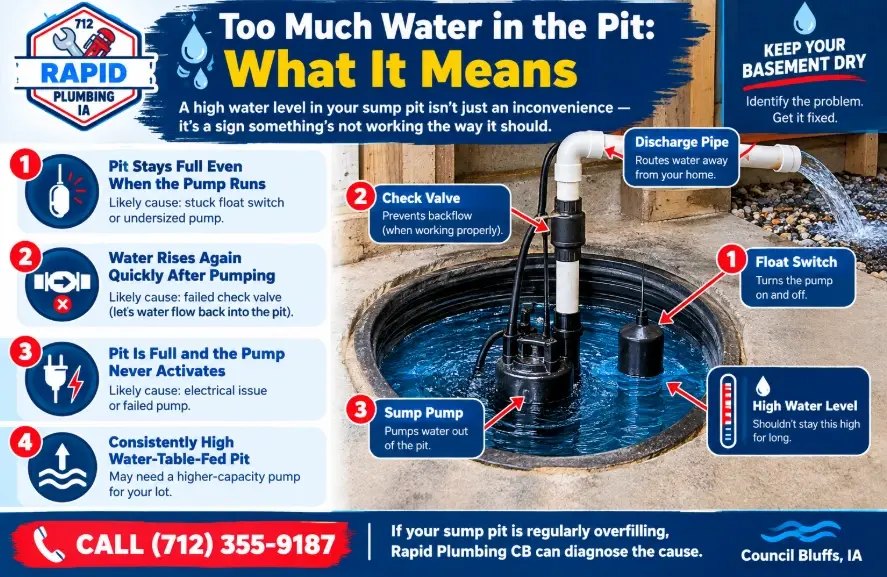
Too Much Water in the Pit: What It Means
| What You’re Seeing | Likely Cause |
|---|---|
| Pit stays full even when the pump runs | Stuck float switch, or a pump that’s undersized for the water coming in |
| Water rises again quickly after pumping | Failed check valve letting water flow back into the pit |
| Pit is full and the pump never activates | Electrical issue or a completely failed pump |
| Consistently high water table-fed pit | May simply need a higher-capacity pump for your lot |
If your pit is regularly overfilling or the pump seems to be struggling to keep up, our sump pump troubleshooting guide covers check valve and drainage issues in detail, and if the pump isn’t responding at all, our sump pump not working guide walks through the most common causes.
Sump Pit Covers: Why They Matter
An open, uncovered sump pit isn’t just a tripping hazard — it also lets basement humidity rise (since standing water evaporates freely into the air), allows debris to fall in and eventually jam the pump, and in some cases lets sewer gas escape into your basement if the pit connects to a nearby drain line. A sealed, gasketed cover addresses all three: it keeps moisture contained, keeps the pit clean, and improves both indoor air quality and radon mitigation in homes where that’s a concern. If your pit doesn’t currently have a proper lid, it’s one of the simplest upgrades available for the cost.
Can You Have a Sump Pump Without a Pit?
Not really, in the traditional sense — the pit is what makes the whole system possible in the first place, giving the pump somewhere to sit and water somewhere to collect before it’s removed. Some crawl space installations use a shallower, more compact basin rather than a full-depth basement-style pit, but the underlying concept is the same. Our crawl space sump pump guide covers how pit design differs in tighter spaces.
Council Bluffs Homes & Pit Placement
A lot of the clay-heavy soil common across Pottawattamie County drains slowly, which is part of why proper pit placement and floor grading matter more here than in areas with sandier, faster-draining ground. If you’re adding a new pit to a home that didn’t originally have one, or relocating an existing one, that kind of foundation work typically requires a permit through the city’s Building Division — something we handle as part of any new pit installation.
Why Choose Rapid Plumbing CB
We diagnose pit and drainage issues before recommending equipment — sometimes the fix is as simple as a new cover or repositioning a float switch, not a whole new pump. Our sump pump repair and installation team handles everything from a straightforward pit cleaning to a full new-pit installation, and we service homes throughout Lake Manawa, North Broadway, and Downtown Council Bluffs, where older, retrofitted pits are common.
Frequently Asked Questions
How much water is normal in a sump pump pit?
A few inches, sitting below the pump’s intake level, is typical — especially after rain or snowmelt. The water should come and go as the pump cycles, not sit at a constantly high level.
Is it bad if my sump pump pit is always dry?
Not on its own — it usually just means your home isn’t currently taking on groundwater. It’s only a concern if you’re seeing moisture elsewhere in the basement while the pit stays dry, which can mean the floor grading or pit placement isn’t directing water correctly.
How deep is a typical sump pump pit?
Most residential pits are around 24-30 inches deep and 18-24 inches wide, though the exact size depends on the pump and the amount of water your home typically needs to manage.
Should my sump pump pit have a cover?
Yes. A sealed cover reduces basement humidity, keeps debris out of the pump, improves safety, and can help with radon mitigation in homes where that’s a concern.
Can I add a sump pump pit to a home that doesn’t have one?
Yes, and it’s a common project for older homes with recurring basement moisture. It typically involves breaking a section of the basement floor, installing the basin, and connecting a pump — work that usually requires a city permit.
Not Sure If Your Sump Pit Is Set Up Correctly?
Free inspection, honest recommendation, licensed local plumbers — available 24/7 across Council Bluffs, IA.
Call (712) 355-9187