Cast Iron Drain Pipe Replacement Council Bluffs: What Homeowners Need to Know
If your house or building still has heavy, dark drain pipes from before PVC became the standard, it is worth understanding cast iron drain pipe replacement Council Bluffs before a failure forces the decision. Where a lot of housing near the historic core was built decades ago, cast iron drain stacks and under-floor drain lines are still working in plenty of basements and walls, right up until they are not. This guide explains how cast iron fails, which warning signs deserve action, what your repair, reline and replace options look like, how a cast iron to PVC swap is done, and what drives the price. If you already suspect a problem, our licensed team handles sewer line repair in Council Bluffs and can show you exactly what is happening inside the pipe with a camera.
Think Your Cast Iron Pipes Are Failing?
Get a straight answer from a licensed Council Bluffs plumber. We inspect first and explain your options before any work starts.
📞 Call (712) 355-9187What Are Cast Iron Drain Pipes and Why Do Older Council Bluffs Homes Have Them?
Cast iron was the standard material for drain, waste and vent piping in homes and commercial buildings for most of the twentieth century. It is strong, fire-resistant and quiet, which is why builders trusted it. It started giving way to plastic pipe from the 1960s and 1970s onward, so a home built before then very likely still has cast iron somewhere in its drainage system.
It helps to be clear about what this guide covers. Cast iron is a drain material, the pipes that carry wastewater away from your toilets, tubs, sinks and floor drains. It is a different problem from the rusting galvanized steel supply pipes that cause low pressure and brown water, which we explain in our old house plumbing guide for Council Bluffs. If your issue is supply-side, see whole-home repiping instead.
Why Cast Iron Drain Pipes Corrode and Fail
Cast iron pipe corrosion is a slow, mostly hidden process, which is why it surprises so many homeowners. A few things work together to wear these pipes out:
- Corrosion from the inside. Wastewater, soap, and moisture attack the pipe wall. Rough rust scale (called tuberculation) builds up inside, narrows the pipe, and catches hair, grease and paper.
- Corrosion from the outside. Damp basements, condensation, leaking fixtures and wet soil rust the outside of the pipe. A pipe that is wet on both sides thins faster.
- Failing joints. Older stacks use hub-and-spigot joints sealed with packing or lead. Those seals dry out, shift and leak long before the iron itself gives out.
- Movement and stress. Settling, vibration, and old repairs add cracks to brittle metal. Cast iron does not bend; it breaks.
- Harsh drain chemicals. Aggressive products can speed up damage to weakened metal. Read why chemical drain cleaners damage pipes before pouring anything down an old line.
Signs of Cast Iron Pipe Failure
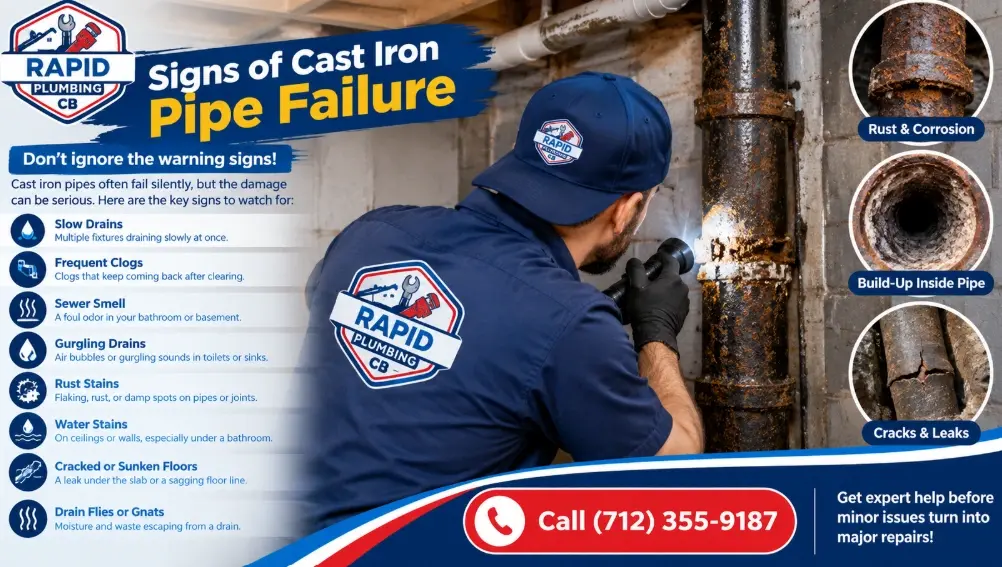
Because the damage is inside the pipe and often behind walls, you usually notice the symptoms before you ever see the pipe. These are the signs we take seriously on an older Council Bluffs property:
| What you notice | What it can mean | How urgent |
|---|---|---|
| Slow drains in several fixtures at once | Scale narrowing the main drain or stack, not a single clog | Schedule an inspection |
| Clogs that keep coming back after clearing | Rough, corroded pipe walls catching waste. See hydro jetting vs. snaking | Schedule an inspection |
| Sewer smell in the bathroom or basement | A leaking joint or cracked section letting sewer gas escape. Compare causes in our guide to sewer smell in a bathroom | Inspect soon |
| Gurgling drains or bubbling toilets | Partial blockage or a vent problem. See clogged plumbing vents | Inspect soon |
| Rust stains, flaking, or damp spots on the pipe or at joints | Active rusted cast iron pipe or a weeping joint | Inspect soon |
| Water stains on ceilings under a bathroom, or damp wall sections | A leaking drain line or stack inside the wall. Also see signs of a hidden water leak | Act promptly |
| Wastewater backing up through a basement floor drain | A blocked or collapsed section. Read what to do about a basement floor drain backup | Emergency: call now |
| Cracked or sunken floor over a slab drain line | A leak under the slab washing out soil. See slab leak signs and costs | Act promptly |
| Drain flies, gnats, or a musty odor with no clear source | Moisture and waste escaping from a leaking drain | Inspect soon |
One symptom on its own is not a verdict. A single slow sink is usually a drain cleaning job. When several of these show up together, or the same clog returns within weeks, the pipe itself is the likely problem. If wastewater is coming up into your home right now, call our emergency plumber team.
Cast Iron Stack or Underground Drain: Which Part Is Failing?
The answer changes the repair, the access needed, and the price, so it is worth sorting out early. There are three places cast iron commonly lives:
- The vertical drain stack. The main vertical pipe inside a wall that collects waste from every floor above and carries it down. Replacing a cast iron drain stack usually means opening a wall and working floor by floor.
- Horizontal drain lines in the basement or crawl space. The branch pipes hanging from joists or running along the floor. These are the easiest to reach.
- Drain lines under a slab or basement floor. Hardest to reach, because replacing them means breaking concrete.
The sewer line that runs from your house out to the street is a separate subject. Clay and cast iron laterals outside the home have their own failure modes, covered in our sewer line repair cost guide and tree roots in sewer lines article. To learn where your responsibility ends and the city begins, read who is responsible for the sewer line in Council Bluffs, or contact the City of Council Bluffs Sewer Division.
How a Plumber Confirms Cast Iron Damage
Guessing is expensive. A good inspection replaces guesses with evidence:
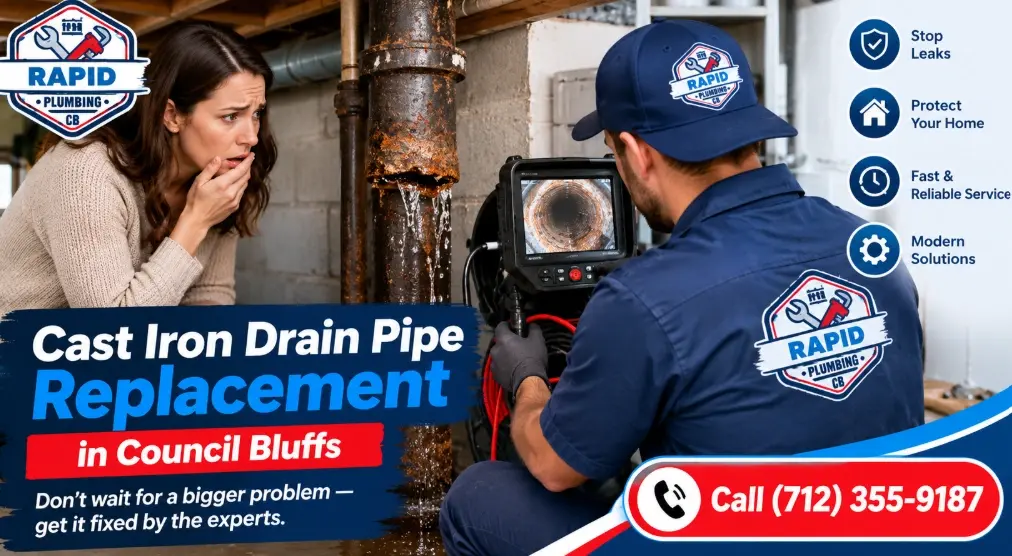
- Camera inspection. A small waterproof camera travels through the line through a cleanout and shows scale, cracks, offsets, root intrusion and low spots. You get footage you can see yourself. Not sure where your access point is? Start with where to find your sewer cleanout.
- Visual and hands-on check of exposed pipe. Rust blisters, flaking, wet joints and stains on the stack and branch lines tell a plumber a great deal before a camera ever goes in.
- Flow and leak testing. Running water through the system, and in some cases a controlled test, shows whether a joint or section is leaking.
Ask for the findings in plain language with photos or video, and a written scope before approving anything. Our checklist in what to ask before hiring a plumber in Council Bluffs covers the questions that matter.
Cast Iron Drain Pipe Replacement Council Bluffs: Repair, Reline or Replace Options
Not every old cast iron pipe needs to come out, and the right approach to cast iron drain pipe replacement Council Bluffs properties need varies by building. The right choice depends on how much of the pipe is damaged, where it sits, and how much disruption you can accept.
| Option | Best when | Trade-offs |
|---|---|---|
| Spot repair | One cracked section or one failed joint, with the rest of the pipe in good shape | Fast and lower cost, but the rest of the old pipe is still aging |
| Relining (cured-in-place) | The pipe is dirty or lightly damaged but still structurally sound, and digging or opening walls would be costly. See trenchless pipe lining | Less demolition, but not suitable for collapsed, badly offset or heavily corroded sections |
| Full replacement with PVC or ABS | Widespread corrosion, repeated leaks or backups, collapsed sections, or a stack that is leaking inside the wall | More upfront work and wall or floor access, but a long-lasting, rust-free system |
Many jobs combine approaches, such as replacing a failed stack while lining a sound horizontal run. Whichever route fits, the point is the same: base the decision on what the camera and inspection show, not on a sales pitch. If a plumber recommends full replacement, ask to see the evidence.
Cast Iron to PVC Replacement: How the Job Works
Switching from cast iron to PVC (or ABS) is a well-established job. Here is what a typical project looks like:
- Inspect and define the scope. The plumber confirms what is failing and agrees on exactly which pipes are being replaced, and in writing.
- Pull the permit. Drain, waste and vent changes normally need a permit and inspection. See the Council Bluffs plumbing permit guide, and the City’s Building Division and permit applications pages.
- Protect your home and shut down fixtures. Water to affected fixtures is stopped, floors are covered, and access openings are planned to limit damage.
- Cut out and remove the cast iron. The old pipe is heavy and brittle, so sections are supported before they are cut and removed in controlled pieces.
- Install new PVC or ABS. New pipe is set at the correct slope and supported properly. Rubber transition couplings join new plastic to any remaining cast iron.
- Test and inspect. The new drain is tested for leaks and passes inspection before walls and floors are closed.
- Restore access. Openings are patched so you are not left with a mystery hole in the wall.
What Affects the Cost of Cast Iron Pipe Replacement?
The cost of cast iron drain pipe replacement Council Bluffs homeowners are quoted depends on the pipe, so no honest plumber can name a price without looking at it. National estimates vary widely, from a few thousand dollars for a limited section to well over ten thousand for a whole-house job, and local conditions matter. These factors move the number the most:
- How much pipe is involved. A single branch line costs far less than a full stack plus the horizontal runs.
- Access. Exposed basement pipe is straightforward. Pipe in finished walls, upper floors, or under a concrete slab adds labor and restoration.
- Building size and height. A multi-story stack means more floors to open and more fixtures to reconnect.
- Method. Spot repair, relining and full replacement each carry a different price and scope.
- Permits and inspections. Required for most drain replacement work.
- Finish work. Drywall, flooring and concrete patching are sometimes handled separately from the plumbing.
Ask for a written, itemized quote that spells out what is and is not included. We explain how we price jobs in our transparent pricing promise, and our sewer line repair cost breakdown shows what usually drives pricing underground.
Older Downtown and Historic-Core Buildings: Cast Iron Stacks to Watch
Downtown Council Bluffs has been a commercial and residential center for a long time. Bayliss Park, the downtown town square, was laid out in 1853, and many buildings and homes around the historic core date from well before PVC was available. In older properties like these, cast iron stacks are common, and so are decades of patched-together repairs: a section of plastic here, a no-hub coupling there, a steel nipple somewhere it should not be.
We do not assume what is inside your wall. We confirm the material and condition on every job with a camera and a hands-on look. A few situations come up often in older buildings:
- Multi-unit buildings. One failing stack can affect every unit it serves, so a leak in an upper unit can show up as a stain below. See our rental plumbing guide and plumbing maintenance checklist for landlords.
- Commercial spaces. Restaurants and shops put heavy grease and constant use on old drain lines. Read how we serve downtown restaurants and commercial properties.
- Work that reaches the street. If a project touches the public right-of-way, check with the City’s Right-of-Way Division before any digging.
We serve older properties throughout Downtown Council Bluffs, Old Town and North Broadway, and our neighborhood plumbing case studies show the kinds of problems we see around town.
Buying or Selling an Older Home? Check the Drain Pipes First
A cast iron drain system is one of the most expensive things that can hide inside an older house, and a standard home inspection often cannot see inside it. If you are buying a pre-1970s Council Bluffs home, ask for a drain camera inspection before closing so any needed replacement becomes part of the negotiation instead of a surprise. Sellers benefit too: knowing the pipe condition up front avoids deals falling apart late. For rental owners, the same logic applies in our guide to plumbing inspections for rental properties.
How to Protect Cast Iron Pipes Until You Replace Them
- Skip chemical drain openers. They sit in the pipe and can attack thin metal. Learn the alternatives in our chemical drain cleaner guide.
- Be careful with aggressive snaking. A hard-cranked cable can catch on scale or crack brittle pipe. Compare methods in hydro jetting vs. snaking.
- Keep grease, wipes and paper towels out of the drain. Rough, scaled pipe catches everything.
- Do not ignore a slow, recurring clog. It is a symptom, not a nuisance.
- Know where your cleanout is so help can reach the line fast: find your sewer cleanout.
- Watch for leaks. Damp spots or stains near drain lines deserve a look, not paint.
Choosing a Plumber for Cast Iron Replacement
This is a big, messy, code-regulated job, so who you hire matters. Confirm the plumber is licensed, ask who pulls the permit, and get the scope and price in writing. The City’s Contractor Licensing page explains local licensing, and our guide to licensed vs. unlicensed plumber risks shows what can go wrong. For code questions, see whether your plumbing is up to code in Iowa. If the project is part of a larger renovation, remodel plumbing in Council Bluffs explains why opening walls is the cheapest time to replace old pipe.
Other services that often come up alongside this work:
Ready for a Clear Answer on Your Drain Pipes?
Call Rapid Plumbing CB for an honest inspection and a written plan: repair, reline, or replace. Open 24/7 for emergencies.
📞 Call (712) 355-9187Cast Iron Drain Pipe Replacement Council Bluffs: FAQs
How long do cast iron drain pipes last?
Cast iron drain pipes are commonly cited as lasting 50 to 100 years, but the real number depends on how much water, waste and moisture the pipe has seen. Corrosion happens from the inside, so age alone does not tell you the condition. A camera inspection is the only reliable way to know how much life a specific pipe has left.
How do I know if my drain pipes are cast iron?
Cast iron is heavy, dark gray or black, often rough and rust-spotted, and it makes a dull, solid sound when tapped. Older stacks typically use bell-and-spigot hubs at the joints. A magnet will stick to it, though it will also stick to steel, so a plumber can confirm the material during an inspection.
Can cast iron drain pipes be repaired instead of replaced?
Sometimes. A single cracked section or a failed joint can often be cut out and replaced, and some pipes that are still structurally sound can be relined from the inside. When corrosion is widespread, walls of the pipe are thin, or sections have collapsed, replacement is usually the longer-lasting fix.
Is cast iron to PVC replacement worth it?
For most homeowners, yes. PVC and ABS do not rust, have smooth interior walls that resist buildup, and are lighter and quicker to install. The trade-off is that plastic can be noisier inside walls, which can be reduced with insulation wrap around the new pipe.
Does a cast iron pipe replacement need a permit in Council Bluffs?
Plumbing alterations such as replacing drain, waste and vent piping generally require a permit, and the work should be inspected. Requirements can change, so confirm with the City of Council Bluffs Building Division before work starts. A licensed plumber will normally handle the permit for you.
Does homeowners insurance cover cast iron pipe replacement?
Many standard policies exclude wear, corrosion and gradual deterioration, so the pipe itself is often not covered, although resulting water damage sometimes is. Coverage differs between policies, so read yours or ask your agent before assuming either way.
Can I replace cast iron drain pipes myself?
It is not a practical DIY project. Cast iron is very heavy, cutting it requires special tools, a drain stack may support several floors of fixtures, and the finished system must meet plumbing code and pass inspection. A mistake can leak sewer gas or wastewater into your walls, so hire a licensed plumber.
Related Reading From Rapid Plumbing CB
Keep learning about drains, sewers and older-home plumbing with these Council Bluffs guides: