Leaky Faucet Repair vs Replace Council Bluffs: How Council Bluffs Homeowners Should Decide
That drip-drip-drip coming from your kitchen or bathroom faucet isn’t just annoying — the EPA estimates a single leaking faucet can waste around 500 gallons of water a year, and that shows up on your water bill whether you notice the sound or not. The real question homeowners in Council Bluffs usually call us with isn’t “how do I fix this” — it’s leaky faucet repair vs replace: is this worth fixing again, or is it time for a new faucet? Here’s how to make that call with confidence.
What’s Actually Causing Your Faucet to Leak
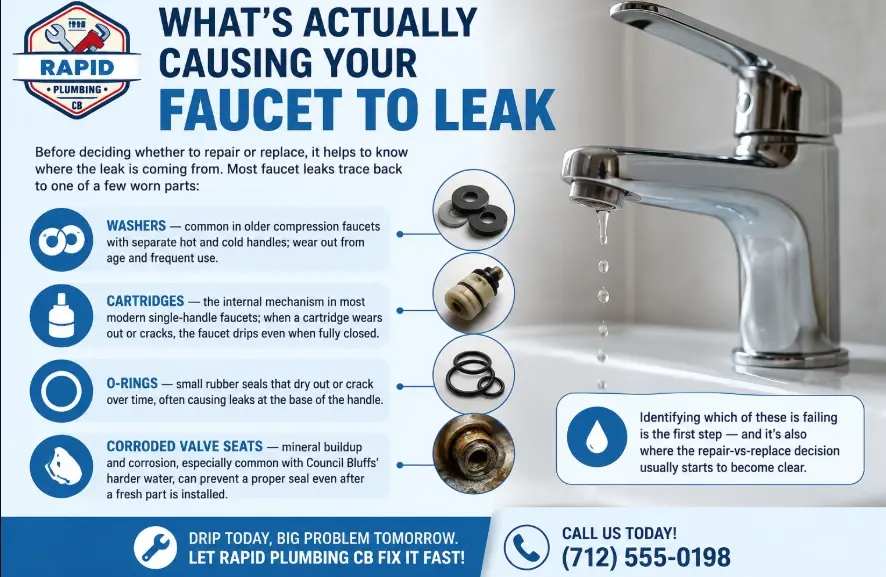
Before deciding whether to repair or replace, it helps to know where the leak is coming from. Most faucet leaks trace back to one of a few worn parts:
- Washers — common in older compression faucets with separate hot and cold handles; wear out from age and frequent use.
- Cartridges — the internal mechanism in most modern single-handle faucets; when a cartridge wears out or cracks, the faucet drips even when fully closed.
- O-rings — small rubber seals that dry out or crack over time, often causing leaks at the base of the handle.
- Corroded valve seats — mineral buildup and corrosion, especially common with Council Bluffs’ harder water, can prevent a proper seal even after a fresh part is installed.
Identifying which of these is failing is the first step — and it’s also where the repair-vs-replace decision usually starts to become clear.
When Repair Is the Right Call
In a lot of cases, repair is the faster, cheaper, and perfectly reasonable choice. Repair usually makes sense when:
- The faucet itself is under 8-10 years old and otherwise in good condition
- The leak is isolated to a single worn part — a washer, O-ring, or cartridge
- There’s no visible corrosion, cracking, or mineral buildup inside the fixture body
- You like the faucet and it matches your fixtures, and replacing it isn’t otherwise necessary
A straightforward cartridge or washer swap is a routine repair, and it’s often the more cost-effective option when the faucet body itself is still sound.
When Replacement Makes More Sense
Repair stops being the smart move once a faucet starts showing its age in more than one way. Signs it’s time to replace instead of repair again:
- You’ve repaired it more than once for the same leak. Repeat leaks usually mean the valve seat or faucet body itself is worn, not just a single part.
- The faucet is old enough that parts are hard to find. This is a real problem with vintage and discontinued faucets — some homeowners end up hunting for decades-old replacement parts just to keep an aging fixture running.
- There’s visible corrosion, staining, or mineral crust on the faucet body itself, not just the internal parts.
- You’re noticing reduced water pressure or inconsistent temperature control alongside the leak — often a sign of internal wear beyond a single component.
- You want to upgrade finish, style, or function (touchless, pull-down sprayer, water-saving aerators) while you’re already dealing with the fixture.
As a rule of thumb: one repair on an otherwise good faucet is usually worth it. A second repair on the same fixture, or any sign the leak is coming from the faucet body rather than a replaceable part, is usually the point where replacement pays off faster than continuing to patch it.
Cost Comparison: Leaky Faucet Repair vs Replace Council Bluffs
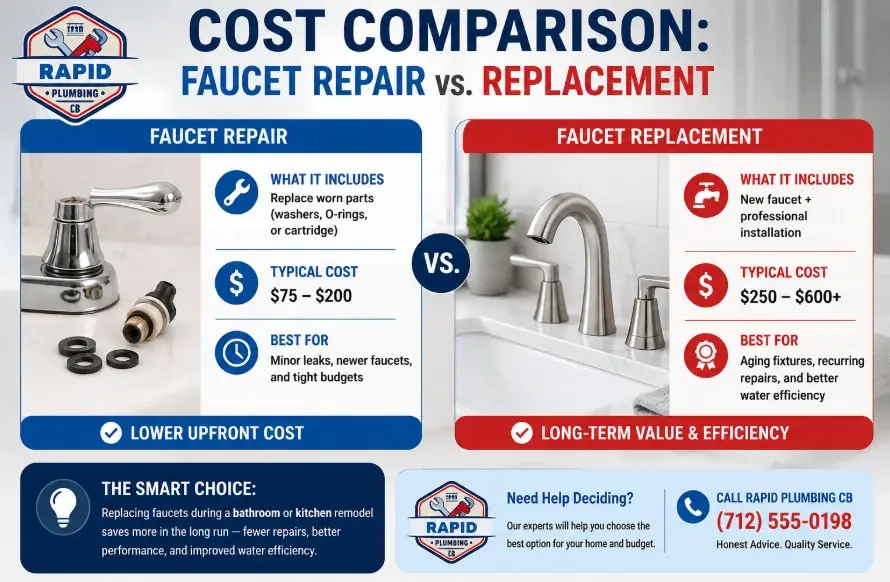
Repair costs are typically driven by labor plus inexpensive parts — a washer or O-ring costs very little, while a full cartridge replacement runs a bit more depending on the faucet brand. Replacement costs more upfront since it includes the new fixture itself plus installation labor, but it also resets the clock: no more repeat service calls for the same aging faucet, and modern faucets are generally more water-efficient than fixtures installed 15-20 years ago. If you’re already budgeting for a bathroom or kitchen remodel, replacing faucets at the same time is usually more cost-effective than doing it as a standalone job later.
Rare or Discontinued Faucet Parts in Council Bluffs
One thing worth knowing locally: some Council Bluffs plumbing outfits specialize specifically in sourcing old and rare faucet parts, including hardware dating back decades, for homeowners determined to keep a vintage faucet running. That’s a legitimate option if you have a fixture with sentimental or historic value you don’t want to replace. But for most everyday leaks, chasing down discontinued parts for a 30-plus-year-old faucet often costs more in time and money than simply installing a new one — and a new faucet comes with a warranty a decades-old part never will.
DIY Faucet Repair vs. Calling a Plumber
A basic washer or O-ring swap is within reach for a reasonably handy homeowner with the right tools and 30 minutes to spare. Where it gets riskier is diagnosing which part is actually failing, working around corroded shut-off valves (common in older Council Bluffs homes), and making sure a new installation is properly sealed so you’re not back to square one — or dealing with water damage — a few months later. Hidden leaks from a poorly sealed faucet install can go unnoticed under a sink for a while before they cause real damage, which is exactly why professional installation matters more than it might seem for what looks like a simple fixture swap.
Get a Straight Answer on Your Faucet
Not sure whether your leaky faucet is worth fixing or ready to be replaced? Rapid Plumbing CB will diagnose the actual cause, give you an honest repair-vs-replace recommendation, and handle whichever option makes the most sense for your home and budget.
Frequently Asked Questions
Is it cheaper to repair or replace a leaky faucet?
Repair is almost always cheaper upfront for a single worn part like a washer, O-ring, or cartridge. Replacement costs more initially but can be the better value if the faucet has needed repeat repairs, since you avoid paying for another service call down the line.
How long should a faucet last before I consider replacing it instead of repairing it?
Most faucets last 15-20 years with normal maintenance. Once a faucet is past that range, or has already needed more than one repair for leaking, replacement typically makes more sense than continuing to fix it.
Can a leaky faucet cause water damage?
Yes. A leak at the base or under the sink that goes unnoticed can lead to cabinet damage, mold, or subfloor issues over time, even if the faucet itself still works normally otherwise.
Should I try to repair a leaky faucet myself?
Simple washer or O-ring replacements are DIY-manageable for many homeowners. Diagnosing the actual cause, working with older or corroded shut-off valves, and ensuring a proper seal are where it’s worth calling a licensed plumber, especially if you’re not confident the repair fully solved the leak.
What if my faucet is an old or discontinued model?
Some plumbers can source rare or vintage faucet parts if you want to preserve a specific fixture. For most everyday leaks, though, replacing an aging faucet is usually faster and more cost-effective than hunting down discontinued parts.
Council Bluffs Resources on Home Plumbing & Permits
- Board of Water Works Trustees — oversees municipal water service that affects fixtures throughout your home
- City of Council Bluffs Utilities — utility services and water account information
- Building Division — permitting oversight for plumbing and fixture work
- Contractor Licensing — verify licensing for any plumbing work done in your home
- Permits and Licenses — general permitting resources for Council Bluffs homeowners
- Public Works Department — oversight of city water infrastructure that supplies your home’s fixtures
Related Reading from Rapid Plumbing CB
- Why Does My Water Smell Like Sulfur? Causes & Fixes
- Do You Need a Water Softener in Council Bluffs? Hard Water Signs & Solutions
- Signs of a Hidden Water Leak in Your Home
- Low Water Pressure in Council Bluffs Homes
- Bathroom & Kitchen Remodel Plumbing in Council Bluffs
- What Makes a Plumbing Job “Up to Code” in Iowa?
- Best Water Heater Brands for Council Bluffs Homes
- Why Your Basement Floor Drain Backs Up
- Signs You Need Whole-Home Repiping in Council Bluffs
- Gas Line Installation in Council Bluffs
- Garbage Disposal Repair vs. Replacement
- Common Toilet Problems in Council Bluffs Homes
- Sump Pump Installation Cost in Council Bluffs
- Why We Use Camera Inspections Before Every Sewer Repair
- Water Heater Repair & Installation Cost in Council Bluffs, IA
- Slab Leak Repair in Council Bluffs: Warning Signs, Cost & What to Expect
- Sewer Line Repair Cost in Council Bluffs, IA
- What Happens When You Call an Emergency Plumber in Council Bluffs
- Why Choose a Family-Owned Local Plumber
- Our Transparent Pricing Promise: No Hidden Fees, No Surprises
- Case Study: How a Homeowner Saved on a Drain Clog
- Plumbing Inspections for Rental Properties
- Plumbing Maintenance Checklist for Landlords
- Benefits of Hiring a Local Plumber in Council Bluffs
- Drain Cleaning Cost in Council Bluffs
- Residential vs. Commercial Plumber: What’s the Difference?
- Signs Your Water Heater Is About to Fail
- When to Call a Plumber Instead of Fixing It Yourself
- Tankless vs. Traditional Water Heaters
- How to Prepare Your Plumbing for Iowa/Nebraska Winters
- What to Ask Before Hiring a Plumber in Council Bluffs
- Reverse Osmosis vs. Water Filter: Which One Do You Need?
- Common Plumbing Problems Homeowners Face
- Why Chemical Drain Cleaners Damage Pipes
- Licensed vs. Unlicensed Plumber Risks
- Tree Roots in Sewer Lines
- What Causes Noisy Pipes?
- Why Is My Sump Pump Running Constantly?