How to Test Sump Pump Council Bluffs Before Iowa’s Spring Rains Hit
Ten minutes with a bucket of water can tell you whether your sump pump will actually work the day you need it most — before snowmelt and spring storms put it to the real test.
Every spring, the same pattern plays out across Council Bluffs: snowmelt saturates the ground, a few heavy rain systems roll through, and sump pumps that sat mostly idle all winter suddenly have to work overtime. Most homeowners never find out their pump has a problem until it’s already failing during that exact moment. Learning how to test sump pump Council Bluffs takes about ten minutes, costs nothing, and is the single easiest way to catch a problem while there’s still time to fix it.
How to Test a Sump Pump: The Quick Version
Pour a few gallons of water into the sump pit and watch what happens. If the float switch rises, the pump kicks on within a few seconds, the water drains out, and the pump shuts itself off — your pump passed. If any part of that sequence doesn’t happen, you’ve just found a problem before a storm did.
What You’ll Need
- A 5-gallon bucket (or anything similar to carry water)
- A flashlight
- About 10 minutes
No tools, no special skills — this is genuinely a task any homeowner can do safely.
Step-by-Step: How to Test Your Sump Pump
Do a quick visual inspection first
Before adding any water, check the power cord for cuts or fraying, confirm it’s plugged into a GFCI outlet, and look at the pit for visible debris. Remove anything that could block the intake screen or jam the float switch.
Check the discharge line
Walk outside and confirm the discharge pipe is clear, not clogged with dirt or leaves, and is actually directing water away from your foundation rather than pooling right next to it.
Pour water into the pit
Slowly pour 4-5 gallons of water into the sump pit until the float switch rises. Watch closely — the pump should activate within a few seconds of the float reaching its trigger point.
Watch it drain and shut off
The pump should clear the water and then shut off on its own once the float drops back down. If it keeps running after the pit is empty, or never shuts off cleanly, that’s worth having looked at.
Test the battery backup separately, if you have one
Unplug the primary pump while there’s still water in the pit and confirm your battery backup activates on its own within seconds. Many backups also include a dedicated test button — check your manual if yours has one.
Safety note: never let a sump pump run dry for more than a few seconds. These motors are designed to be cooled by the water passing through them — running one dry, even briefly, can overheat and damage the motor. If you’re testing by lifting the float directly rather than pouring water, lower it again within a couple seconds of hearing the motor start.
How Often Should You Test It?
Twice a year is the standard recommendation — once in early spring before snowmelt and heavy rain season, and again in fall before winter sets in. If your pump runs frequently or your home has flooded before, testing quarterly is a reasonable extra step. The National Weather Service’s Missouri Basin River Forecast Center publishes a spring flood outlook each year covering the Missouri River basin, including the Council Bluffs and Omaha metro — worth a look each March as a reminder that testing season has arrived.
What a failed test usually means: if the pump doesn’t activate at all, it’s often a stuck float switch or a power issue. If it activates but doesn’t clear the water, the impeller may be clogged or the check valve may have failed. Either way, it’s easier and cheaper to fix in a quiet moment than during an actual storm.
What Does a Sump Pump Checkup Cost in Council Bluffs?
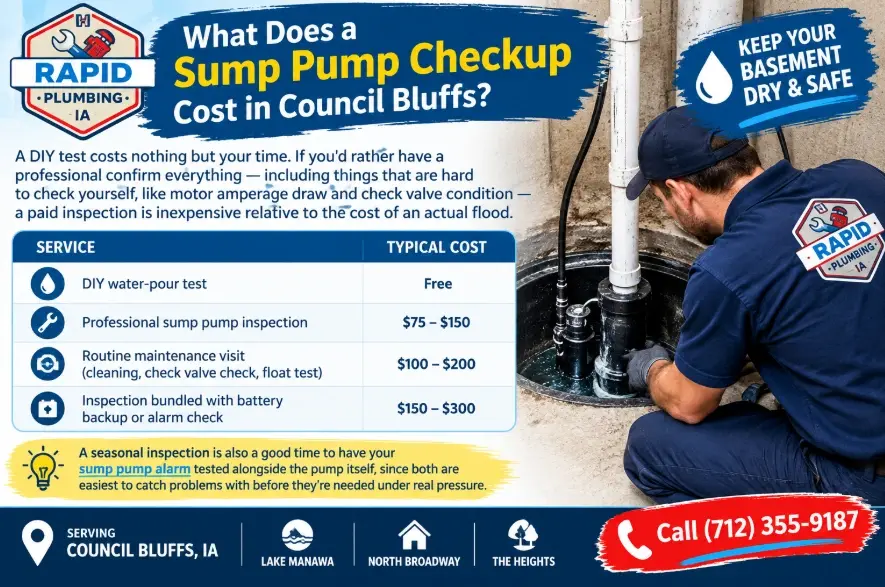
A DIY test costs nothing but your time. If you’d rather have a professional confirm everything — including things that are hard to check yourself, like motor amperage draw and check valve condition — a paid inspection is inexpensive relative to the cost of an actual flood.
| Service | Typical Cost |
|---|---|
| DIY water-pour test | Free |
| Professional sump pump inspection | $75 – $150 |
| Routine maintenance visit (cleaning, check valve check, float test) | $100 – $200 |
| Inspection bundled with battery backup or alarm check | $150 – $300 |
A seasonal inspection is also a good time to have your sump pump alarm tested alongside the pump itself, since both are easiest to catch problems with before they’re needed under real pressure.
When Testing Reveals a Problem
If your pump fails any part of this test, don’t wait for the next storm to deal with it. A pump that won’t activate, won’t shut off, or runs constantly without actually clearing water all point to specific, diagnosable issues — our guide on why a sump pump runs constantly covers several of the most common causes. If the pump itself is old or the motor has failed outright, our replacement cost guide breaks down what that typically runs.
Why Choose Rapid Plumbing CB
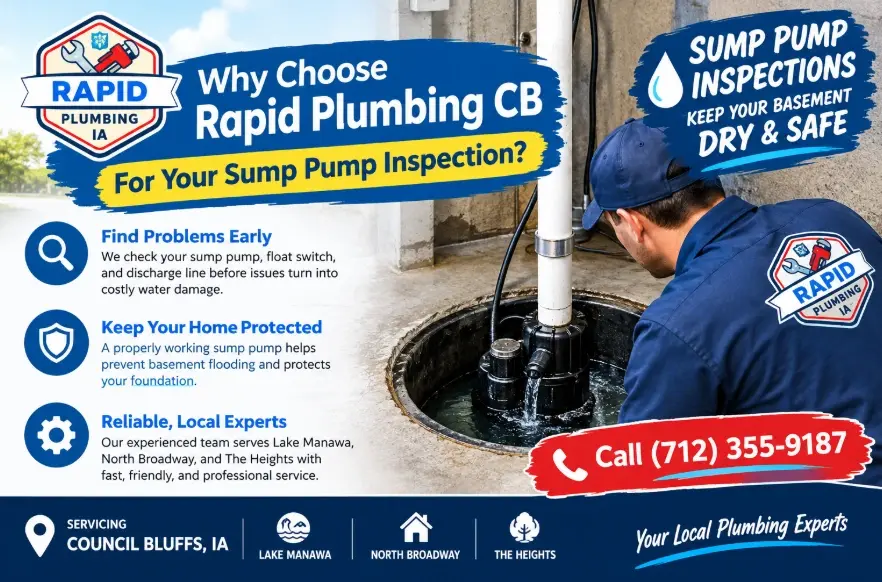
Our seasonal sump pump inspections check everything a DIY water test can’t easily catch — motor performance under load, check valve integrity, and battery backup readiness — all before the season that actually puts your system to the test. Our sump pump repair and installation team handles the full range, from a quick spring checkup to a complete pump replacement, and we service homes throughout Lake Manawa, North Broadway, and The Heights.
Frequently Asked Questions
How do I test my sump pump without a hose?
Pour water from a bucket directly into the pit instead — a 5-gallon bucket filled from a sink or tub works fine. You can also lift the float switch by hand, though that only tests the switch, not whether the pump actually drains water.
How do I know if my sump pump is working properly?
It should activate within a few seconds of the float switch rising, audibly hum or whir while running, fully drain the water in the pit, and shut off cleanly once the float drops. Any deviation from that sequence is worth investigating.
Can I damage my sump pump by testing it?
Only if you let it run dry for an extended period. A few seconds of dry running while lifting the float to check activation is generally fine, but avoid letting it run dry for more than that.
How often should I test my sump pump?
Twice a year is standard — once in early spring before snowmelt and rain season, and again in fall. Test quarterly if your home has flooded before or your pump runs frequently.
What if my sump pump makes noise but doesn’t pump water?
This usually points to a clogged impeller, a jammed intake screen, or a failed check valve. The motor running without moving water means it’s not a power problem — it’s a mechanical blockage somewhere in the system.
Want a Professional to Test It for You?
Seasonal sump pump inspections — licensed local plumbers, available 24/7 across Council Bluffs, IA.
Call (712) 355-9187