Backwater Valve for Basement Sewer Backup Council Bluffs?
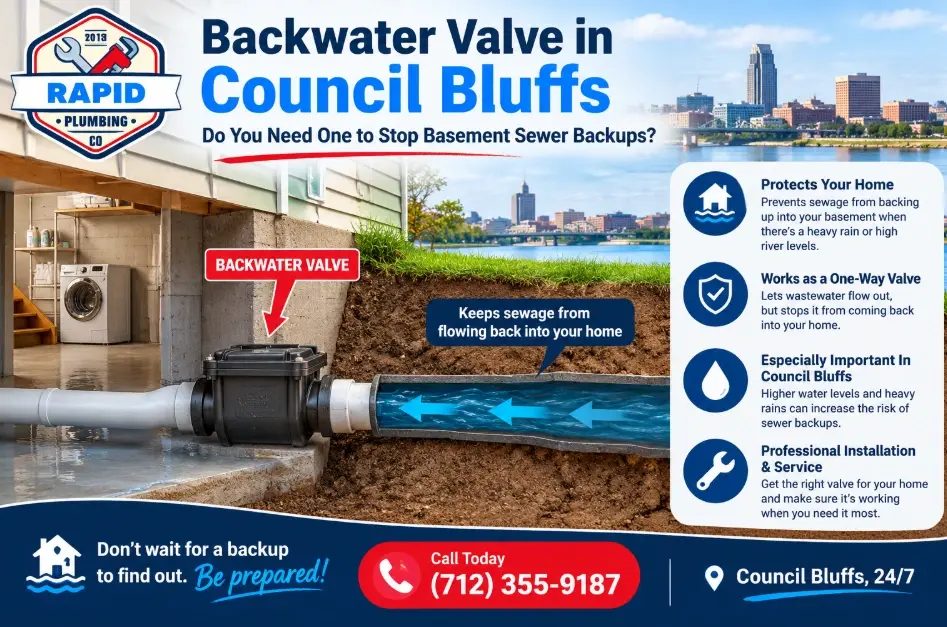
A Backwater Valve for Basement Sewer Backup Council Bluffs is a one-way valve on your sewer line. It lets wastewater leave your house, but it closes on its own if sewage tries to flow back in from the city main. If your Council Bluffs home has a basement with a floor drain, shower, toilet or laundry, a backwater valve is one of the most effective ways to stop a sewer backup before it reaches your floor.
Not every home needs one, though. Below we explain how a backwater valve works, which Council Bluffs homes are most at risk, what installation and cost look like, and how it differs from the other devices people mix it up with.
Short answer: You probably need a backwater valve if you have any fixture or floor drain below the level of the street sewer, you have had a backup during heavy rain or high river levels, or you are finishing a basement bathroom. A plumber can confirm this with a sewer camera and a quick elevation check.
Had sewage come up a basement drain?
Stop using water, keep kids and pets away, and call a Council Bluffs plumber.
What Is a Backwater Valve and How Does It Work?
Inside the valve is a flap (or gate) that swings in only one direction. In normal conditions, wastewater from your fixtures pushes the flap open and flows out to the municipal sewer. When the city sewer fills up and pressure pushes the wrong way, the flap closes and blocks the flow, so sewage cannot come up through your basement drains.
Many valves have a clear access cap so a plumber can inspect the flap. It is a simple mechanical part, which is its strength and its weakness: it only protects you if the flap is clean, free of debris and able to move.
Why it matters: a closed valve works both ways
While the valve is closed, wastewater from the protected fixtures cannot leave your home either. That means you should avoid using basement-level toilets, showers, sinks and the washing machine during a backup event until the city sewer drains down. Your plumber designs the layout so that, where possible, upper-floor fixtures are not stuck behind a closed valve.
Why Council Bluffs Basements Are at Risk of Sewer Backup
Backups usually start in the shared sewer system, not inside your house. When heavy rain and high water overload the system, the only place for sewage to go is up the lowest drain it can find, which is often a basement floor drain.
- River-driven flooding: In June 2019, with the Missouri River above flood stage and heavy rain, raw sewage backed up into homes near the river. According to local news coverage of that event, the city said the sewer system could not take any more water, and that a long-term fix would be expensive.
- Low-lying ground: Parts of southwest Council Bluffs sit low, and Lake Manawa itself was created by Missouri River flooding. If you live in the Lake Manawa neighborhood, ask a plumber to check your drain elevation against the nearest manhole.
- Older homes and older pipes: Clay and cast iron lines, root intrusion and past repairs all make backups more likely. Our guide to old house plumbing in Council Bluffs covers what to look for.
- Basement living space: Finished basements, basement bathrooms and laundry rooms turn a small backup into an expensive loss.
Signs You May Need a Backwater Valve
- Your basement floor drain has bubbled, gurgled or overflowed during a storm. See our guide on basement floor drain backup in Council Bluffs for what to do first.
- Several fixtures gurgle at the same time, or toilets burp when the washer drains.
- You notice sewer odor near the basement during heavy rain. If the smell is constant, read about sewer smell in a bathroom because it may be a dry trap or vent problem instead.
- You are adding or finishing a basement bathroom, laundry or bar sink.
- Your home sits near the river or on low ground and neighbors have had backups.
- You have no way to tell whether a valve already exists. A plumber can look for an access cover along your sewer line.
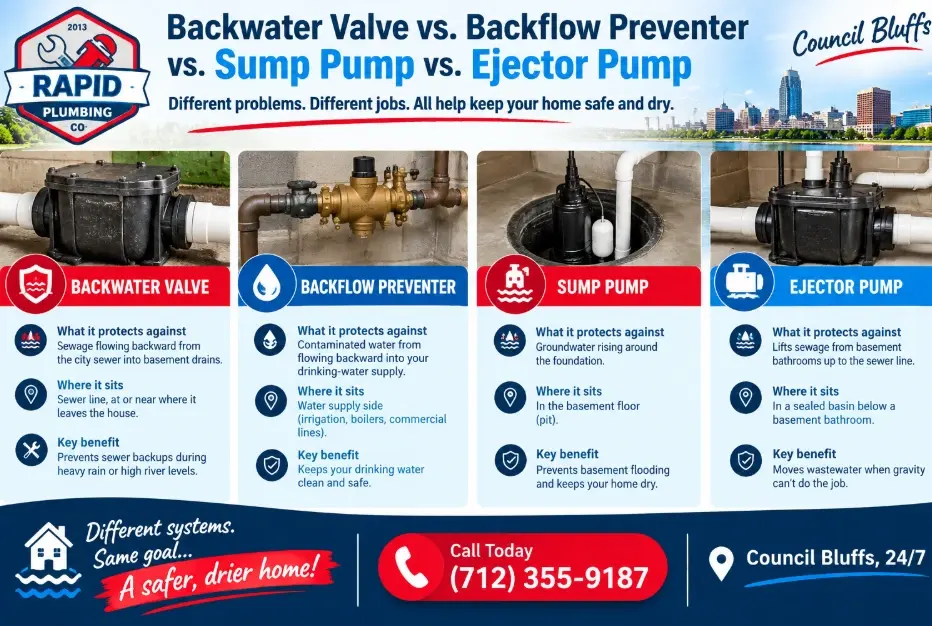
Backwater Valve vs. Backflow Preventer vs. Sump Pump vs. Ejector Pump
These four devices sound similar and are often confused. They solve different problems, and a basement may need more than one.
| Device | What it protects against | Where it sits |
|---|---|---|
| Backwater valve | Sewage flowing backward from the city sewer into basement drains | Sewer line, at or near where it leaves the house |
| Backflow preventer | Contaminated water flowing backward into your drinking-water supply | Water supply side (irrigation, boilers, commercial lines) |
| Sump pump | Groundwater rising around the foundation | Pit in the basement floor |
| Ejector pump | Lifts sewage from basement bathrooms up to the sewer line | Sealed basin below a basement bathroom |
In short, a backwater valve keeps city sewage out, a sump pump keeps groundwater out, and an ejector pump moves your own basement sewage up and out. If you are unsure about groundwater, compare options in our sump pump vs. French drain guide, and if your pit runs during river season, read about a sump pump near the Missouri River.
Backwater Valve Installation in a Basement: What to Expect
Installing a backwater valve in an existing home is a real plumbing project, not a quick swap. Here is how it typically goes:
- Inspect the line. A sewer camera inspection shows pipe material, depth, roots, belly sections and any existing valve.
- Choose the location. The valve usually goes on the building sewer just downstream of where your fixtures join, in the basement slab or in an outdoor access pit. If only a basement bathroom is at risk, a branch valve may be an option.
- Open the slab or dig. In most retrofits the concrete floor has to be cut, or the line excavated outside, to reach the pipe.
- Install the valve and a cleanout. Adding an accessible sewer cleanout makes later inspection and cleaning much easier.
- Test, patch and inspect. The line is tested, the slab or trench restored, and the work inspected where a permit applies.
If your line has root damage or a collapsed section, fix that first. A valve will not help a pipe that is already failing, and our sewer line repair in Council Bluffs team can repair or replace the damaged section during the same visit. See tree roots in sewer lines for why that happens.
Backwater Valve Cost: What Affects the Price?
Backwater valve cost varies a lot from house to house. Industry sources generally put a retrofit in an existing home at somewhere around $1,000 to $5,000 depending on complexity, while adding one during new construction costs much less because the slab is not yet poured. We price your job after we see the line, not before.
- Slab cutting vs. outdoor excavation: Breaking and repouring concrete adds labor.
- Pipe depth and material: Deep or older lines take longer and may need extra repair.
- Valve type and size: Full-line, branch-only and alarm-equipped valves cost differently.
- Cleanout and access pit: Needed for proper maintenance.
- Related repairs: Root cutting, drain cleaning or pipe replacement. For repair budgets, see sewer line repair cost in Council Bluffs.
- Permit and inspection: Confirm requirements with the city (see below).
Insurance: ask before you need it
Standard homeowners policies often exclude sewer or drain backup unless you add a specific endorsement. Ask your insurance agent whether you have that coverage, and whether installing a backwater valve affects your premium or claim options. Valve plus coverage is the strongest combination.
Who Is Responsible for the Sewer Line?
The city maintains the public main in the street. The pipe running from your house to that main is usually the homeowner’s responsibility, and so is a backwater valve on it. Read Council Bluffs sewer responsibility to see where the property-line split typically falls before you call for repairs.
Permits and City Contacts in Council Bluffs
Work on a sewer line generally needs a plumbing permit and inspection, and details can change. Before any digging or slab work, confirm the current requirements with the City of Council Bluffs Building Division, which lists its plumbing and mechanical inspectors on its official Building Division page (phone (712) 890-5276). General city services are on the City of Council Bluffs website. We also explain the basics in our Council Bluffs plumbing permit guide.
Important: A backwater valve reduces risk but does not remove it. It needs periodic inspection and cleaning to keep the flap moving, and you should still keep a sump system and battery backup in working order. See sump pump battery backup for storm-season power loss.
How to Maintain a Backwater Valve
- Have the valve checked at least once a year, and after any backup event.
- Keep the access cover clear and never bury or tile over it.
- Do not flush wipes, grease or debris that can jam the flap. Avoid harsh chemicals, as explained in why chemical drain cleaners damage pipes.
- Schedule hydro jetting or snaking if your main line clogs often.
Backwater Valve FAQs
What does a backwater valve do?
A backwater valve lets wastewater flow out of your home but closes automatically when sewage tries to flow back in from the city sewer, which helps prevent basement sewer backups.
Do I need a backwater valve if I have a sump pump?
Yes, they do different jobs. A sump pump removes groundwater, while a backwater valve blocks sewage coming back through your drains. Many basements benefit from both.
How much does backwater valve installation cost?
Retrofits in existing basements commonly run from about $1,000 to $5,000 depending on slab cutting, pipe depth and the valve type, and new construction is usually cheaper. A sewer camera inspection gives an accurate quote.
Is a backwater valve the same as a backflow preventer?
No. A backwater valve protects the sewer side of your plumbing, while a backflow preventer protects your drinking-water supply from contamination.
Can I use my basement toilet while the valve is closed?
You should avoid it. When the valve is closed, wastewater from protected fixtures cannot leave the house, so using them can cause a backup inside your home.
Does Council Bluffs require a backwater valve?
Requirements can change, so confirm with the City of Council Bluffs Building Division at (712) 890-5276 before starting work. A local plumber can also check your drain elevation and advise.
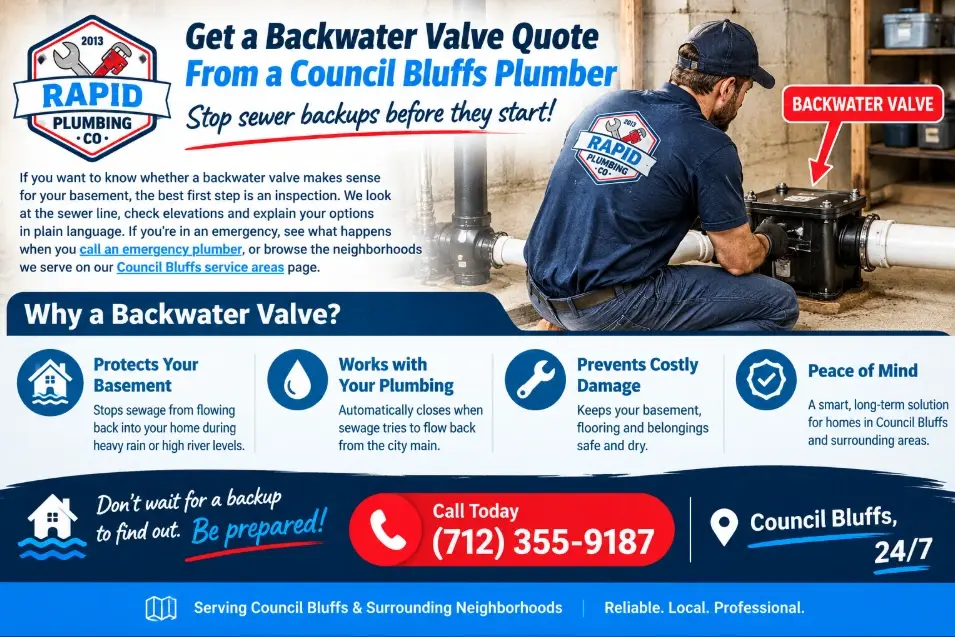
Get a Backwater Valve Quote From a Council Bluffs Plumber
If you want to know whether a backwater valve makes sense for your basement, the best first step is an inspection. We look at the sewer line, check elevations and explain your options in plain language. If you are in an emergency, see what happens when you call an emergency plumber, or browse the neighborhoods we serve on our Council Bluffs service areas page.
Protect your basement before the next storm
Call Rapid Plumbing CB for a sewer line inspection and backwater valve quote.