🚰 SEWER RESPONSIBILITY · COUNCIL BLUFFS, IA
Council Bluffs Sewer Responsibility: City vs. Homeowner Responsibility
Where the City’s sewer system ends and your private line begins — and why it matters the moment you have a backup.
Quick answer: The City of Council Bluffs’ Public Works Department maintains the public sewer mains running under the street through its Water Pollution Control and Sewer Maintenance divisions. As in the large majority of U.S. cities, the homeowner owns and maintains the private sewer lateral connecting their home to that main — including the section running under the street to the connection point. If you’re unsure exactly where the line falls for your address, Public Works Engineering can confirm at (712) 890-5296.
“Sewer council bluffs ia” is a search that usually shows up at the worst possible moment — water backing up into a basement drain or a toilet that won’t flush no matter what. The confusion is understandable: part of the pipe running from your house genuinely belongs to the City, and part of it genuinely belongs to you, and the two look identical from the surface. Here’s how that split actually works, based on the City of Council Bluffs’ own Public Works structure, and what to do depending on which side the problem is on.
What the City of Council Bluffs Handles
Council Bluffs’ Public Works Department runs sewer infrastructure through two of its divisions: Water Pollution Control (which includes the city’s pump stations) and Sewer Maintenance, under the Operations branch. Together they’re responsible for:
- The public sewer main lines running under city streets
- Sewer pump stations that move wastewater to treatment
- Wastewater treatment itself through Water Pollution Control
- Public education — the City’s own “No Wipes in the Pipes” message asks residents not to flush wipes, noting that even packaging labeled “flushable” can still clog sewer lines
You can reach Public Works Engineering directly at (712) 890-5296 or Operations at (712) 328-4641 for anything involving the city’s side of the system.
What’s the Homeowner’s Responsibility
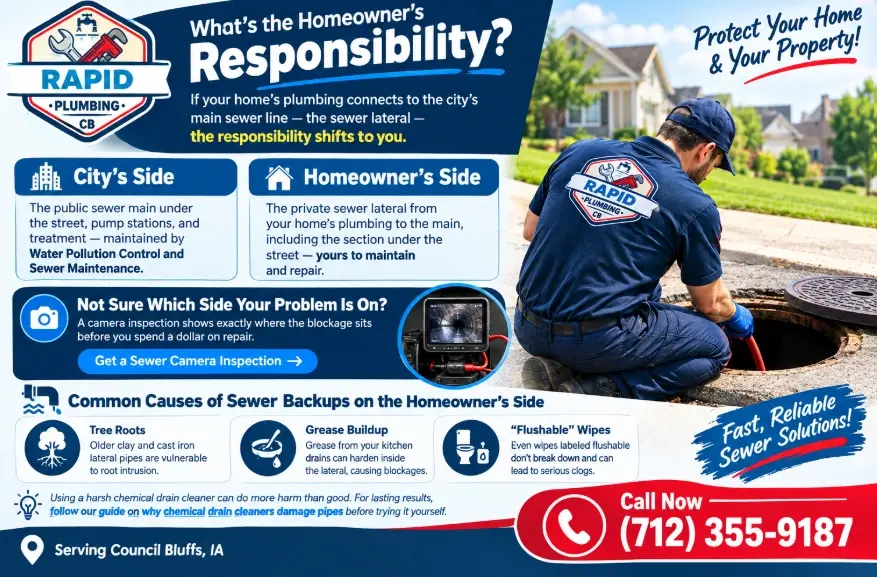
The pipe connecting your home’s plumbing to the city’s main — called the sewer lateral — is where the responsibility shifts. As in the large majority of U.S. cities, the property owner is responsible for their sewer lateral along its full length, including the portion that runs under the street between the property line and the connection point at the main. This is the near-universal standard used by cities across the country, though the exact policy language can vary; if you want the City’s specific written position for your property, Public Works Engineering can confirm it.
🏛️ City’s Side
Public sewer main under the street, pump stations, and treatment — maintained by Water Pollution Control and Sewer Maintenance.
🏠 Homeowner’s Side
The private sewer lateral from your home’s plumbing to the main, including the section under the street — yours to maintain and repair.
Not Sure Which Side Your Problem Is On?
A camera inspection shows exactly where the blockage sits before you spend a dollar on repair
Get a Sewer Camera InspectionCommon Causes of Sewer Backups on the Homeowner’s Side
Most sewer backups homeowners deal with in Council Bluffs trace back to one of three causes:
- Tree roots — older clay and cast iron laterals are especially vulnerable to root intrusion through cracks and joints; see our tree roots in sewer lines guide for how this develops over time.
- Grease buildup — grease poured down a kitchen drain cools and hardens inside the lateral, narrowing it until a backup happens.
- “Flushable” wipes — exactly what the City’s own public messaging warns against. Even wipes labeled flushable frequently don’t break down the way toilet paper does, and they’re a leading cause of lateral clogs.
Using a harsh chemical drain cleaner to try to clear a backup can also make things worse on an older lateral — see our guide on why chemical drain cleaners damage pipes before reaching for one.
How to Tell Whose Problem It Is
| Sign | Likely Responsible Party |
|---|---|
| Only your home is backing up | Your private lateral (homeowner) |
| Multiple homes on the same street backing up at once | The city’s main line (Public Works) |
| Backup at the lowest drain in the house (basement floor drain) | Usually the lateral — see our basement floor drain backup guide |
| Sewer smell with no visible backup yet | Could be either — worth an inspection before it becomes a full backup |
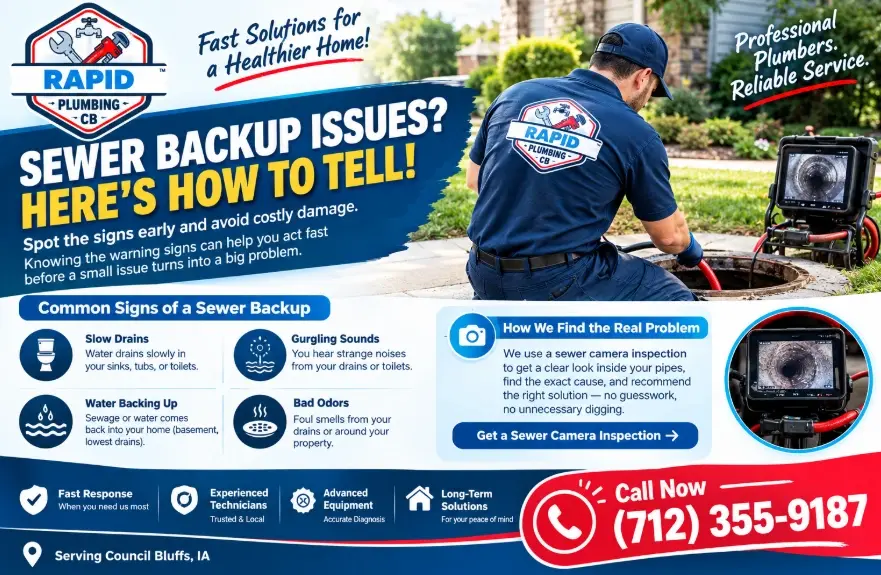
The only way to know for certain is to see inside the pipe. A sewer camera inspection shows exactly where a blockage, root intrusion, or break sits, which also tells you immediately whether the issue falls on your side of the property line or the City’s.
What to Do When You Have a Sewer Backup
- Stop using water in the house — more water going down the drain while a lateral is blocked makes a backup worse.
- Check if neighbors are also affected. If so, contact Public Works Operations at (712) 328-4641 — it may be the city’s main line.
- If it’s isolated to your home, call a licensed plumber for a camera inspection to confirm the cause and exact location before any digging or repair.
- Get a repair estimate based on what the camera actually shows — see our sewer line repair cost guide for what affects pricing.
- Ask about trenchless repair for an aging lateral — pipe lining can often fix root intrusion or cracks without digging up your yard or the street.
All lateral repair work should be done to the current Iowa plumbing code and, where it affects the public right-of-way, coordinated with the City’s Public Works Engineering division.
Sewer Backup Right Now?
24/7 emergency response across Council Bluffs, IA
📞 Call (712) 355-9187 See Sewer Line Repair ServicesFrequently Asked Questions
Who is responsible for sewer problems in Council Bluffs — the city or the homeowner?
As in most U.S. cities, the City of Council Bluffs’ Public Works Department (Water Pollution Control and Sewer Maintenance divisions) maintains the public sewer mains that run under the street. The homeowner is responsible for the private sewer lateral connecting their home to that main, including the portion running under the street to the connection point. Confirm exact specifics for your address with Public Works Engineering at (712) 890-5296.
What is a sewer lateral?
A sewer lateral is the pipe that runs from your home’s plumbing out to the city’s sewer main, typically located under the street. It carries all of your household wastewater and, in most cities, is owned and maintained by the property owner for its entire length.
How do I know if my sewer backup is my responsibility or the city’s?
A good rule of thumb: if only your home is affected, the problem is very likely in your private lateral. If multiple homes on the same street are backing up at the same time, the problem may be in the city’s main line, which is Public Works’ responsibility. A sewer camera inspection is the definitive way to tell exactly where a blockage sits.
What commonly causes sewer backups on the homeowner’s side in Council Bluffs?
Tree roots intruding through aging clay or cast iron laterals, grease poured down kitchen drains, and “flushable” wipes are the most common causes. The City of Council Bluffs specifically asks residents not to flush wipes, since even products labeled flushable can clog sewer lines.
Does Council Bluffs have any assistance for sewer lateral repair costs?
Contact the City of Council Bluffs Public Works Department directly to ask about any current homeowner assistance programs for sewer lateral repair — availability and terms can change, so Public Works is the accurate source rather than third-party directories.
Sources: City of Council Bluffs Public Works department structure (Water Pollution Control, Sewer Maintenance divisions) and the City’s public “No Wipes in the Pipes” messaging, verified live 09-26-2026. Contact: Public Works Engineering (712) 890-5296, Public Works Operations (712) 328-4641. The city/homeowner lateral split described here reflects standard municipal practice used by most U.S. cities; confirm exact current policy for your specific address with Council Bluffs Public Works.
Own the line? Check its condition. If the lateral is your responsibility, a sewer camera inspection in Council Bluffs shows its condition before a small crack becomes a costly backup.