
Where Is My Sewer Cleanout Council Bluffs? The Quick Answer
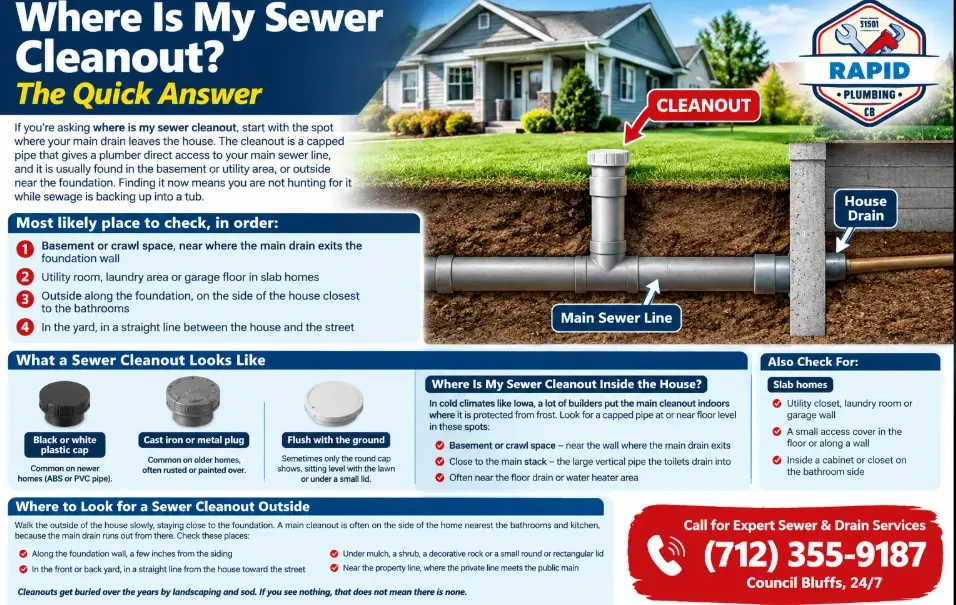
Searching for where is my sewer cleanout Council Bluffs? Start with the spot where your main drain leaves the house. The cleanout is a capped pipe that gives a plumber direct access to your main sewer line, and it is usually found in the basement or utility area, or outside near the foundation. Finding it now means you are not hunting for it while sewage is backing up into a tub.
Most likely places to check, in order:
- Basement or crawl space, near where the main drain exits the foundation wall
- Utility room, laundry area or garage floor in slab homes
- Outside along the foundation, on the side of the house closest to the bathrooms
- In the yard, in a straight line between the house and the street
Below you will find what a cleanout looks like, where to look indoors and outdoors, a step-by-step way to track down a hidden one, and what to do if your home does not have one. If you are already dealing with a backup, skip ahead and call an emergency plumber in Council Bluffs.
What a Sewer Cleanout Looks Like
A sewer cleanout is a short vertical or angled pipe with a threaded cap on top. The cap usually has a square or round raised nut so a wrench can turn it. Most are 3 or 4 inches across, which is wider than any other capped pipe you will see around the house.
- Black or white plastic cap: common on newer homes (ABS or PVC pipe).
- Cast iron or metal plug: common on older homes, often rusted or painted over.
- Flush with the ground: sometimes only the round cap shows, sitting level with the lawn or under a small lid.
Where Is My Sewer Cleanout Inside the House?
In cold climates like Iowa, a lot of builders put the main cleanout indoors where it is protected from frost. Look for a capped pipe at or near floor level in these spots:
Basement or crawl space
- Near the wall where the main drain exits the house
- Close to the main stack, the large vertical pipe the toilets drain into
- Often near the floor drain or water heater area
Slab homes
- Utility closet, laundry room or garage wall
- A small access cover in the floor or along a wall
- Inside a cabinet or closet on the bathroom side
Where to Look for a Sewer Cleanout Outside
Walk the outside of the house slowly, staying close to the foundation. A main cleanout is often on the side of the home nearest the bathrooms and kitchen, because the main drain runs out from there. Check these places:
- Along the foundation wall, a few inches from the siding
- In the front or back yard, in a straight line from the house toward the street
- Under mulch, a shrub, a decorative rock or a small round or rectangular lid
- Near the property line, where the private line meets the public main
Cleanouts get buried over the years by landscaping and sod. If you see nothing, that does not mean there is none.
How to Find a Hidden or Buried Sewer Cleanout
- Check your paperwork. A plot plan, builder drawings or a past home inspection report often show the sewer line and cleanout.
- Find where the main drain leaves the house. Inside, look for the large pipe running through the foundation wall. The cleanout is usually near that exit point.
- Match it to the outside. Go outside to the same spot on the exterior wall and look in line with that exit for a cap or a lid.
- Look under cover. Check under mulch, rocks, plant pots and shrubs. Use a hand trowel only for a few inches of soil.
- Call 811 before you dig deeper. Underground gas, electric and water lines may be nearby. Iowa One Call arranges free line marking before any real digging.
- Bring in a plumber. A plumber can trace the line with a camera and locator and mark the cleanout for you.
Things That Look Like a Cleanout but Are Not
Several capped pipes and covers around the house get mistaken for the sewer cleanout:
- Floor drain: a grate in the basement floor. If it backs up, read about a basement floor drain backup instead.
- Vent pipe: the open pipe on the roof, not a ground-level cap. Problems here are covered in our guide to a clogged plumbing vent.
- Water meter or shut-off lid: these cover supply lines, not drains.
- Septic tank lid: if your home is not on city sewer, see our page on sewage tank pumping.
Why You Should Know Where Your Sewer Cleanout Is Before an Emergency
When a main line clogs, every minute counts. Knowing the location saves time and can lower the bill because the plumber goes straight to the access point. A cleanout is also where a plumber sends a camera or a cleaning tool down the line.
- It gives access for a sewer camera inspection to see what is really inside the pipe.
- It is where tree roots in sewer lines are cut out of the pipe.
- It is the entry for cleaning, and hydro jetting vs snaking helps you choose the right method.
- It lets you tell a clog in one fixture from a problem in the main line.
Safety Before You Touch the Cap
Avoid chemical drain openers on a main line problem. They rarely reach the clog and can burn the plumber working next. Our post on why chemical drain cleaners damage pipes explains why.
What If Your Home Has No Sewer Cleanout?
Some older homes have no accessible cleanout at all. In that case a plumber has to pull a toilet or work through a roof vent to reach the line, which is slower and harder on the fixtures. Adding one is usually a smart upgrade, and it is often done during a repair. A licensed plumber can install a cleanout at the right spot on your line, and we can do it as part of sewer line repair in Council Bluffs.
Check permit requirements before the work starts. The City of Council Bluffs Building Division can tell you what applies to your address. Our plumbing services page lists everything we handle.
Council Bluffs Resources for Sewer and Utility Questions
Who owns which part of the line matters when you plan any work. We explain that in Council Bluffs sewer responsibility. For questions about the public sewer or utility locations, start here:
- City of Council Bluffs for public sewer, permit and inspection questions
- Council Bluffs Water Works for water service and utility questions
- Iowa One Call before any digging on your property
Can’t Find Your Sewer Cleanout?
Rapid Plumbing CB can locate it, label it and check the line with a camera. Call us now or send a request and we will get back to you.
Sewer Cleanout FAQs
How many sewer cleanouts does a house have?
Most homes have one main cleanout. Larger or older homes may have more than one, such as one inside and one outside, or extra ones on long runs.
Is a sewer cleanout the same as a floor drain?
No. A floor drain is a grate that collects water from the floor. A cleanout is a capped pipe that gives access to the main sewer line.
Can I open my sewer cleanout myself?
You can look, but do not open it during a backup. If the line is full, it can release sewage quickly. For any clog in the main line, call a plumber.
What size is a sewer cleanout?
Most main cleanouts are 3 or 4 inches across, with a threaded cap that has a raised nut for a wrench.
Does adding a cleanout need a permit?
It depends on the work and your property. Ask the City of Council Bluffs Building Division before you start, and use a licensed plumber.
Know Your Cleanout Now, Skip the Stress Later
Take ten minutes this week to answer the question where is my sewer cleanout Council Bluffs for your own house. Walk the foundation, check the basement wall where the main drain exits, and take a photo of what you find. Write the location on your water heater or on a note near the fuse box. If you cannot find one, drain cleaning in Council Bluffs from a local plumber is the safest way to get the line opened and checked.