
The toilet replacement cost in Council Bluffs depends less on the toilet and more on what sits under it. The fixture is often the smallest line on the bill. The floor flange, the shut-off valve, the wax seal and the condition of the subfloor decide whether the swap takes one visit or turns into a bigger repair. This guide breaks the price into its parts, compares a licensed plumber with a DIY swap, and lists what to ask before you agree to any quote.
Toilet Replacement Cost Council Bluffs: What You Should Expect
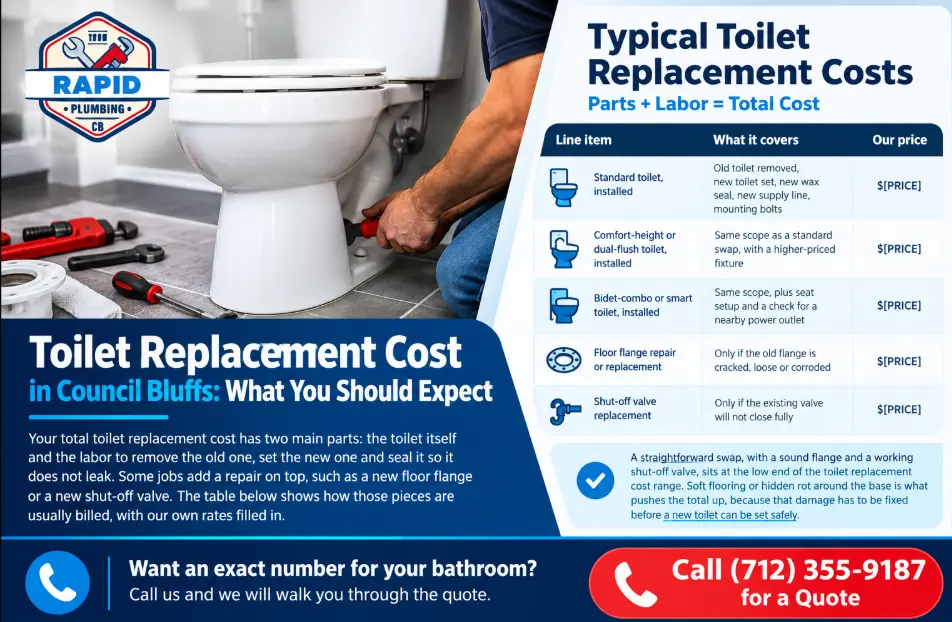
Your total toilet replacement cost has two main parts: the toilet itself and the labor to remove the old one, set the new one and seal it so it does not leak. Some jobs add a repair on top, such as a new floor flange or a new shut-off valve. The table below shows how those pieces are usually billed, with our own rates filled in.
| Line item | What it covers | Our price |
|---|---|---|
| Standard toilet, installed | Old toilet removed, new toilet set, new wax seal, new supply line, mounting bolts | $[PRICE] |
| Comfort-height or dual-flush toilet, installed | Same scope as a standard swap, with a higher-priced fixture | $[PRICE] |
| Bidet-combo or smart toilet, installed | Same scope, plus seat setup and a check for a nearby power outlet | $[PRICE] |
| Floor flange repair or replacement | Only if the old flange is cracked, loose or corroded | $[PRICE] |
| Shut-off valve replacement | Only if the existing valve will not close fully | $[PRICE] |
A straightforward swap, with a sound flange and a working shut-off valve, sits at the low end of the toilet replacement cost range. Soft flooring or hidden rot around the base is what pushes the total up, because that damage has to be fixed before a new toilet can be set safely.
Want an exact number for your bathroom? Call us and we will walk you through the quote.
Call (712) 355-9187 for a QuoteFive Factors That Change Your Toilet Replacement Cost Council Bluffs
1. The condition of the floor flange
The floor flange is the ring that bolts the toilet to the floor and connects it to the drain. If it is cracked, loose or corroded, the new toilet will rock or leak no matter how carefully it is set. Repairing or replacing the flange adds time and parts to the job, so it is the most common reason a quote goes up.
2. Hidden subfloor damage
A toilet that has leaked for months can leave soft spots, stained boards or a musty smell under the bathroom floor. Water damage has to be dealt with first, and the cost depends on how much flooring and subfloor is affected. Ask the plumber to check this before any work starts.
3. The shut-off valve
The valve on the wall behind the toilet is easy to forget until you need it. If it is stuck or drips when you turn it, replace it during the swap. You can read more about a stuck valve in our guide on what to do when a water shut-off valve will not work.
4. The toilet you choose
Most toilets are sized for a 12-inch rough-in, which is the distance from the wall to the center of the drain. Measure before you buy, because a toilet with the wrong rough-in will not fit the existing drain without changes. Taller comfort-height models and bidet seats also cost more to buy and sometimes need extra setup.
5. Access and layout
A toilet in a tight half-bath, a basement bathroom or a second-floor room takes longer to remove and set. The same is true when the old toilet is bolted down with corroded hardware. Tell the plumber about these conditions when you ask for a quote, so the price reflects the real job.
Plumber vs DIY Toilet Replacement: An Honest Comparison
A DIY swap can save labor cost, and many homeowners do it successfully. The risk is in what you cannot see until the old toilet is up. The table below compares the two options side by side.
| Factor | Licensed plumber | DIY swap |
|---|---|---|
| Labor cost | Billed for removal, setting, sealing and cleanup | No labor fee, but your time and tools |
| Time needed | Usually completed in one visit when the flange and valve are sound | Plan on a full day if this is your first time |
| Hidden damage | Checks the flange, subfloor and valve before setting the toilet | You only see what is visible once the toilet is off |
| Leak risk | Tests the seal and supply connection before leaving | Wax seal or supply line mistakes can leak days later, out of sight |
| Permit questions | Confirms what the job needs under local rules | Your responsibility to check before work begins |
A DIY swap is reasonable when the flange is solid, the floor is dry and firm, the shut-off valve closes fully, and you are replacing a toilet with the same rough-in. Stop and call a plumber if you find soft flooring, a cracked flange, or water under the base of the toilet. For a broader look at which jobs belong with a professional, read our post on when to call a plumber instead of fixing it yourself.
Replace or Repair? How to Decide Before You Pay for a New Toilet
Not every toilet problem calls for a new toilet. A running tank, a weak flush or a slow bowl can often be fixed with parts. Replacement makes more sense when the bowl or tank is cracked, the toilet rocks no matter how it is shimmed, or the fixture is old and uses far more water than it should.
Older toilets are a common reason for replacement. Toilets made before 1994 often use 3.5 gallons or more per flush, while current models use 1.6 gallons or less. The U.S. Environmental Protection Agency’s WaterSense toilet guidance explains which models meet current efficiency standards.
If you are not sure which group your toilet falls into, start with our guide to common toilet problems in Council Bluffs homes. It explains the usual causes of running, clogging and leaking, so you can tell a repair from a replacement before you call.
Signs a toilet replacement is the better choice
- A cracked bowl or tank that cannot be sealed safely
- A toilet that rocks even after the flange and bolts are tightened
- Water staining or soft spots around the base
- Repeated clogs that a drain cleaning does not solve (see our drain cleaning services)
- A fixture that is old, hard to find parts for, or uses much more water than newer models
Do You Need a Permit for a Toilet Replacement in Council Bluffs?
The City of Council Bluffs Building Division issues plumbing permits and performs plumbing inspections. Whether a like-for-like toilet swap needs a permit depends on the scope of the work, so it is smart to confirm before the job starts rather than assume either way. You can call the Building Division at (712) 890-5276 or visit the City of Council Bluffs Building Division page for current details.
If a permit is required, the application is submitted through the city’s online Customer Portal. The city’s Customer Portal how-to guides walk you through the steps.
How to Choose a Plumber for Your Toilet Replacement
When you compare quotes for a toilet replacement cost, the lowest number is not always the best value. Use this checklist to compare them fairly:
- Confirm the license. Iowa plumbers are licensed through the state. You can check the rules and board information on the Iowa Plumbing and Mechanical Systems Board page.
- Ask for an itemized written quote. It should separate the toilet, the labor, the wax seal, the supply line and any flange or valve work.
- Ask what is checked before setting the toilet. A good plumber inspects the flange, subfloor and shut-off valve first.
- Ask who handles the permit, if one is needed for your job.
- Ask about warranty. Get the workmanship and parts coverage in writing before the work starts.
If your toilet is leaking right now, do not wait for the replacement. Shut off the water at the valve behind the toilet and call for help. Our emergency plumbing service page explains what to do while you wait.
Toilet Replacement Cost FAQs
How long does a toilet replacement take?
When the floor flange and shut-off valve are in good shape, a standard swap is often finished in one visit. Hidden damage, a stuck valve or a difficult layout can add time.
Can I reuse the old wax ring?
No. A wax ring compresses when the toilet is set and cannot seal properly a second time. It should be replaced every time the toilet is removed.
Should the supply line be replaced during a toilet swap?
Usually yes. A supply line is a low-cost part, and replacing it during the swap removes one of the most common leak points in the bathroom.
Why does the labor cost more than the toilet itself?
Labor covers removing the old toilet, inspecting the flange and floor, setting and sealing the new fixture, testing for leaks, and cleaning up. Those steps take skill and time, and they are what protect the floor below.
Should I repair my toilet or replace it?
If the problem is a worn part, such as a flapper, fill valve or handle, repair is usually the better value. If the bowl or tank is cracked, the base leaks, or the toilet is old and inefficient, replacement is usually the smarter long-term choice. A plumber can tell you which one applies to your toilet.
Get a Toilet Replacement Quote in Council Bluffs
Every bathroom is different. A fair toilet replacement cost depends on the floor, the flange, the valve and the toilet you choose. Call Rapid Plumbing CB and we will look at your situation and give you a clear, itemized quote. You can also visit our toilet repair page to see the other toilet services we offer, or browse our full list of plumbing services.
Ready to schedule? Speak with our team today.
Call (712) 355-9187You can also reach us through our contact page if you prefer to send your details first.