Pressure Reducing Valve Failing Council Bluffs: What It Means for Your Home
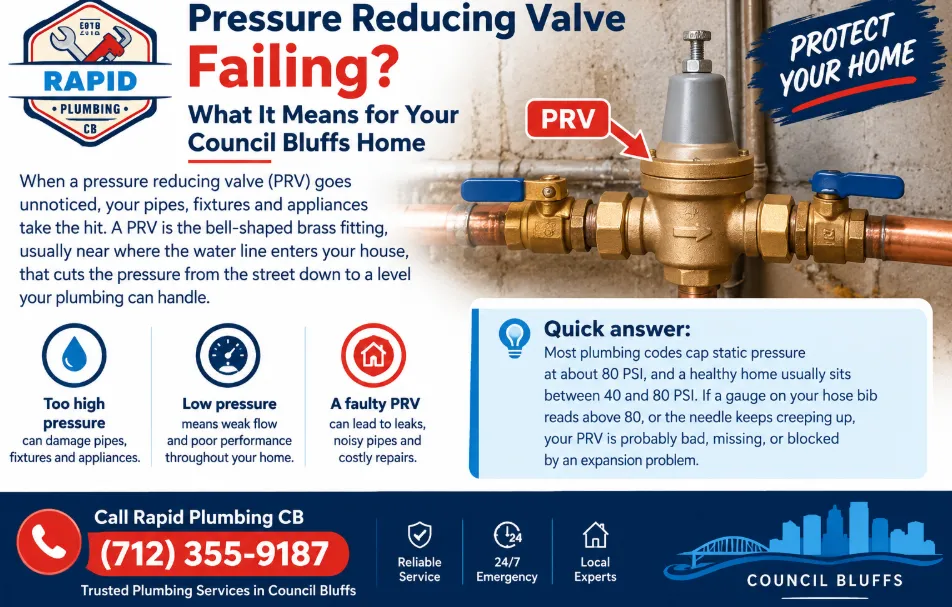
Pressure reducing valve failing Council Bluffs is a problem many homeowners only notice once pipes start banging or a fixture leaks. Left alone, your pipes, fixtures and appliances take the hit. A pressure reducing valve (PRV) is the bell-shaped brass fitting, usually near where the water line enters your house, that cuts the pressure coming from the street down to a level your plumbing can handle. When it wears out, the pressure inside the house can climb, surge, or swing up and down. Nothing warns you ahead of time. The symptoms below are usually the first clue.
This guide is for the opposite problem of weak flow. If your water barely trickles, read our guide on low water pressure in Council Bluffs instead. Here we cover water pressure that is too high, how to confirm it with a gauge, and what the fix looks like.
Think your pressure is too high?
Rapid Plumbing CB tests your pressure and replaces failing regulators in Council Bluffs.
Call (712) 355-9187What a Pressure Reducing Valve Does and Where to Find It
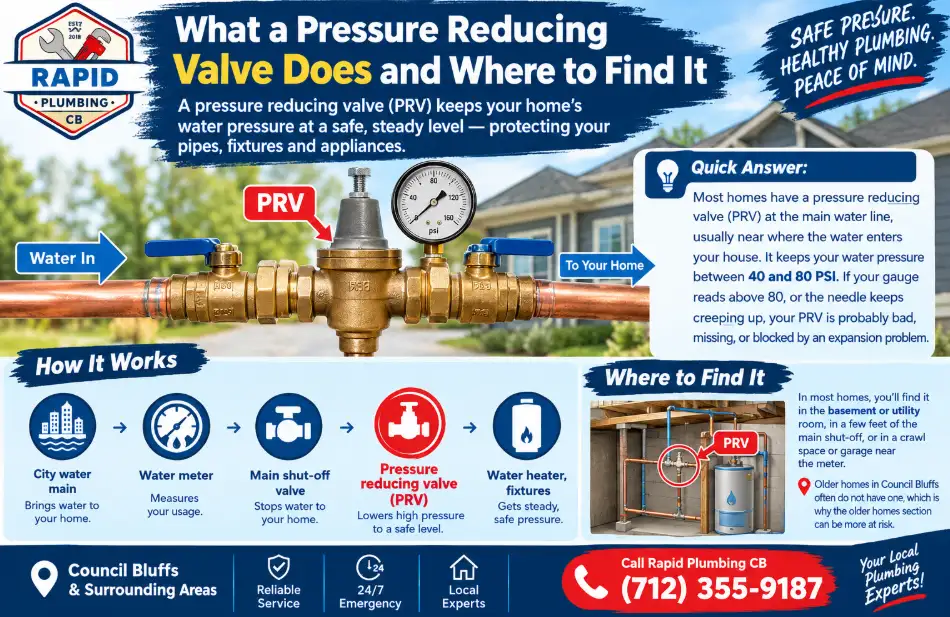
Water leaves the main under the street at a much higher pressure than a house needs. The PRV, also called a water pressure regulator, sits on your main line after the shut-off valve and reduces that pressure to a safe, steady level for every fixture. Inside is a spring and a rubber diaphragm that open and close a seat as demand changes.
In most homes you will find it in the basement or utility room within a few feet of the main shut-off, or in a crawl space or garage near the meter. If you cannot find one, your house may not have one. Older homes in Council Bluffs often do not, which we cover in the older homes section below. If your main shut-off itself is stuck, see what to do when a water shut-off valve is not working before you touch anything.
The water main in the street, the meter and the line up to the meter belong to the utility. Council Bluffs Water Works maintains the system and can be reached at (712) 328-1006. The PRV and everything after it is your side of the line. If you are not sure where the city’s responsibility ends, our guide to a water main break or yard leak in Council Bluffs explains who to call.
Signs of a Pressure Reducing Valve Failing (High Water Pressure Symptoms)
A failing PRV rarely stops working all at once. These are the symptoms to look for:
- Banging or hammering pipes. A knock in the wall when a faucet or appliance shuts off is a classic sign. Other things cause it too, so see common causes of noisy pipes to rule them out.
- Forceful, hard-to-control faucets. Water blasts out of the tap, splashes out of the sink, or the shower feels like a fire hose.
- Surging pressure. Strong flow when you first open a tap that then drops off, or pressure that swings from one minute to the next.
- Toilets that run or refill on their own. Excess pressure forces fill valves open. Compare with other common toilet problems.
- A water heater relief valve that drips. High or rising pressure can make the temperature and pressure relief valve weep. If you see water at the base, read about a water heater leaking from the bottom to tell the causes apart.
- Appliance hoses and fixture seals failing early. Washing machine hoses, dishwasher valves and faucet cartridges that keep wearing out point to pressure that is too high.
- Repeat leaks in different places. If you keep fixing one leak and another shows up, pressure may be the root cause. Read the signs of a hidden water leak as well.
- A water bill that creeps up with no change in how you use water.
A PRV can also fail in the other direction. A clogged or worn regulator can restrict flow, so showers lose pressure when someone runs a second fixture. If that sounds like your house, our low water pressure guide walks through those causes.
How to Test Your Water Pressure at Home
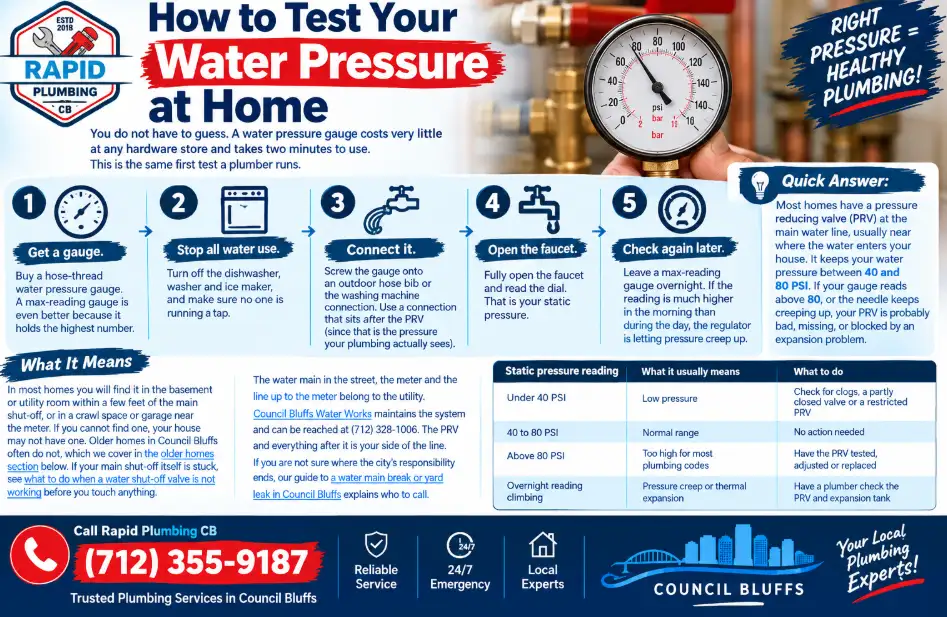
You do not have to guess. A water pressure gauge costs very little at any hardware store and takes two minutes to use. This is the same first test a plumber runs.
- Get a gauge. Buy a hose-thread water pressure gauge. A max-reading gauge is even better because it holds the highest number.
- Stop all water use. Turn off the dishwasher, washer and ice maker, and make sure no one is running a tap.
- Connect it. Screw the gauge onto an outdoor hose bib or the washing machine connection. Use a connection that sits after the PRV, since that is the pressure your plumbing actually sees.
- Open the faucet fully and read the dial. That is your static pressure.
- Check again later. Leave a max-reading gauge on overnight. If the reading is much higher in the morning than during the day, the regulator is letting pressure creep up.
| Static pressure reading | What it usually means | What to do |
|---|---|---|
| Under 40 PSI | Low pressure | Check for clogs, a partly closed valve or a restricted PRV |
| 40 to 80 PSI | Normal range | No action needed |
| Above 80 PSI | Too high for most plumbing codes | Have the PRV tested, adjusted or replaced |
| Overnight reading climbing | Pressure creep or thermal expansion | Have a plumber check the PRV and expansion tank |
Why a Pressure Reducing Valve Fails
- Age. The spring and diaphragm wear out. Many PRVs last roughly a decade, sometimes less, depending on the water and the brand.
- Mineral buildup and debris. Hard water scale or sediment from the line can stop the seat from sealing. A water softener in Council Bluffs helps protect the valve and every other fixture.
- A stuck or broken diaphragm. The regulator then lets full street pressure into the house.
- Thermal expansion. When a PRV or a backflow device closes the system, the heated water in your tank has nowhere to go and pressure spikes after a long shower. This is not always the PRV’s fault, but it looks the same. See our notes on a backflow preventer in Council Bluffs and ask about an expansion tank.
- Wrong setting or poor installation. A regulator set too high or installed after the wrong fitting never protects the house.
- High supply pressure. Homes in lower parts of town can receive more pressure from the main than homes on higher ground. The PRV has to work harder in those spots and wears faster.
The Fix: Adjust, Rebuild or Replace the Water Pressure Regulator
Once the gauge confirms the problem, a plumber works through these options:
1. Adjust the regulator
If the valve still works but is set too high, a small adjustment with a gauge attached brings it back to a safe level. Many homeowners aim for the 50 to 60 PSI zone, which is comfortable and kind to fixtures. Always follow the manufacturer’s instructions and watch the gauge while you adjust.
2. Replace the pressure reducing valve
If the reading will not come down, the pressure keeps creeping up, or the valve is leaking, replacement is the real answer. Water pressure regulator replacement usually means shutting off the main, cutting out the old unit, fitting a new one with the right unions and setting it with a gauge. Because it connects to your main supply, a mistake can flood a basement, which is why most homeowners hire a plumber.
3. Install one where none exists
If your gauge reads high and there is no PRV at all, adding one is one of the most protective upgrades you can make for the whole system. Pair it with an expansion tank where the setup needs one.
4. Deal with what the high pressure already damaged
Worn supply lines, leaking fixtures or a tired water heater may need work. If the pipes themselves are old and leaking in several places, read the signs you need whole-home repiping and see how whole-home repiping in Council Bluffs works. If the water heater is the problem, our water heater replacement guide explains your options.
Why Older Council Bluffs Homes Need to Check Their PRV
Many homes in older parts of Council Bluffs were built before pressure regulators were standard. Neighborhoods like Old Town and Downtown Council Bluffs have plenty of houses and buildings where the original plumbing has been patched over decades. If the house never had a PRV, or the one it has is original, a gauge test is worth doing the next time you are in the basement. Our guide to old house plumbing in Council Bluffs covers what else to check.
The same applies if you are buying. If a home inspection flags rattling pipes or leaky fixtures, ask about the pressure. Our service area includes neighborhoods across Council Bluffs, and a pressure test is part of what we look at on a regular visit. Seasonal checks matter too, so use our Council Bluffs weather plumbing checklist each fall.
Get your water pressure tested today
Fast diagnosis, upfront pricing and a pressure reducing valve that is set correctly.
Call (712) 355-9187 Request service onlinePressure Reducing Valve Failing Council Bluffs: Frequently Asked Questions
How do I know if my pressure reducing valve is bad?
Hammering pipes, surging or very forceful water, running toilets, a dripping water heater relief valve and early fixture failures all point to a pressure reducing valve failing. The only sure test is a gauge reading above 80 PSI, or a reading that creeps up overnight.
What is a normal water pressure for a house?
Most homes run well between 40 and 80 PSI. Many plumbers like to set the regulator in the 50 to 60 PSI range.
How long does a pressure reducing valve last?
Many last about 10 years, though hard water, debris and high street pressure can shorten that. If yours is original in an older house, it is worth testing.
Can I replace a PRV myself?
It is possible, but it ties into your main water line, so a bad cut or a wrong fitting can cause flooding. Most homeowners hire a plumber for water pressure regulator replacement.
Is the pressure reducing valve my responsibility or the city’s?
Council Bluffs Water Works maintains the main and the line up to the meter. The PRV sits on your side, so you maintain and replace it.
What if my house has high pressure but no PRV?
Have a plumber install one. Add an expansion tank if the system needs one so thermal expansion does not push pressure back up.
Need a Plumber for High Water Pressure in Council Bluffs?
If your pipes bang, your faucets blast, or your gauge reads above 80 PSI, do not wait for a burst pipe to prove the point. Rapid Plumbing CB, 112 S 18th St, Council Bluffs, IA 51501, tests pressure, replaces failing regulators and handles the repairs that follow. Browse our full list of plumbing services in Council Bluffs, or call now.
Related guides