
🚰 WATER QUALITY GUIDE · COUNCIL BLUFFS, IA
Council Bluffs Water Quality Guide: What the 2025 CBWW Report Means for Your Plumbing
Real numbers from Council Bluffs Water Works’ own 2025 report — not a guess, not a generic “hard water is common here” line.
Quick answer: Council Bluffs water quality guide is safe to drink and meets every federal standard, but it’s also genuinely hard water — 160-173 mg/L of hardness straight from Council Bluffs Water Works’ 2025 report, roughly 9-10 grains per gallon. That’s the single biggest reason local water heaters and fixtures wear out faster here than in a soft-water city.
Search “Council Bluffs water quality” and most results tell you the same thing: the water is hard, it’s safe, move on. What they don’t show you is the actual data. Council Bluffs Water Works (CBWW) publishes a detailed annual report with real hardness, chlorine, and pH readings from its two treatment plants — and as a licensed plumber working on Council Bluffs homes every week, that report is exactly what we use to explain why a customer’s water heater is scaling up faster than the manual says it should.
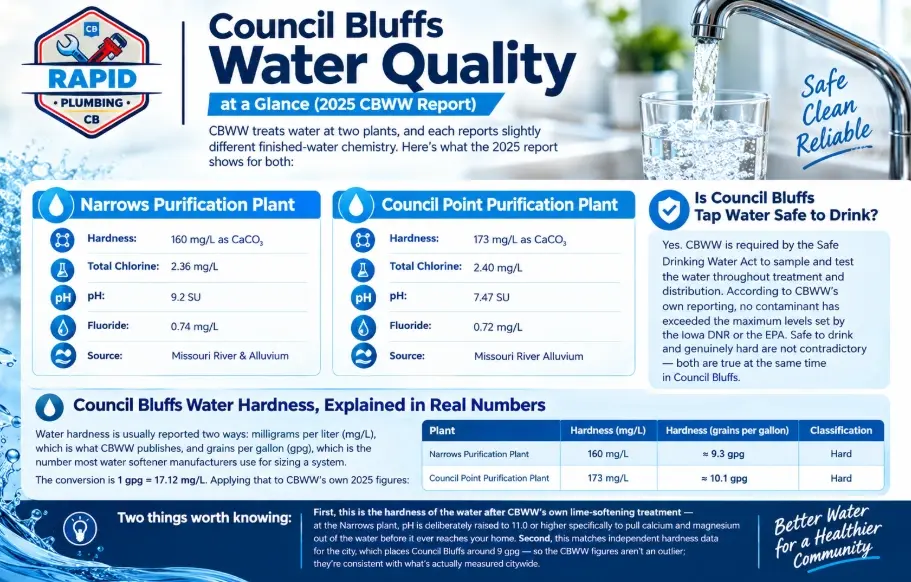
Council Bluffs Water Quality at a Glance (2025 CBWW Report)
CBWW treats water at two plants, and each reports slightly different finished-water chemistry. Here’s what the 2025 report shows for both:
💧 Narrows Purification Plant
Hardness: 160 mg/L as CaCO3
Total Chlorine: 2.36 mg/L
pH: 9.2 SU
Fluoride: 0.74 mg/L
Source: Missouri River & Alluvium
💧 Council Point Purification Plant
Hardness: 173 mg/L as CaCO3
Total Chlorine: 2.40 mg/L
pH: 7.47 SU
Fluoride: 0.72 mg/L
Source: Missouri River Alluvium
Is Council Bluffs Tap Water Safe to Drink?
Yes. CBWW is required by the Safe Drinking Water Act to sample and test the water throughout treatment and distribution around the clock, with additional testing at a state-approved laboratory for more than 80 contaminants. According to CBWW’s own reporting, no contaminant has exceeded the maximum levels set by the Iowa Department of Natural Resources or the EPA. Safe to drink and genuinely hard are not contradictory — both are true at the same time in Council Bluffs.
Council Bluffs Water Hardness, Explained in Real Numbers
Water hardness is usually reported two ways: milligrams per liter (mg/L), which is what CBWW publishes, and grains per gallon (gpg), which is the number most water softener manufacturers use for sizing a system. The conversion is 1 gpg = 17.12 mg/L. Applying that to CBWW’s own 2025 figures:
| Plant | Hardness (mg/L) | Hardness (grains per gallon) | Classification |
|---|---|---|---|
| Narrows Purification Plant | 160 mg/L | ≈ 9.3 gpg | Hard |
| Council Point Purification Plant | 173 mg/L | ≈ 10.1 gpg | Hard |
Two things worth knowing: first, this is the hardness of the water after CBWW’s own lime-softening treatment — at the Narrows plant, pH is deliberately raised to 11.0 or higher specifically to pull calcium and magnesium out of the water before it ever reaches your home. Second, this matches independent hardness data for the city, which places Council Bluffs around 9 gpg — so the CBWW figures aren’t an outlier, they’re consistent with what’s actually measured citywide.
What Hard Water Actually Does to Your Plumbing
At 9-10 gpg, the effects show up gradually, not overnight:
- Water heater tanks scale up faster. Calcium and magnesium settle at the bottom of the tank, insulating the burner or element from the water and forcing it to work harder to heat the same amount of water.
- Fixtures and faucet aerators clog with mineral deposits over months, not years.
- Glassware, shower doors, and dishes develop cloudy mineral spots even after a rinse cycle.
- Soap and detergent lather less, so cleaning takes more product to do the same job.
- Pipes accumulate scale internally over years, gradually reducing water flow.
This is also exactly why we see more water heater sediment flush calls in Council Bluffs than in cities with naturally soft water — see our guide on how often you should flush your water heater for the schedule we recommend given local hardness.
Tired of Scale Buildup at 9-10 Grains Per Gallon?
Get a water softener sized correctly for Council Bluffs’ actual hardness — not a generic estimate
Get a Free Softener QuoteChlorine and pH: What the Rest of the Report Means
CBWW’s 2025 figures show total chlorine at 2.36-2.40 mg/L, used to disinfect the water supply through the distribution system and keep it safe from bacteria and other pathogens. That’s within EPA-allowed limits, but it’s on the higher end of what people notice by smell or taste straight from the tap. If your water has a distinct chlorine smell or, alternately, a rotten-egg odor that isn’t chlorine at all, that’s usually a different issue — see our guide on why your water might smell like sulfur to tell the two apart. Fluoride sits at 0.72-0.74 mg/L, maintained for dental health, and the Narrows plant’s high pH (9.2) is a direct result of the lime-softening process described above, not a water quality concern on its own.
Where Council Bluffs Gets Its Water
CBWW draws primarily from the Missouri River, with the Missouri River Alluvium used as an alternate source as conditions require. Both plants run a conventional lime-softening treatment train: intake screening, coagulation, two-stage flocculation and clarification to precipitate out calcium and magnesium, filtration through sand and granular activated carbon, chlorine disinfection, and finally fluoridation before the water is distributed to homes across the city. It’s a genuinely thorough process — it just can’t remove all of the hardness before the water reaches your tap.
What Council Bluffs Homeowners Should Actually Do About It
- If you don’t have a softener, it’s worth sizing one against these real numbers. At 9-10 gpg, a properly sized system is one of the highest-value upgrades for protecting a water heater long-term. See our Council Bluffs water softener installation guide for how sizing, cost, and installation work locally.
- Flush your water heater on a schedule that matches local hardness, not a generic manufacturer default — our water heater flush guide covers what we recommend for Council Bluffs homes specifically.
- If you’re chasing better-tasting drinking water on top of whole-home softening, compare your options in our reverse osmosis vs. water filter comparison.
- Watch for early sediment symptoms — reduced hot water pressure, longer heating times, or popping and rumbling sounds from the tank. If you’re already seeing these, our no hot water troubleshooting guide walks through diagnosis, and our signs your water heater is about to fail guide covers what to check on an aging unit.
Not Sure If It’s Time for a Water Heater Flush or a Repair?
See real Council Bluffs pricing before you decide
See Water Heater Repair PricingSeeing Scale Buildup or a Water Heater Working Overtime?
Free assessment for softener sizing and water heater service across Council Bluffs, IA
📞 Call (712) 355-9187 Request Service OnlineFrequently Asked Questions
Is Council Bluffs tap water safe to drink?
Yes. Council Bluffs Water Works’ own reporting confirms the water meets Safe Drinking Water Act requirements, and samples are tested regularly for more than 80 contaminants with no exceedances of state or federal limits.
Is Council Bluffs water hard or soft?
It’s hard water. CBWW’s 2025 report shows finished water hardness of 160 mg/L at the Narrows plant and 173 mg/L at Council Point, which converts to roughly 9.3 to 10.1 grains per gallon — and that’s after the utility’s own lime-softening treatment.
Why does my water leave spots on dishes and glasses in Council Bluffs?
That’s hard water mineral residue — calcium and magnesium left behind as water evaporates, consistent with CBWW’s reported hardness levels.
Do I need a water softener in Council Bluffs?
Given hardness in the 9 to 10 grains-per-gallon range citywide, most Council Bluffs homes benefit from a softener, mainly to protect the water heater and extend the life of fixtures and appliances.
Where does Council Bluffs get its drinking water?
From the Missouri River and the Missouri River Alluvium, treated at CBWW’s Narrows and Council Point purification plants using a conventional lime-softening process before it’s distributed to homes.
Source: Council Bluffs Water Works, 2025 Water Quality Facts and Figures (Narrows Purification Plant & Council Point Purification Plant). CBWW operates under the oversight of the City of Council Bluffs‘ Board of Water Works Trustees. mg/L-to-gpg conversions calculated at 1 gpg = 17.12 mg/L. This guide reflects the utility’s published annual figures; hardness and chlorine levels can vary slightly by season and location within the distribution system.


Dealing with hard water at home? A whole-house softener is the usual fix. See water softener installation in Council Bluffs.