What Pipe Lining Contractors Council Bluffs Trenchless Repair Actually Do (And How It Differs From Repiping)
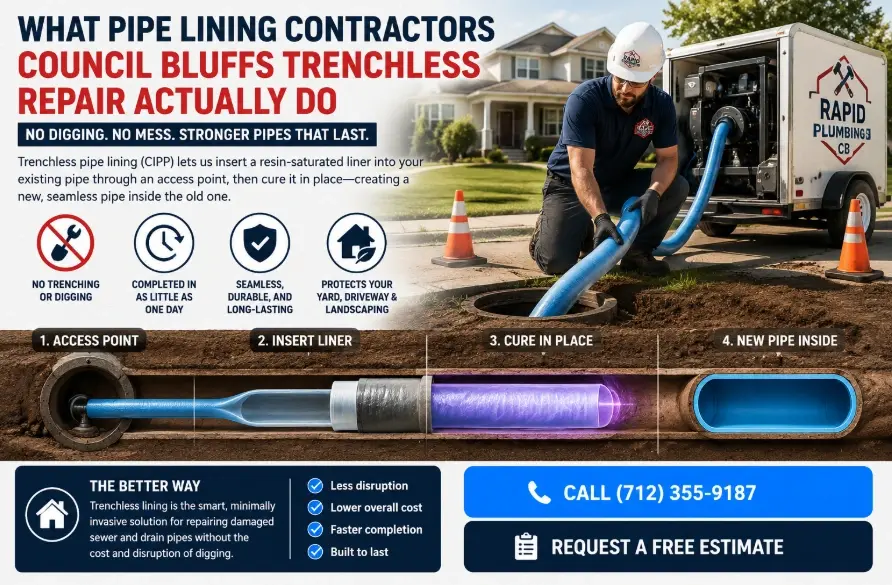
If you’ve searched for pipe lining contractors, you’re probably weighing an alternative to tearing up your yard, basement floor, or driveway to replace a damaged pipe. Trenchless pipe lining — also called CIPP, or cured-in-place pipe — lets a plumber insert a resin-saturated liner into your existing pipe through an access point like a cleanout, then cure it in place to form a new, seamless pipe inside the old one. No trenching, no jackhammering a slab, and in many cases the whole repair is done in a single day. It’s a different tool than a full repipe: our whole-home repiping guide covers when your entire supply system needs replacing, while this guide focuses specifically on lining a damaged drain or sewer line without digging it up.
How Pipe Lining Contractors Council Bluffs Trenchless Repair Works, Step by Step
- Camera inspection first. A plumber runs a sewer camera through the line to confirm the pipe is a good candidate — lining works well for cracks, small holes, root intrusion, and corrosion, but not for pipes that are collapsed or badly offset at the joints.
- Cleaning the existing pipe. The line is hydro-jetted clean of scale, roots, and debris so the new liner can bond properly to the pipe wall.
- Inserting the liner. A flexible, resin-saturated liner is fed into the pipe through an existing access point — usually a cleanout, so there’s no need to dig down to the pipe itself.
- Inflating and curing. The liner is inflated against the old pipe wall and cured using heat, UV light, or ambient air, depending on the resin system, forming a smooth new pipe inside the original one.
- Final camera inspection. A last camera pass confirms the liner cured correctly and the line is clear and structurally sound.
Liners generally come in two resin types: epoxy, which cures faster and is common for smaller residential lines, and cementitious lining, a cement-based liner often used on larger-diameter or structurally rougher pipe where extra rigidity helps. Both are no-dig, no-trench methods — the right one depends on the pipe’s size, material, and condition, which is exactly what the initial camera inspection helps determine.
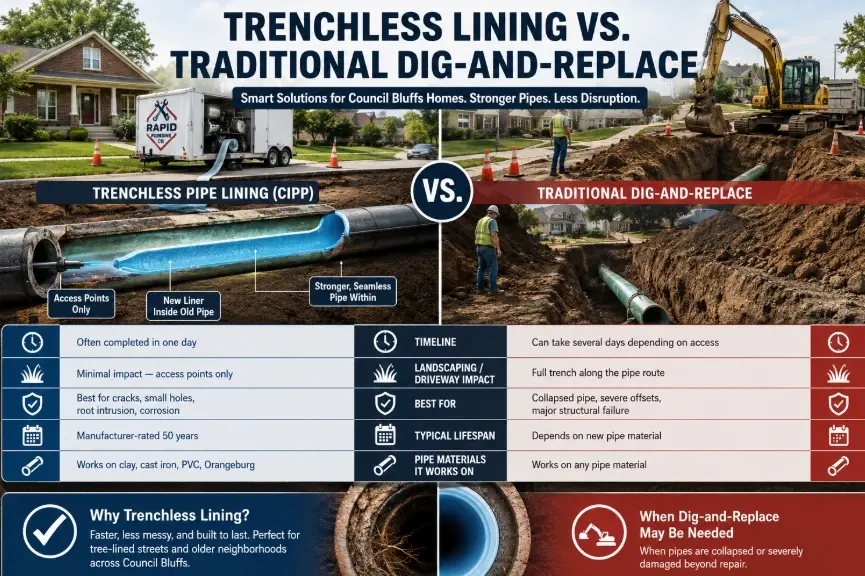
Trenchless Lining vs. Traditional Dig-and-Replace
| Factor | Trenchless Lining | Traditional Dig-and-Replace |
|---|---|---|
| Timeline | Often completed in one day | Can take several days depending on access |
| Landscaping/driveway impact | Minimal — access points only | Full trench along the pipe route |
| Best for | Cracks, small holes, root intrusion, corrosion | Collapsed pipe, severe offsets, major structural failure |
| Typical lifespan | Manufacturer-rated 50 years | Depends on new pipe material |
| Pipe materials it works on | Clay, cast iron, PVC, Orangeburg | Any |
Council Bluffs has a lot of older neighborhoods still running clay and Orangeburg sewer laterals, and lining is often the fastest, least disruptive fix for a pipe that’s cracked or root-invaded but still structurally intact. Our tree roots in sewer lines guide covers how root intrusion happens in the first place and why it’s such a common issue in the area’s older, tree-lined blocks.
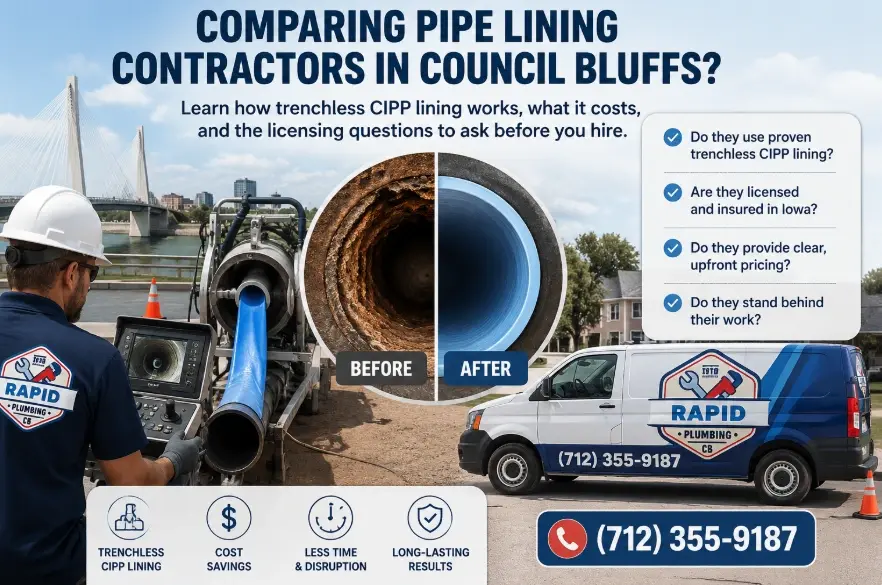
What to Ask Before You Hire Pipe Lining Contractors Council Bluffs Trenchless Repair
Not every plumbing company offers trenchless lining, and not every contractor who does is equally qualified. Before signing off on the work, ask:
- Is the technician certified on the specific lining system being used? CIPP resin systems have manufacturer training and certification requirements.
- Will a camera inspection happen both before and after the lining? A reputable contractor documents the pipe condition going in and confirms the cure came out clean.
- What’s the warranty on the liner itself? Most quality liner systems carry a long-term structural warranty — ask for it in writing.
- Is the contractor licensed to work in Iowa, and will the work be pulled under a proper City permit if it involves the public sewer main or right-of-way?
- Does the quote include the pre-cleaning (hydro-jetting) needed before lining? Skipping this step is a common corner-cutting red flag.
Our licensed vs. unlicensed plumber risks guide covers why these credential questions matter well beyond just lining work — an uninsured or uncertified installer voids most liner manufacturer warranties outright.
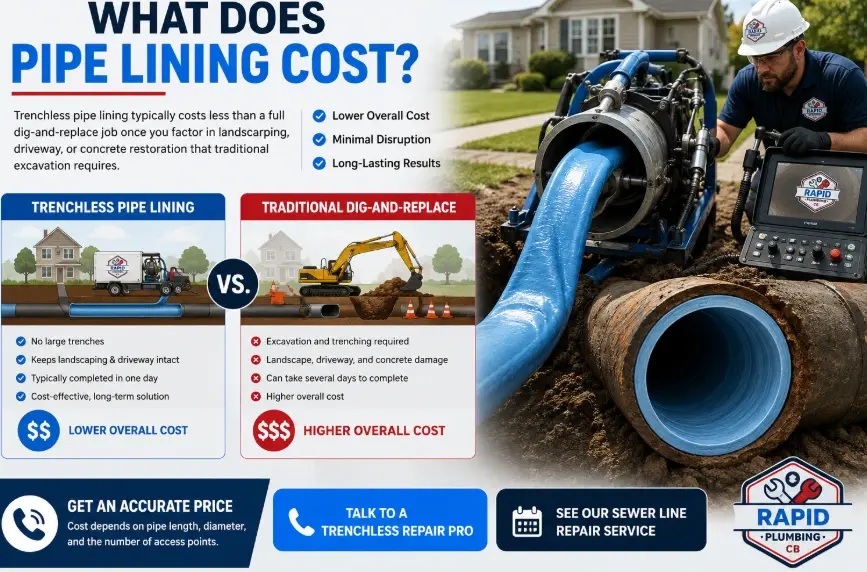
What Does Pipe Lining Cost?
Trenchless lining typically costs less than a full dig-and-replace job once you factor in landscaping, driveway, or concrete restoration that traditional excavation requires — though the exact number depends on pipe length, diameter, and how many access points are needed. For a full breakdown of pricing factors on the sewer side, see our sewer line repair cost guide, and if a camera inspection reveals damage severe enough that lining isn’t an option, our sewer line repair service covers what full replacement involves instead.
Council Bluffs Permitting & Right-of-Way Resources
Frequently Asked Questions
What do pipe lining contractors actually do?
They insert a resin-saturated liner into an existing damaged pipe through an access point, then cure it in place to form a new structural pipe inside the old one — without digging up the yard, driveway, or floor.
Is trenchless pipe lining as durable as pipe replacement?
Quality CIPP liner systems typically carry manufacturer ratings around 50 years, comparable to many new pipe materials, as long as the underlying pipe is a good candidate (cracked or corroded but not collapsed).
How do I know if my pipe qualifies for lining instead of replacement?
A camera inspection is the only reliable way to tell. Lining works well for cracks, small holes, root intrusion, and corrosion. Collapsed sections or badly offset joints usually still need traditional dig-and-replace.
Does pipe lining work on old clay or Orangeburg pipe?
Yes — lining is a common fix for clay, cast iron, PVC, and Orangeburg pipe, which is especially relevant in Council Bluffs’ older neighborhoods where these materials are still common in sewer laterals.
Do I need a permit for trenchless pipe lining in Council Bluffs?
Work on your private lateral generally doesn’t require the same permitting as excavation in the public right-of-way, but any work connecting to or affecting the public sewer main should be coordinated with the City. Your contractor should handle this coordination as part of the job.