Lead Service Line Council Bluffs: What It Is and Why It Matters
If your home was built before 1986, or you have seen the words “lead service line” in a utility notice, you probably have questions. A lead service line is the pipe that carries water from the city main into your home. Lead was common in these pipes for decades. It can release lead into drinking water, especially when water sits in the pipe overnight. For homeowners searching for lead service line Council Bluffs answers, this guide explains who owns each part of the pipe, how to find out what material you have, and what the current replacement work means.
Who Owns the Lead Service Line in Council Bluffs?
The water line is split into two parts at the curb stop, the shutoff valve near the property line. Council Bluffs Water Works owns the section from the water main to the curb stop. You own the section from the curb stop into your home. Water Works has said the homeowner section typically does not contain lead in Council Bluffs, so the utility’s replacement work focuses on its own piping.
Ownership questions can get confusing when a leak or repair is involved. Our water service line replacement guide for Council Bluffs covers the full split, including which side of a leak belongs to whom.
What Council Bluffs Water Works Is Replacing
For each lead service line Council Bluffs Water Works is responsible for, the utility has kept records of service line materials since the 1880s, and it reports a relatively good inventory of its lead lines. The city banned lead service lines in 1959. The lines that remain are concentrated in older neighborhoods with older homes.
Federal rules now push every water system toward removing lead pipe. Iowa DNR explains that the Lead and Copper Rule Improvements require water systems to identify and replace lead pipes within 10 years, with a compliance date of November 1, 2027. You can read the state’s own explanation on the Iowa DNR lead service line inventories page.
Water Works has contacted about 250 homeowners to gauge interest in a replacement project. Interest has generally been low, and cost is the main concern. For background on the city’s recent projects, see this Iowa Environmental Council article on Council Bluffs community projects. For official city information, visit the City of Council Bluffs website.
How to Check Whether Your Pipe Is Lead
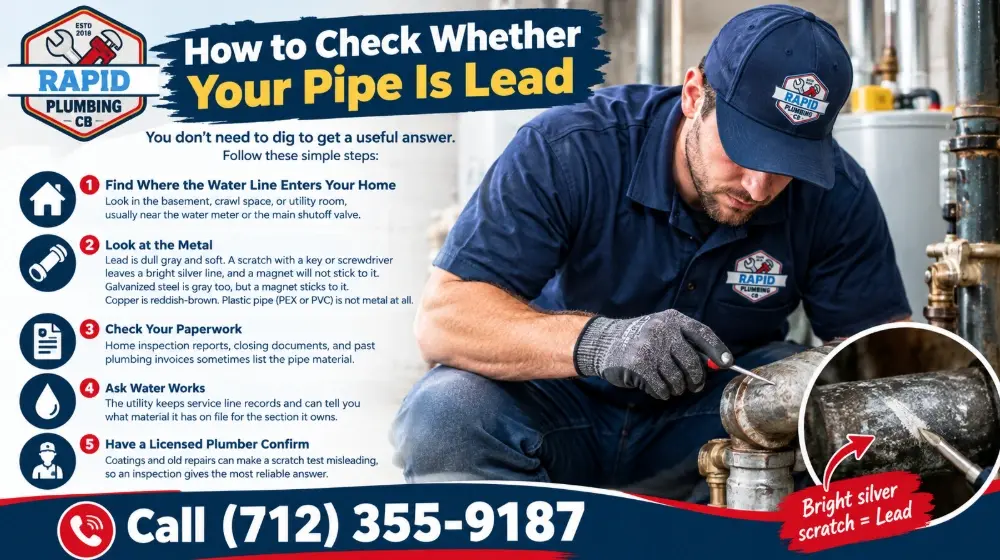
You do not need to dig to get a useful answer. Work through these steps in order:
- Find where the water line enters your home. Look in the basement, crawl space, or utility room, usually near the water meter or the main shutoff valve.
- Look at the metal. Lead is dull gray and soft. A scratch with a key or screwdriver leaves a bright silver line, and a magnet will not stick to it. Galvanized steel is gray too, but a magnet sticks to it. Copper is reddish-brown. Plastic pipe (PEX or PVC) is not metal at all.
- Check your paperwork. Home inspection reports, closing documents, and past plumbing invoices sometimes list the pipe material.
- Ask Water Works. The utility keeps service line records and can tell you what material it has on file for the section it owns.
- Have a licensed plumber confirm. Coatings and old repairs can make a scratch test misleading, so an inspection gives the most reliable answer.
Checking the pipe and testing your water are two different steps. A certified lab can test your tap water for lead, and that result tells you what is coming out of the faucet, not what the pipe is made of.
Not sure what material is in your home?
A licensed plumber can check the pipe where it enters your home, explain your options, and tell you what work is on your side of the curb stop.
Call (712) 355-9187 Request a Pipe InspectionReplacing a Lead Line: What Is Involved and Who Pays
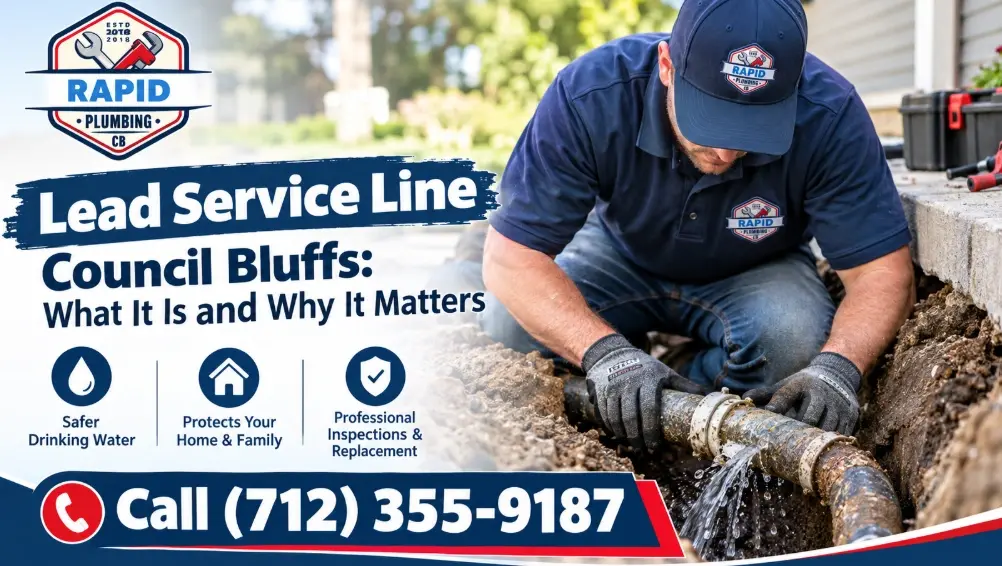
Replacing a lead service line usually means excavating the line from the main to the house and installing new non-lead piping. Work on your side often happens alongside the utility’s work, so the two projects should be coordinated.
Funding is the biggest question for most homeowners. Iowa’s State Revolving Fund offers lead line loans at 0% interest. Under the federal infrastructure law, 49% of these loans can be forgiven for disadvantaged communities. The remaining 51% must be paid by the utility or the homeowner. Ask Water Works whether your line is part of a funded project and what your share would be before you agree to anything.
If you find lead in your home, use only cold tap water for drinking, cooking, and baby formula, and run the cold tap for a few minutes before use if the water has been sitting. Lead can also appear in older solder and some brass fixtures, so a plumber can check those as part of the same visit.
Lead Service Line Council Bluffs FAQs
How do I know if my water service line is lead?
Check your home’s records, ask Water Works what it has on file, or have a licensed plumber inspect the pipe where it enters your home. A scratch test helps, but it is not a full inspection.
Who owns the lead service line in Council Bluffs?
Council Bluffs Water Works owns the section from the water main to the curb stop. You own the section from the curb stop to your home.
Is lead still allowed in water service lines?
No. Council Bluffs banned lead service lines in 1959, and federal law banned lead pipe in new water lines in 1986.
Who pays to replace a lead service line?
It depends on the program. Loans carry 0% interest, but the utility or the homeowner pays the share that is not forgiven. Confirm your share with Water Works first.
Next Steps for Council Bluffs Homeowners
Start by identifying your pipe material, then decide what to do on your side of the curb stop. If your home also has aging supply lines, our guide to signs you need whole-home repiping explains when a full repipe makes sense. Homes built in older eras often have additional issues, so the plumbing guide for older Council Bluffs houses is also worth reading. For local water conditions that affect pipe wear, see the Council Bluffs water quality guide.
If you think water is coming from the lead line, a failed shutoff valve, or a leak near the meter, read our note on a water shut-off valve that is not working. For urgent leaks, contact our emergency plumber team in Council Bluffs.
Rapid Plumbing CB helps Council Bluffs homeowners find out what is in their pipes and what their options are. You can review our plumbing services or call us today.
Ready to check your water line?
Call Rapid Plumbing CB for a straightforward look at your pipe and your options.
Call (712) 355-9187 Book Online