
🌦️ SEASONAL PLUMBING · COUNCIL BLUFFS, IA
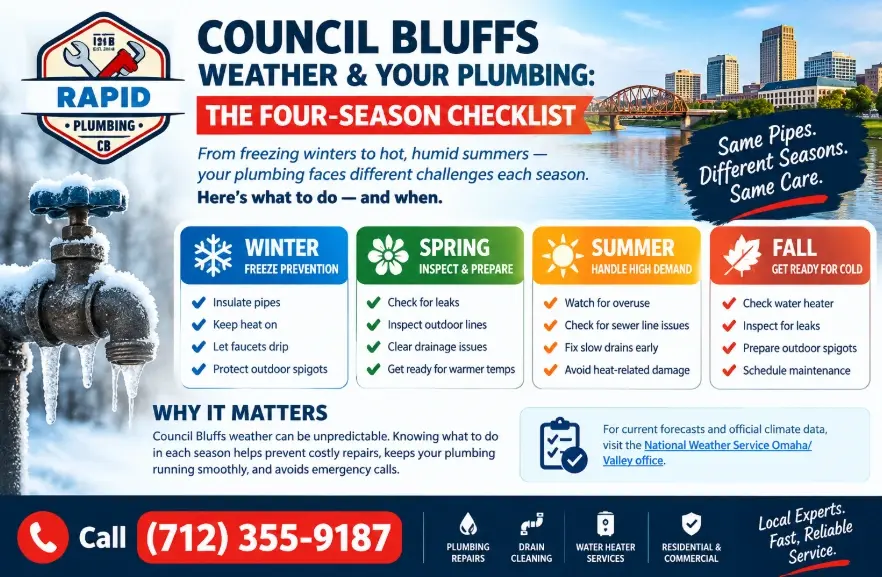
Council Bluffs Weather & Your Plumbing: The Four-Season Checklist
Sub-zero winters, Missouri River spring thaws, and summer downpours each attack your plumbing differently. Here’s what to do — and when.
Quick answer: Council Bluffs weather hits plumbing in a predictable cycle — winter freezes pipes and stresses water heaters, spring thaw and river-season rain push sump pumps to their limit, summer storms overload sewer lines, and fall is your window to prepare for all of it. Do the right task in the right season and most emergency calls never happen.
Search “Council Bluffs weather” and you get forecasts. What you don’t get is what that weather actually does to the pipes, pumps, and drains in your home. In a city that swings from sub-zero January nights to 100-degree summer highs — and sits beside the Missouri River — council bluffs weather plumbing problems follow a pattern we see every year on service calls. This checklist walks through that pattern, season by season, with local numbers and the specific fixes that prevent each problem.
Council Bluffs Weather by the Numbers
These long-term figures explain why the region is hard on plumbing:
| Measure | Council Bluffs, IA (approx.) | Plumbing impact |
|---|---|---|
| Average January low | Mid-teens °F (about 14-17°F) | Pipes in unheated spaces can freeze during extended cold |
| Record cold | About −23°F (most recently Feb. 16, 2021) | Even “protected” lines and outdoor spigots are tested |
| Annual snowfall | Roughly 26 inches | Snowmelt feeds spring water-table rise |
| Annual rainfall | Roughly 32 inches | Peaks late spring through summer storms |
| Wettest single day on record | Over 6 inches (6.46 in., Aug. 7, 1999) | Overloaded sewers, flooded basements |
| Typical July high | Mid-to-upper 80s °F (records above 100°F) | Peak water demand, hose-bib and irrigation stress |
For current forecasts and official climate data, the National Weather Service Omaha/Valley office covers Council Bluffs. Figures above are long-term approximations — always check the forecast before a hard freeze or a heavy-rain week.
Winter: Preventing Frozen Pipes in Council Bluffs
December through March is when frozen pipes in Council Bluffs happen — especially in older homes, on exterior walls, in crawl spaces, garages, and basements near foundation walls. A frozen pipe rarely announces itself: the first sign is often a trickle instead of a flow, or frost on an exposed pipe. Follow this checklist before the first hard freeze:
- Find your main shut-off valve and test it. If it’s stuck, our guide on a water shut-off valve that isn’t working explains what to do before an emergency.
- Insulate exposed pipes in unheated areas and seal drafts near where lines enter the house.
- Open cabinet doors on exterior walls during extreme cold so house heat reaches the pipes, and keep the thermostat at a steady 55°F or higher even when away.
- Let a faucet drip on the coldest nights — moving water resists freezing.
- Disconnect hoses and shut off exterior faucets before the first freeze.
- Check your water heater — winter is its hardest season. See our Council Bluffs water heater winter tips.
For the full cold-weather playbook, read our detailed guide on how to prepare your plumbing for Iowa and Nebraska winters.
⚠️ If a Pipe Freezes or Bursts
Shut off the main water valve, open the affected faucet, and never use a torch or open flame to thaw a pipe. Call a licensed plumber immediately — our emergency plumber guide explains what happens on a call.
Frozen Pipe or No Water This Winter?
24/7 emergency plumbers across Council Bluffs, IA
Get Emergency Plumbing HelpSpring Thaw: Sump Pumps and Missouri River Season
As snow melts and April rain arrives, the water table rises — and the spring thaw sump pump workload begins. The City of Council Bluffs lists major floods in 1952, 1967, 1984, 1993, 1997, 2011, 2019, and 2024, and its levee system protects the city from the river, but it does not lower groundwater under your home. That’s why basements near the river and its creeks can still take on water even when the levee holds. Our full local breakdown is in the sump pump guide for homes near the Missouri River.
- Test your pump in March — before the water table climbs. See how to test your sump pump.
- Clear the discharge line of winter ice and debris — a frozen or clogged discharge line can defeat a working pump.
- Add a battery backup — spring storms cause outages exactly when you need the pump. Learn about a sump pump battery backup.
- Check for slow leaks that winter freezes may have started — see signs of a hidden water leak.
Is Your Sump Pump Ready for Spring?
Testing, repair, and battery backup installation in Council Bluffs
Book Sump Pump ServiceSummer Storms: Preventing Sewer Backups in Council Bluffs
Council Bluffs summers bring warm, wet weather and intense thunderstorms — the area has recorded more than six inches of rain in a single day. When storms overload the system, a private sewer line that’s already narrowed by tree roots or grease is the first to back up into a basement floor drain. Knowing which part of the system is yours matters: read our guide on city vs. homeowner sewer responsibility in Council Bluffs, and see the City of Council Bluffs Public Works page for the city’s side.
- Schedule a camera inspection before storm season — a sewer camera inspection shows roots, cracks, and belly spots before they fail.
- Know the warning signs of a basement floor drain backup — gurgling, slow drains, or sewer odor.
- Deal with roots early — see tree roots in sewer lines.
- Keep wipes and grease out of drains — the City itself asks residents not to flush wipes, even “flushable” ones.
Fall: Your Best Window to Prepare for the Year Ahead
September through early November is the easiest, cheapest time to do plumbing maintenance — before cold arrives and before service calls spike. Council Bluffs’ hard water makes the water heater the priority: the utility’s own report shows hardness around 160-173 mg/L (see our Council Bluffs water quality guide), which builds sediment in tanks.
- Flush your water heater — see how often to flush a water heater in Council Bluffs, and watch for the signs your water heater is about to fail.
- Learn the gas basics before heating season — read what a gas leak smells like so you can react instantly.
- Disconnect hoses, drain exterior faucets, and insulate exposed lines.
- If hot water fails on the first cold night, our no hot water troubleshooting guide covers the fixes to try first.
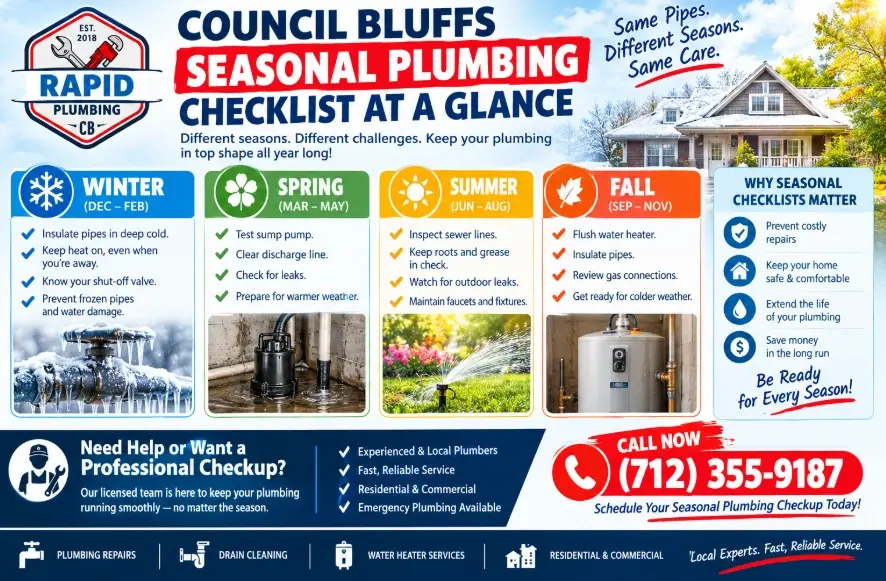
Council Bluffs Seasonal Plumbing Checklist at a Glance
❄️ Winter (Dec-Feb)
Insulate pipes, drip faucets in deep cold, keep heat on, know your shut-off valve.
🌱 Spring (Mar-May)
Test sump pump, clear discharge line, add battery backup, check for freeze damage.
⛈️ Summer (Jun-Aug)
Camera-inspect sewer line, watch floor drains, keep roots and grease in check.
🍂 Fall (Sep-Nov)
Flush water heater, drain exterior faucets, insulate pipes, review gas safety.
Not sure where your home stands? Our licensed team serves every neighborhood in the city — see our Council Bluffs service areas, including Downtown Council Bluffs, or browse our full plumbing services. If you’d rather have a pro look at your system, searching for a plumber near you in Council Bluffs ends here.
Want a Pro to Walk Your Home Through the Seasonal Checklist?
Licensed, insured, and local to Council Bluffs, IA
📞 Call (712) 355-9187 Request Service OnlineFrequently Asked Questions
When do pipes freeze in Council Bluffs?
Council Bluffs winters bring January lows in the mid-teens on average, with cold snaps well below zero — the record low is about -23°F, most recently reached in February 2021. Pipes in unheated spaces such as exterior walls, crawl spaces, garages, and basements near foundation walls are at the highest risk from December through March.
Why does my sump pump run more in spring in Council Bluffs?
Snowmelt plus spring rain raises the local water table, especially for homes near the Missouri River and its tributaries. The City of Council Bluffs lists major floods in 1952, 1967, 1984, 1993, 1997, 2011, 2019, and 2024. A tested sump pump with battery backup is the best protection.
Can summer storms cause sewer backups in Council Bluffs?
Yes. Heavy summer downpours — the area has recorded single-day rainfall above six inches — can overload sewer lines, and tree roots and grease already narrowing a private sewer lateral make backups more likely. A camera inspection before storm season shows whether your line is at risk.
What plumbing maintenance should I do in fall in Council Bluffs?
Disconnect and drain outdoor hoses, shut off and drain exterior faucets, flush the water heater to remove hard-water sediment, test your sump pump and clear its discharge line, and insulate exposed pipes before the first hard freeze.
What should I do if a pipe freezes or bursts?
Shut off the main water valve immediately, open the affected faucet, and never use an open flame to thaw the pipe. If a pipe has burst or you cannot find the frozen section, call a licensed plumber right away.
Sources: National Weather Service Omaha/Valley (official forecasts and climate data); City of Council Bluffs — Council Bluffs Levees (major flood years, levee system); City of Council Bluffs Public Works; Council Bluffs Water Works — Water Quality (2025 hardness figures). Climate averages and records are approximate long-term values compiled from published NOAA-derived summaries; confirm current conditions with the National Weather Service. For questions about your water service line or curb stop, contact Council Bluffs Water Works.
Licensed, insured, and local to Council Bluffs, IA
📞 Call (712) 355-9187 Request Service Online