(712) 355-9187 — Deciding between a gas or electric water heater for your Council Bluffs home? Here’s a straight, local answer on cost, installation, and which one actually fits your house.
Gas vs Electric Water Heater Council Bluffs: Which Is Right for Your Council Bluffs Home?
If you’re replacing an aging unit or building new, the gas vs electric water heater Council Bluffs decision is one of the first forks in the road — and it’s a different question than tank vs. tankless or which brand to buy. Fuel type affects your upfront installation cost, your monthly utility bill, how fast you get hot water back after a full house of showers, and whether your home even has the infrastructure to support one option over the other.
Most Council Bluffs homes already lean one way or the other simply because of what’s already run to the mechanical room — a gas line and vent stack, or a 240-volt electrical circuit. Switching fuel types is possible, but it isn’t free, and that’s exactly where this decision gets confusing. Below, we break down the real differences for a Pottawattamie County home, not just national averages.
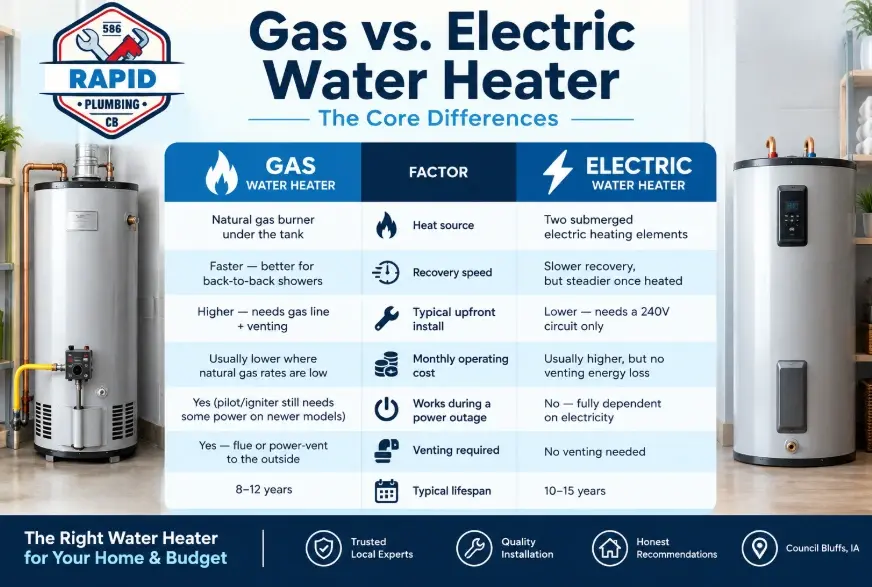
Gas vs. Electric Water Heater: The Core Differences
| Factor | Gas Water Heater | Electric Water Heater |
|---|---|---|
| Heat source | Natural gas burner under the tank | Two submerged electric heating elements |
| Recovery speed | Faster — better for back-to-back showers | Slower recovery, but steadier once heated |
| Typical upfront install | Higher — needs gas line + venting | Lower — needs a 240V circuit only |
| Monthly operating cost | Usually lower where natural gas rates are low | Usually higher, but no venting energy loss |
| Works during a power outage | Yes (pilot/igniter still needs some power on newer models) | No — fully dependent on electricity |
| Venting required | Yes — flue or power-vent to the outside | No venting needed |
| Typical lifespan | 8–12 years | 10–15 years |
Gas and Electric Water Heaters: Pros and Cons for Council Bluffs Homes
Gas Water Heater
- Faster recovery — better for larger households with overlapping showers and laundry
- Lower operating cost in most cases, since natural gas is typically cheaper per unit of heat than electricity
- Keeps working in a power outage on standing-pilot models, which matters during a southwestern Iowa winter storm
- Requires a gas line and proper venting, which adds cost if your home doesn’t already have gas service to that location
- Slightly more complex to install and inspect due to the combustion and venting components
Electric Water Heater
- Simpler, often cheaper installation — most homes already have electrical service nearby
- No venting needed, which opens up more placement options (closets, upstairs utility spaces)
- Generally considered more energy-efficient, since none of the heat is lost venting combustion gases outside
- Slower recovery time — can be a real limitation for a full household
- Completely down during a power outage, with no workaround
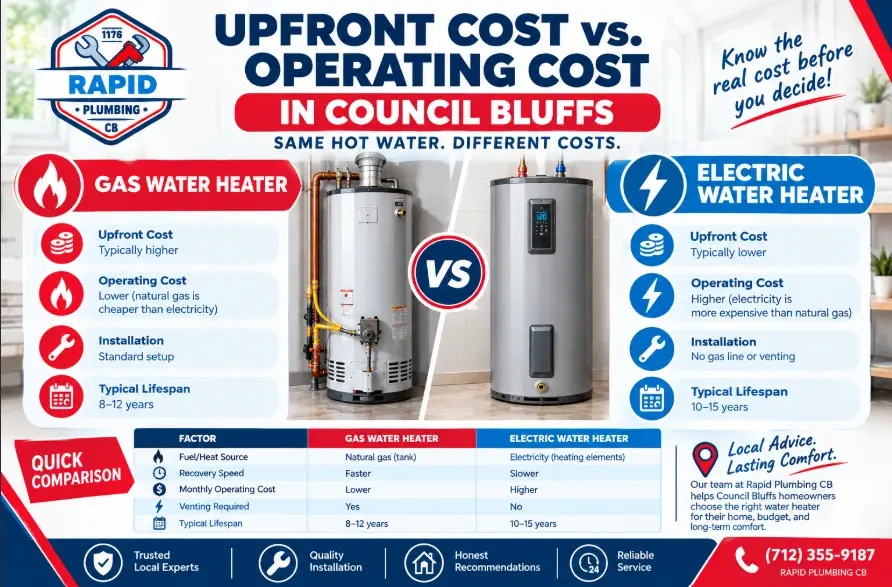
Upfront Cost vs. Operating Cost in Council Bluffs
Sticker price only tells half the story. A gas unit usually costs more to install because of the gas line and venting work, but it can cost less to run month to month. An electric unit is usually cheaper to install but can run higher on the monthly bill, especially for a household that uses a lot of hot water. For ballpark replacement pricing specific to Council Bluffs, our water heater repair and replacement cost guide breaks down current tank, tankless, and hybrid pricing so you can compare against whichever fuel type you’re leaning toward.
Venting, Electrical & Gas Line Requirements
This is the part homeowners underestimate. A gas water heater needs a dedicated vent to the outside — either a traditional flue or a power-vent system — plus a properly sized gas line run to the unit. If you’re considering a switch from electric to gas, or your home was never plumbed for gas at all, that’s a job for a licensed plumber who can evaluate line sizing and venting clearance; see our gas line installation page for what that typically involves in Council Bluffs.
An electric water heater instead needs a dedicated 240-volt circuit sized to the unit’s wattage, which in some older homes means an electrical panel upgrade. Neither option is a simple DIY swap — Council Bluffs requires a plumbing permit for water heater replacement regardless of fuel type, and gas or electrical work adds inspection requirements on top of that. We cover what’s required and why it matters in more detail if you search our site for permit guidance, or you can confirm current requirements directly with the City of Council Bluffs Building Division.
Which Is Right for Your Home? A Quick Decision Guide
- Choose gas if: your home already has a gas line to the water heater location, you have a larger household with heavy simultaneous hot water use, or backup during power outages matters to you.
- Choose electric if: your home doesn’t currently have gas service, you want the simplest and least expensive installation, or you’re prioritizing efficiency over recovery speed for a smaller household.
- Not sure which you currently have? A gas unit has a visible burner access panel and a flue pipe running up and out of the tank. An electric unit has no flue at all — just electrical conduit running into the top or side of the tank.
If your household is also weighing a hybrid heat pump water heater or considering going tankless, it’s worth comparing all three paths before you commit — fuel type, tank technology, and brand are three separate decisions that all affect the final price and performance.
MidAmerican Energy Rebates & Council Bluffs Utility Considerations
Council Bluffs homes are served by MidAmerican Energy for both natural gas and electric service, and MidAmerican periodically offers rebates on qualifying high-efficiency water heaters — for either fuel type, including heat pump electric models. Rebate amounts and eligibility change, so it’s worth checking MidAmerican’s current residential rebate page before you buy, and asking your installer whether the specific model you’re considering qualifies.
Council Bluffs Resources
Frequently Asked Questions
Is a gas or electric water heater better?
Neither is universally better — a gas water heater typically recovers hot water faster and costs less to run month to month, while an electric water heater is usually cheaper and simpler to install and doesn’t need venting. The right choice depends on what’s already run to your mechanical room and your household’s hot water demand.
Is it worth switching from electric to gas water heater?
It can be, especially for larger households frustrated with slow recovery, but only if you factor in the added cost of running a gas line and venting. For many Council Bluffs homes, the payback period depends heavily on current natural gas and electric rates.
Do electric water heaters cost more to run than gas?
In most cases, yes, because electricity is generally more expensive per unit of delivered heat than natural gas. Electric units are more efficient at converting energy into hot water, but that efficiency doesn’t always offset the higher electric rate.
Can I install a gas water heater if my house doesn’t have gas?
Yes, but it requires running a new gas line from your meter or existing gas service to the water heater location, plus proper venting — both of which need a licensed plumber and a permit from the City of Council Bluffs.
How long do gas and electric water heaters last?
Gas water heaters typically last 8–12 years, while electric water heaters often last a bit longer, around 10–15 years, especially with regular flushing to manage sediment from Council Bluffs’ hard water.
Still weighing gas vs. electric for your Council Bluffs home? Our team can walk your specific setup and give you a straight answer — including what a fuel-type switch would actually cost.