
5 Signs You Need Whole-Home Repiping Council Bluffs House
If you’re chasing the same leak for the third time this year, or every faucet in the house has turned into a trickle, patch repairs might not be the answer anymore. Signs You Need Whole-home repiping Council Bluffs replaces the aging supply lines behind your walls with new, code-current pipe — and for a lot of homes in this city’s older neighborhoods, it’s less a question of “if” than “when.” Here are the five signs that tell you it’s time to stop patching and start planning a repipe.
What Is Whole-Home Repiping (And Why It Matters More in Council Bluffs)
Repiping means replacing all — or nearly all — of a home’s water supply lines, rather than fixing one leak or one bad section at a time. It’s a bigger job than a standard repair, but it solves the underlying problem instead of chasing symptoms.
Council Bluffs has a lot of housing stock built well before modern plumbing materials existed. Neighborhoods like Downtown Council Bluffs and North Broadway include a meaningful share of pre-1960s homes, many of which were originally plumbed with galvanized steel — a material with a functional lifespan that’s already been exceeded in a lot of these houses. If your home falls into that older bracket, the five signs below are worth paying closer attention to than they would be in a newer build.
1Discolored or Rusty Water
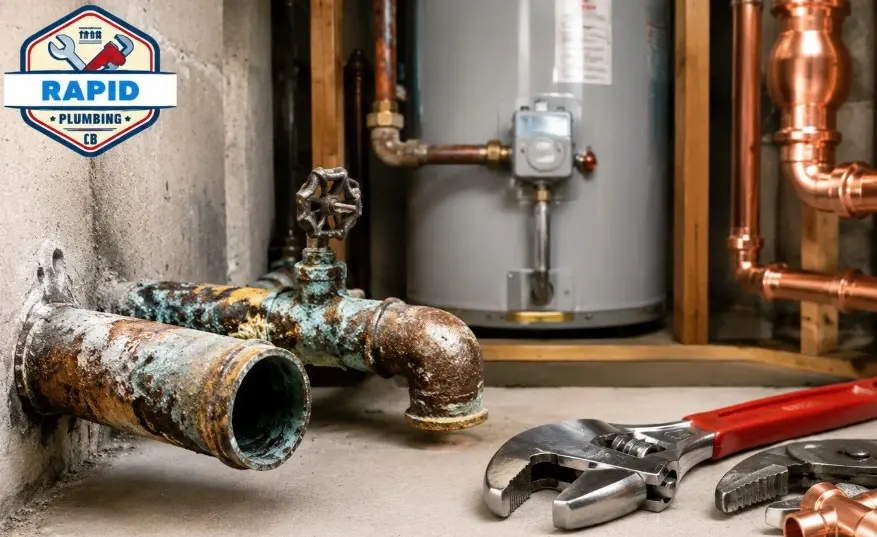
Water that runs brown, yellow, or reddish — especially right after the tap has sat unused for a few hours — usually means galvanized steel pipe is corroding from the inside. Rust flakes into your water supply as the pipe wall deteriorates, which is a water-quality issue as much as a plumbing one. A single rusty tap can sometimes be a localized problem; discoloration at multiple fixtures throughout the house points to a system-wide issue.
2Frequent, Recurring Leaks
One leak is a repair. A second leak six months later, in a different spot, is a pattern. Once a home’s pipes start failing in multiple places, it usually means the material itself — not just one weak joint — has reached the end of its service life. We cover related warning signs in more detail in our post on signs of a hidden water leak, but recurring leaks in different locations are the clearest signal that spot repairs have stopped being cost-effective.
3Low Water Pressure Throughout the House
Corrosion and mineral buildup narrow the inside diameter of old galvanized pipe over years, gradually choking down flow at every fixture — not just one showerhead that needs cleaning. If pressure has been declining slowly across the whole house rather than at a single fixture, the pipe itself is often the bottleneck. Our low water pressure in Council Bluffs guide walks through the full range of causes, but home-wide pressure loss tied to an older system is a strong repiping indicator.
4Noisy, Banging, or Rattling Pipes
Loud banging when a faucet shuts off, rattling inside the walls, or knocking that seems to travel through the house can point to loose pipe hangers, pressure irregularities, or corroded fittings that no longer seal or sit the way they should. We break down the common causes in our noisy pipes post — but when the noise shows up alongside other signs on this list, it’s usually the plumbing system telling you it’s under strain.
5Your Pipes Are Galvanized Steel, Polybutylene, or Just Old
Sometimes the clearest sign isn’t a symptom at all — it’s the pipe material itself. Galvanized steel (common in homes built before the 1960s) and polybutylene (common in homes built in the 1980s and early ’90s) are both materials that plumbers no longer install, precisely because they corrode, become brittle, or fail unpredictably with age. If you know — or suspect — either material is behind your walls, it’s worth having a plumber confirm it before you’re dealing with an emergency instead of a plan.
Not sure which category your house falls into? A quick inspection can usually tell within the hour. Call Rapid Plumbing CB at (712) 355-9187 for a free assessment of your home’s pipe material and condition.
What Whole-Home Repiping Costs in Council Bluffs
Pricing depends on your home’s size, pipe material choice, number of fixtures, and how accessible your walls and floors are. As a general guide:
| Project Scope | Typical Cost Range |
|---|---|
| Small home (under 1,500 sq ft), PEX | $4,000 – $8,500 |
| Average home (1,500–2,500 sq ft), PEX | $6,000 – $9,500 |
| Larger or multi-story home, PEX | $9,000 – $15,000+ |
| Copper repipe (any size) | $8,000 – $15,000+ |
Most whole-home repipe quotes should include the permit, the pressure test, and basic wall-patching after the work is done — ask specifically whether drywall repair and paint are included, since that’s the most common gap between an initial quote and the final bill.
PEX vs. Copper: Which Is Right for Your Council Bluffs Home?
PEX is the material most homeowners choose today — it’s flexible, resists the mineral scale that’s common with Council Bluffs’ hard water, installs with fewer wall openings, and costs meaningfully less than copper installed. Copper has a longer track record and can add resale appeal in some markets, but runs significantly higher in material and labor cost. For most homes replacing old galvanized or polybutylene pipe, PEX is the practical choice; we’re happy to walk through both options and what makes sense for your specific house during a free estimate.
Permits & Iowa Code for Whole-Home Repiping
Whole-home repiping is inspected work in Council Bluffs, the same as any other major plumbing project — the city’s Building Division reviews plumbing work as part of its standard permitting process to confirm it meets current code before it’s signed off. You can review permit requirements and start an application through the city’s Apply for a Permit page. When Rapid Plumbing CB handles your repipe, pulling the permit and scheduling the required inspection is part of the job — not something you have to coordinate separately.
What to Expect When You Call Rapid Plumbing CB
- Free assessment. We inspect your pipe material and condition and tell you honestly whether you need a repipe or just a targeted repair.
- Clear, written quote. Material choice (PEX or copper), labor, permit, and wall-patching are itemized up front — no surprise line items after the walls are already open.
- Scheduled, minimally disruptive work. Most whole-home repipes take a few days, with water restored at the end of each work day whenever possible.
- Permit and inspection handled for you so the finished job is fully signed off with the City of Council Bluffs.
Repiping often comes up alongside other plumbing decisions — if you’re also weighing a related project, our plumbing services page covers the full range of work we handle for Council Bluffs homeowners, and our about page has more on our licensing and local experience.
Seeing two or more of these signs in your Council Bluffs home? Get a free repiping assessment from a licensed local plumber.
Call (712) 355-9187Frequently Asked Questions About Whole-Home Repiping in Council Bluffs
How do I know if my house has galvanized pipes?
Homes built before the 1960s in Council Bluffs are the most likely candidates. A plumber can confirm it quickly by inspecting an exposed section of pipe near the water heater or in the basement — galvanized pipe has a distinct gray, threaded appearance and is often magnetic, unlike copper.
How long does whole-home repiping take?
Most homes are completed in three to five days, depending on size and the number of bathrooms. Water is typically restored by the end of each work day.
Is whole-home repiping cheaper than repeated repairs?
Often, yes — once a home is on its second or third leak from aging pipe, the cost of repeated emergency repairs, water damage, and service calls can add up to more than a single planned repipe over just a few years.
Do I need a permit for whole-home repiping in Council Bluffs?
Yes. The City of Council Bluffs Building Division requires a permit and inspection for whole-home repiping, the same as other major plumbing work.
Will I be without water during the repipe?
Water is typically shut off only during active working hours and restored at the end of each day whenever possible, so extended multi-day outages are uncommon on a well-planned job.