🍽️ COMMERCIAL PLUMBING · HISTORIC 100 BLOCK, COUNCIL BLUFFS, IA
Commercial Plumber for Council Bluffs Restaurants & Bars: The Historic 100 Block Guide
Grease traps, floor drains, backflow prevention, and water heater sizing for the buildings that keep West Broadway’s dining and nightlife scene running.
Quick answer: Restaurants and bars need a commercial plumber who understands four things at once — a properly sized and maintained grease trap, floor drains that can actually keep up with kitchen volume, a tested backflow preventer, and a water heater sized for peak-hour demand, not average demand. On the Historic 100 Block specifically, add one more variable: buildings dating to 1850-1928 running on original cast iron and clay lines that were never designed for a modern commercial kitchen.
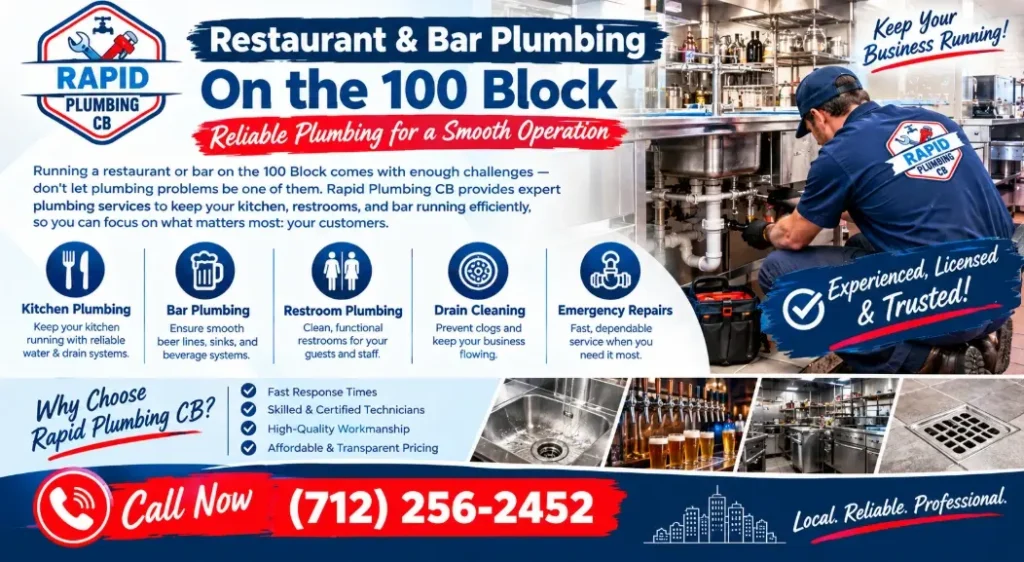
The Historic 100 Block of West Broadway is one of three historic districts anchoring downtown Council Bluffs, listed on the National Register of Historic Places since 2002, and it’s the busiest concentration of restaurants and bars in the city — sports bars, cocktail lounges, scratch-kitchen restaurants, and coffee shops sharing a block of buildings that are, in some cases, more than 170 years old. That combination — high-volume commercial kitchens and bars inside century-old buildings — is exactly where plumbing problems show up first and cost the most in downtime. As a commercial plumber working restaurants and bars across Council Bluffs, here’s what we check first on the 100 Block, and why.
Grease Traps & Interceptors: The First Thing That Fails
Any Council Bluffs restaurant, bar kitchen, or food service operation discharging wastewater to the city’s sanitary sewer is required to install and maintain a properly sized grease interceptor or trap under the City’s sewer use ordinance — this isn’t optional, and it’s typically checked during permitting for any kitchen buildout or remodel. A few things restaurant and bar operators consistently get wrong:
- Undersizing for actual volume. A trap sized for a quiet lunch counter fails fast under 100 Block dinner-rush-plus-bar-crowd volume.
- Skipping the cleaning schedule. Most jurisdictions require interceptors to stay under roughly 25% capacity, serviced on a fixed interval — commonly every 30 to 60 days depending on load. Waiting for a smell or a backup means you’ve already missed it.
- Plumbing the wrong fixtures into it. Dishwashers and restroom fixtures generally should not tie into a grease interceptor — only fixtures that actually introduce fats, oils, and grease (three-compartment sinks, prep sinks, floor drains in food prep areas).
Exact sizing, approval, and current cleaning-interval requirements go through the City of Council Bluffs’ Public Works Department as part of permitting — confirm specifics there before a buildout or remodel, and see our Council Bluffs plumbing permit guide for how that process generally works alongside a water heater or fixture change.
Grease Trap Overdue for Service or Backing Up?
Fast commercial response so your kitchen doesn’t lose a service
Get Emergency Commercial ServiceFloor Drains: Built for Volume, Not Just Code
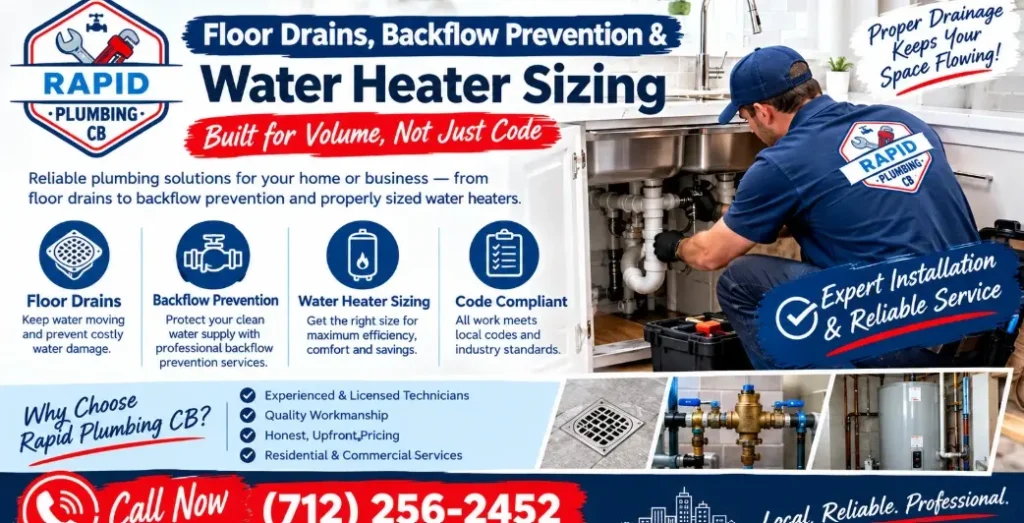
Commercial kitchen and bar floor drains take a beating that a residential drain never sees — ice melt, dish pit overflow, mop water, and grease-laden runoff, often multiple times a shift. On older 100 Block buildings, floor drains frequently tie into original clay or cast iron lateral lines that have narrowed with decades of scale and root intrusion, so a drain that “worked fine last year” can slow dramatically once a new tenant pushes more volume through it. If you’re noticing slow floor drains, standing water near the dish pit, or a recurring sewer smell in the kitchen, that’s usually a sign the lateral line itself needs a look — our sewer camera inspection service finds the exact cause without tearing up the floor, and trenchless pipe lining can often fix an aging line without closing the kitchen for a dig.
Backflow Prevention: Non-Negotiable for Bars and Kitchens
Bars and commercial kitchens are considered higher cross-connection risk than almost any other business type — carbonators on soda systems, chemical dish machines, mop sinks, and hose bibs all create a path where contaminated water could theoretically be pulled back into the drinking water supply if pressure drops. That’s why a backflow prevention assembly at the water service entrance, tested annually by a certified tester, is standard for restaurant and bar plumbing. We handle installation and annual testing together so it’s one call, not two — see our backflow testing and installation guide for how the annual cycle works.
Water Heater Sizing: Why “Big Enough at Home” Isn’t Big Enough Here
A residential water heater sizing rule of thumb doesn’t translate to a restaurant or bar kitchen. Commercial sizing has to account for every fixture that could realistically run at once during a dinner rush: a three-compartment sink, a high-temp or chemical sanitizing dishwasher, hand sinks at every station, a mop sink, and — for bars — glass washers running continuously through a busy night. Undersizing is the single most common mistake we see in 100 Block kitchens, and it shows up as hot water running out mid-shift, not on day one. See our commercial water heater guide for how we size tank and tankless systems for restaurant and bar demand specifically.
🔥 High-Recovery Tank Systems
Often the right call for a kitchen with a predictable, concentrated peak — fast recovery between rushes, simpler gas line requirements than a large tankless bank.
⚡ Commercial Tankless / Multi-Unit
Better fit for a kitchen and bar running hot water demand nearly continuously through service — no tank to run dry, but sized in banks, not a single household-style unit.
Why the Historic 100 Block Specifically Needs This Approach
Most buildings on the Historic 100 Block of West Broadway date to between 1850 and 1928, and the block has been listed on the National Register of Historic Places since 2002. That history is a huge part of what makes the district a draw for locals and visitors from across the Omaha metro — but for plumbing, it means two things layered on top of each other: original-era drain and supply lines that were never engineered for a modern commercial kitchen’s volume, and a genuinely high-traffic dining and bar scene running through those same lines every night of the week. A grease trap sized correctly, a floor drain that’s actually clear, and a water heater built for peak demand matter more here than in a newer strip-mall restaurant space precisely because the infrastructure underneath has less margin for error.
What Restaurant and Bar Owners on the 100 Block Should Do
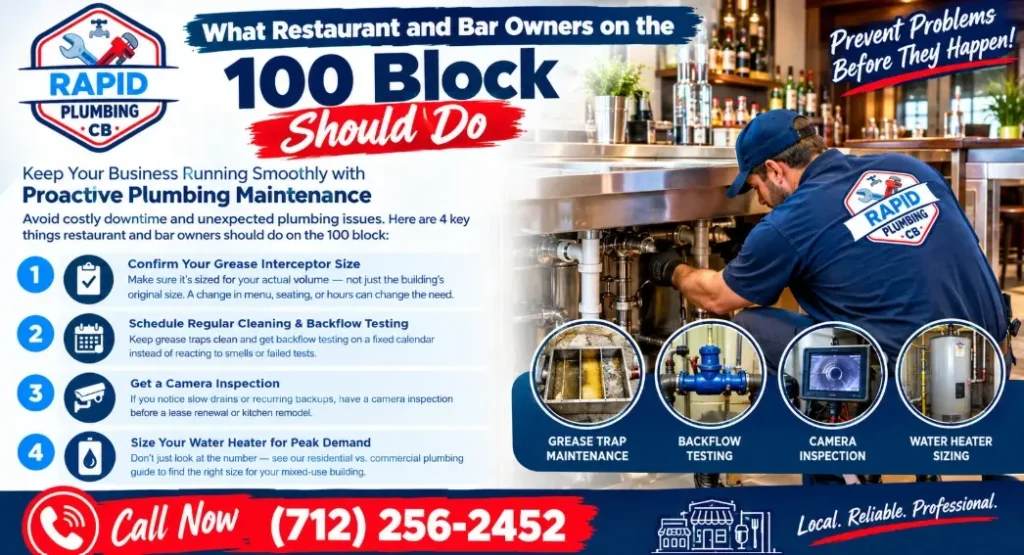
- Confirm your grease interceptor is sized for actual volume — not what the building had when it opened. A change in menu, seating, or hours changes the requirement.
- Put grease trap cleaning and backflow testing on a fixed calendar instead of reacting to smells or a failed test — both are far cheaper on a schedule than as an emergency.
- Get a camera inspection of your lateral line if you’re noticing slow drains or recurring backups, especially before a lease renewal or kitchen remodel.
- Size any water heater replacement for peak-hour demand, not the number the building came with — see our residential vs. commercial plumbing guide if you’re weighing a mixed-use building with both.
If you’re a property owner leasing to multiple 100 Block tenants, our plumbing maintenance checklist for landlords covers how to build these into a standing maintenance plan across units, and every job is performed to the current Iowa plumbing code.
Restaurant or Bar Plumbing on the Historic 100 Block?
Commercial-scale response for Council Bluffs kitchens and bars, day or night
📞 Call (712) 355-9187 See Commercial Plumbing ServicesFrequently Asked Questions
Does my Council Bluffs restaurant need a grease trap?
Almost certainly yes. Any Council Bluffs food service establishment discharging wastewater to the city’s sanitary sewer is required to install and maintain a properly sized grease interceptor or trap under the City’s sewer use ordinance. Exact sizing and approval go through the City’s Public Works Department before a permit is issued.
How often does a commercial grease trap need to be cleaned?
Most cities, Council Bluffs included, require grease interceptors to stay under roughly 25% capacity and be serviced on a set schedule, commonly every 30 to 60 days depending on volume. A busy kitchen on the Historic 100 Block during peak dinner and bar service will need more frequent service than a low-volume operation.
Is backflow prevention required for a Council Bluffs bar or restaurant?
Yes. Commercial kitchens and bars are considered higher cross-connection risks because of chemical dish machines, carbonators, and mop sinks, so a backflow prevention assembly is typically required at the water service entrance and tested annually by a certified tester.
Why do older buildings on the Historic 100 Block have more plumbing problems?
Most buildings on the Historic 100 Block of West Broadway date to between 1850 and 1928. Original cast iron and clay drain lines from that era are decades past their expected service life, and older buildings were never designed for modern commercial kitchen and bar water demand.
How is a commercial water heater sized for a restaurant or bar?
Sizing is based on peak-hour hot water demand across every fixture at once — three-compartment sinks, a high-temp or chemical dish machine, hand sinks, mop sinks, and bar glass washers — not a single household formula. Undersizing is the most common mistake and shows up as hot water running out mid-dinner-rush.
Sources: City of Council Bluffs sewer use ordinance and grease interceptor permitting guidance (general requirements referenced; confirm current specifics with the City’s Public Works Department before a buildout or remodel) · Iowa plumbing licensure via the Iowa Plumbing and Mechanical Systems Board. Historic 100 Block district facts (National Register status, building age range) per the Council Bluffs Convention & Visitors Bureau and published local history sources. This guide reflects general commercial plumbing code requirements; exact grease interceptor sizing, cleaning intervals, and backflow testing requirements should be confirmed with the City before work begins.
Restaurant or commercial kitchen? Dishwashers, boilers and carbonators often need protected water lines. We offer backflow testing in Council Bluffs with clear written results.
Not a restaurant? We serve bars, offices, retail and rentals too. See our commercial plumber in Council Bluffs page.