🚿 MAINTENANCE GUIDE · COUNCIL BLUFFS, IA
How Often Should You Flush Your Water Heater in Council Bluffs, IA?
Your water heater is quietly collecting sediment right now — here’s how often to flush it in a city with genuinely hard water, backed by the utility’s own numbers.
Short answer: flush a standard tank water heater once a year in Council Bluffs. If you don’t have a water softener, or your unit is older than 8 years, flush it every 6 months instead — Council Bluffs’ water hardness accelerates sediment buildup faster than in softer-water cities.
Most water heater maintenance advice online is generic — “flush it once a year” — without ever explaining why, or whether that number actually applies to your city’s water. This guide answers how often to flush your water heater using Council Bluffs Water Works’ own published hardness data, not a national average that doesn’t reflect what’s actually coming out of your tap.
How Hard Is Council Bluffs Water, Really?
📊 Official Council Bluffs Water Works Data (2025)
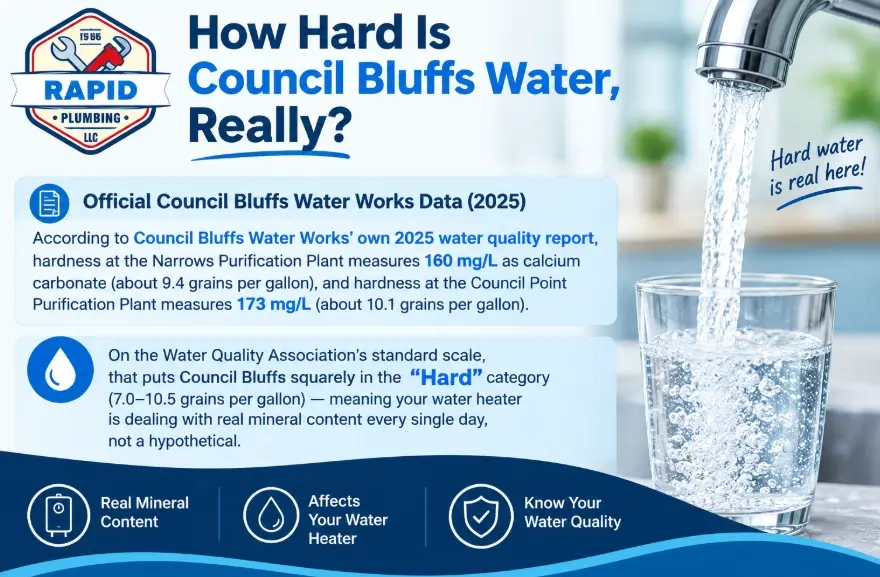
According to Council Bluffs Water Works’ own 2025 water quality report, hardness at the Narrows Purification Plant measures 160 mg/L as calcium carbonate (about 9.4 grains per gallon), and hardness at the Council Point Purification Plant measures 173 mg/L (about 10.1 grains per gallon).
On the Water Quality Association’s standard scale, that puts Council Bluffs squarely in the “Hard” category (7.0-10.5 grains per gallon) — meaning your water heater is dealing with real mineral content every single day, not a hypothetical.
Those dissolved calcium and magnesium minerals don’t disappear when water is heated — they settle out and collect at the bottom of your tank as sediment. That’s the entire reason flushing matters here more than it would in a genuinely soft-water city.
How Often Should You Flush a Water Heater in Council Bluffs?
| Situation | Recommended Frequency |
|---|---|
| Standard tank, home has a water softener | Once a year |
| Standard tank, no water softener installed | Every 6 months |
| Tank is 8+ years old (any setup) | Every 6 months |
| Tankless water heater | Annual descaling (heat exchanger is more scale-sensitive) |
| Hybrid heat pump water heater | Once a year, same as standard tank |
Signs Your Water Heater Is Overdue for a Flush
- Popping or rumbling sounds during heating cycles — sediment trapped under the heating element or burner.
- Longer time to heat water than it used to, even at the same thermostat setting.
- Rusty or cloudy hot water, especially right when you first turn on a tap.
- Rising energy bills with no other explanation — sediment forces the unit to work harder.
If you’re also noticing any of these alongside age-related wear, take a look at our signs your water heater is about to fail guide to rule out a bigger problem than sediment alone.
What Happens If You Skip It?
Sediment buildup doesn’t just sit quietly at the bottom of the tank — over time it insulates the heating element or burner from the water above it, forcing the unit to run longer and hotter to reach the same temperature. That extra strain accelerates wear on the tank lining and can shorten a water heater’s working life by years. A $100-$250 flush is a fraction of the cost of an early replacement — see our water heater repair and installation cost guide for what a full replacement runs if neglect turns into failure.
How to Flush Your Water Heater
Flushing involves shutting off power or gas to the unit, connecting a hose to the drain valve, and draining the tank until the water runs clear. We’ve already written a full step-by-step walkthrough — see our how to drain a water heater guide for the complete process if you want to do it yourself, or book a technician below if you’d rather leave it to us.
Water Softener vs. Flushing: Do You Need Both?
Yes — they solve different parts of the same problem. Flushing removes sediment that’s already accumulated; a whole-house water softener reduces how much new sediment forms in the first place by pulling hardness minerals out of your water before they ever reach the tank. Homes with a softener installed can often stretch to annual flushing instead of every 6 months, since there’s simply less mineral content reaching the heater to begin with. If your water also has a noticeable odor, our guide on why your water smells like sulfur covers a separate but related water-quality issue worth ruling out.
When to Call a Plumber Instead of DIY Flushing
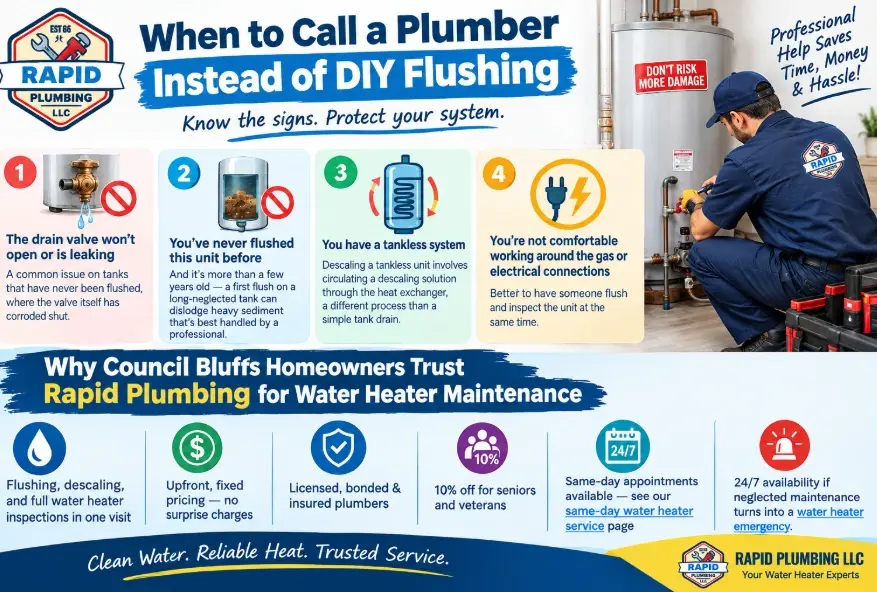
- The drain valve won’t open or is leaking — a common issue on tanks that have never been flushed, where the valve itself has corroded shut.
- You’ve never flushed this unit before and it’s more than a few years old — a first flush on a long-neglected tank can dislodge heavy sediment that’s best handled by a professional.
- You have a tankless system — descaling a tankless unit involves circulating a descaling solution through the heat exchanger, a different process than a simple tank drain.
- You’re not comfortable working around the gas or electrical connections — better to have someone flush and inspect the unit at the same time.
Why Council Bluffs Homeowners Trust Rapid Plumbing CB for Water Heater Maintenance
- 🔧 Flushing, descaling, and full water heater inspections in one visit
- 💲 Upfront, fixed pricing — no surprise charges
- ✅ Licensed, bonded & insured plumbers
- 🎖️ 10% off for seniors and veterans
- 🕐 Same-day appointments available — see our same-day water heater service page
- 🚨 24/7 availability if neglected maintenance turns into a water heater emergency
We service water heaters throughout Council Bluffs, IA 51501 and 51503, including Downtown, Lake Manawa, The Heights, and North Broadway. For the full range of water heater services we offer, visit our water heater repair and installation services page.
Ready to Book a Water Heater Flush?
Same-day appointments available across Council Bluffs, IA
📞 Call (712) 355-9187 Schedule Service OnlineFrequently Asked Questions
How often should you flush a water heater in Council Bluffs?
Most Council Bluffs homeowners should flush a standard tank water heater once a year. If your home doesn’t have a water softener, or your unit is more than 8 years old, flushing every 6 months helps offset the extra mineral sediment from the city’s hard water supply.
Is Council Bluffs water hard?
Yes. According to Council Bluffs Water Works’ own 2025 water quality report, hardness measures 160-173 mg/L as calcium carbonate (roughly 9.4-10.1 grains per gallon) depending on the treatment plant, which falls in the “Hard” classification on the Water Quality Association’s scale.
What happens if I never flush my water heater?
Sediment builds up at the bottom of the tank, which reduces heating efficiency, can cause popping or rumbling noises, and accelerates corrosion of the tank lining — often shortening the unit’s lifespan and leading to premature replacement instead of a low-cost flush.
Does a tankless water heater need flushing too?
Yes, and if anything it matters more — tankless units are more sensitive to mineral scale buildup in the heat exchanger. Most manufacturers recommend descaling a tankless water heater annually, especially in a hard water area like Council Bluffs.
Do I still need to flush my water heater if I have a water softener?
Yes, but less urgently. A whole-house water softener significantly reduces the minerals reaching your water heater, which slows sediment buildup, but annual flushing is still recommended as routine maintenance since no softener removes 100% of hardness minerals.
Sources: Council Bluffs Water Works 2025 Water Quality Report (cbwaterworks.com) · Water Quality Association hardness classification scale. Hardness figures reflect the utility’s most recently published treatment plant data and may vary slightly by neighborhood and season.