🌊 SUMP PUMP GUIDE · MISSOURI RIVER · COUNCIL BLUFFS, IA
Sump Pump Council Bluffs Missouri River
What the City’s own flood and levee records mean for your basement — and how to set up a sump pump that won’t fail when it matters most.
Quick answer: Council Bluffs sits behind a Missouri River levee system that’s protected the city since the 1950s, but that levee protects against the river overtopping its banks — not against the naturally high groundwater table under homes close to the river and its tributaries. If you’re in that zone, a properly sized sump pump with battery backup isn’t optional equipment, it’s the thing standing between normal spring weather and a flooded basement.
Search “sump pump Council Bluffs Missouri River” and you’ll mostly find generic sump pump sales pages. What’s missing is the actual local context: how close your home really is to a levee, what the City’s own flood records show, and why a home two blocks from the river behaves completely differently than one across town during spring thaw. As a plumber installing and servicing sump pumps across Council Bluffs, here’s the local picture, backed by the City’s own data.
Council Bluffs’ Levee System and Flood History
Council Bluffs is protected by a Missouri River levee system originally designed and built by the U.S. Army Corps of Engineers, with construction beginning in 1946 and largely completed by 1954, plus additional channel improvements finished in 1963. The system runs approximately 28 miles around the city and helps protect an estimated 11,700 residential buildings and 35,000 residents. Without it, the City itself notes that roughly 60% of Council Bluffs’ incorporated area would face a significantly greater flood risk.
Length of the Council Bluffs levee system
Residential buildings protected
Residents protected
Age of the levee system today
That history matters because the levee has been tested repeatedly. Per the City of Council Bluffs, major floods affecting the city occurred in 1952, 1967, 1984, 1993, 1997, 2011, 2019, and 2024 — driven by snowmelt, heavy rainfall, and high Missouri River flows. The levee is now more than 70 years old and, by the City’s own description, requires ongoing maintenance, inspection, and rehabilitation to keep performing as designed.
Why a Levee Doesn’t Solve Your Basement’s Water Table Problem
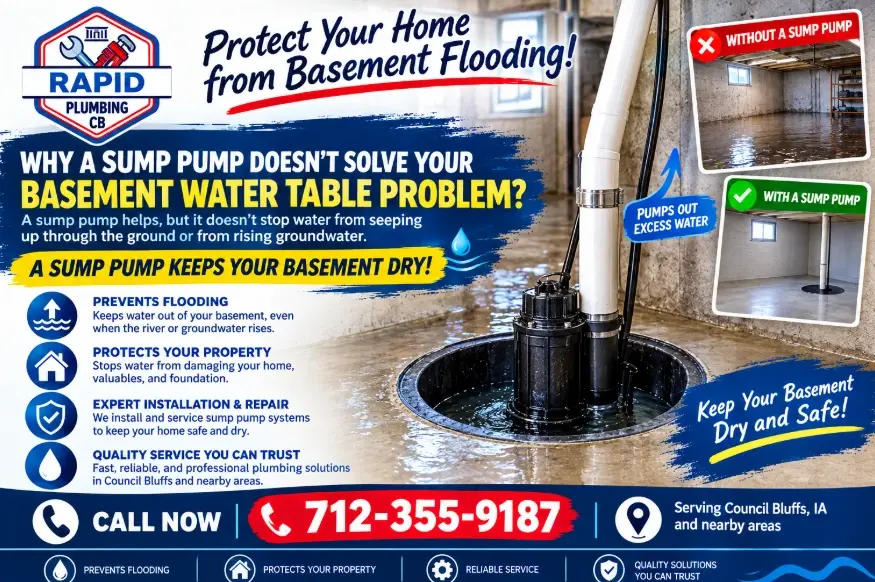
This is the part homeowners most often miss: a levee blocks river water from overtopping the bank and spreading across the city — it does not lower the groundwater sitting underneath homes built close to the river or along Mosquito Creek and Indian Creek, both of which feed into the levee system’s design. Homes in these areas typically sit on a naturally higher water table than homes further from the river, which means:
- Basements can seep or flood from rising groundwater even when the Missouri River itself never comes close to breaching the levee
- Sump pumps in these homes cycle far more frequently, year-round, than pumps in higher-elevation parts of the city
- A pump that’s “good enough” for an average Council Bluffs basement may be undersized for a home in a genuinely high-water-table area
This is also why some homes near the river need crawl space sump pump systems in addition to a basement pump, and why understanding what a sump pump pit actually does matters more here than in drier parts of the city.
Not Sure If Your Home Is in a High Water Table Zone?
We’ll assess your basement and sump pit against Council Bluffs’ actual flood risk map
Get a Free Sump Pump AssessmentSpring Thaw: When Council Bluffs Sump Pumps Work Hardest
Every spring, snowmelt combines with rain to push more water into the ground than it can absorb, and that’s when homes near the Missouri River see the sharpest jump in sump pump activity. If your pump suddenly seems to be running constantly starting in March, that’s usually the water table rising, not a malfunction — though it’s also exactly the season when a frozen or clogged discharge line from the tail end of winter can turn a working pump into a flooded basement in hours. Late winter and early spring are the highest-value time of year to confirm your discharge line is clear and your pump is cycling properly.
Power Outages: When Your Primary Pump Isn’t Enough
The same spring storms and high-water events that raise the water table are also the events most likely to knock out power — which is precisely when a standard AC-powered sump pump goes silent. A battery backup sump pump is the single highest-value upgrade for a home near the river, since it keeps working through the exact outage that a river-adjacent storm is likely to cause. Pairing that with a sump pump alarm means you’ll know immediately if the primary pump fails, rather than finding out when water is already on the floor.
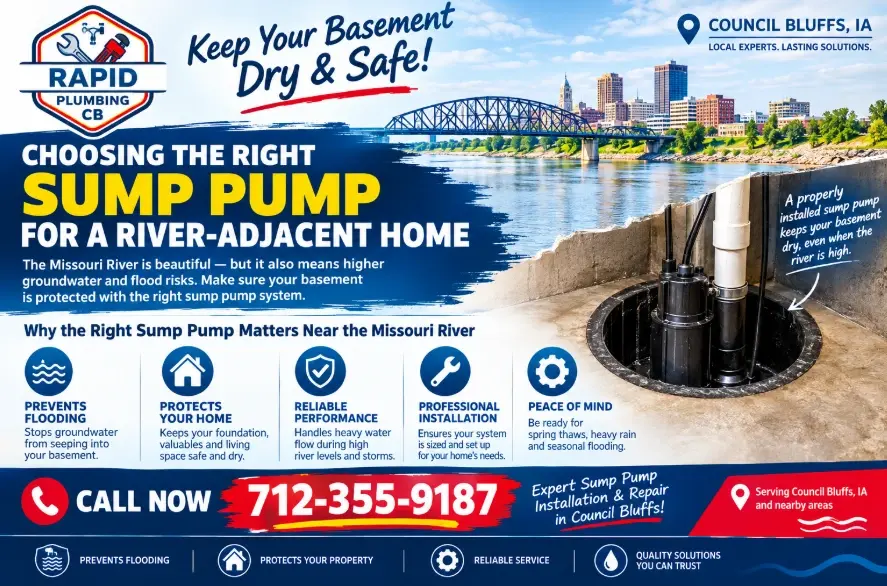
Choosing the Right Sump Pump for a River-Adjacent Home
Not every sump pump setup is a fit for a high-water-table property. A few decisions matter more here than elsewhere in Council Bluffs:
| Decision | Why It Matters Near the River |
|---|---|
| Submersible vs. pedestal | Submersible pumps generally handle frequent cycling better — see our submersible vs. pedestal sump pump comparison for the full trade-offs. |
| Primary pump vs. ejector pump | Homes with finished basements or below-grade bathrooms near the river should understand the difference — see our ejector pump vs. sump pump guide. |
| Battery backup capacity | A backup sized for a two-hour outage isn’t enough if a spring storm knocks out power overnight during peak water table season. |
| Discharge line routing | Needs to route water well away from the foundation and stay clear of freeze-prone sections through winter. |
Maintenance: The Difference Between “Installed” and “Ready”
A sump pump that isn’t tested is a pump you’re hoping works, not one you know works. We recommend homeowners near the river test their system before spring thaw and again before any forecasted heavy rain — our how to test your sump pump guide walks through the process in a few minutes. Beyond testing, know your pump’s expected service life (see our sump pump lifespan guide) and watch for early warning signs — our sump pump troubleshooting guide and sump pump not working guide cover the most common failure points, including a worn impeller that needs replacement after years of heavy cycling.
What It Costs to Get This Right
Costs vary by home, but budgeting correctly starts with knowing the real numbers rather than guessing. See our sump pump installation cost guide for a new system, or our sump pump replacement cost guide if you’re upgrading an aging or undersized unit ahead of the next spring thaw.
What Homeowners Near the Missouri River Should Do
- Know your actual flood risk, not just whether you’re “inside the levee” — the City points residents to the National Levee Database and FEMA’s Map Service Center to check current flood zone status for a specific address.
- Test your sump pump before spring thaw, not after the water table has already risen.
- Add battery backup if you don’t have it — the outage risk and the flood risk near the river peak at the same time of year.
- Have your discharge line checked each fall so a winter freeze doesn’t leave you with a working pump and nowhere for the water to go.
- Don’t wait for a backup event to test the backup — a battery backup system should be tested on the same schedule as the primary pump.
If your home is in Downtown Council Bluffs or another neighborhood close to the river, our Downtown Council Bluffs page covers local service details, and our service area page lists every neighborhood we cover across the city.
Protect Your Basement Before the Next Spring Thaw
Sump pump installation, battery backup, and repair across Council Bluffs, IA
📞 Call (712) 355-9187 Schedule an InstallationFrequently Asked Questions
Does the Council Bluffs levee mean I don’t need a sump pump?
No. The levee system protects against the Missouri River overtopping its banks, but it does nothing to lower the natural groundwater table under homes close to the river and its tributaries. Basements in these areas can flood from rising groundwater and heavy rain even when the river itself stays well within the levee.
Has Council Bluffs flooded before?
Yes. According to the City of Council Bluffs’ own records, major floods affecting the city occurred in 1952, 1967, 1984, 1993, 1997, 2011, 2019, and 2024, caused by snowmelt, heavy rainfall, and high Missouri River flows.
Why does my sump pump run more in spring?
Spring snowmelt combined with rain pushes more water into the ground than it can absorb, raising the local water table. Homes near the Missouri River and its tributaries typically see their sump pumps run far more often from March through May than the rest of the year.
Do I need a battery backup sump pump near the Missouri River?
Strongly recommended. Flooding and severe storms are also when power outages are most likely, which is exactly when a primary sump pump stops working unless it has a battery or water-powered backup system.
What kind of sump pump is best for a high water table?
A submersible pump with a battery backup is generally the better choice for homes with a consistently high water table, since it runs quieter and handles more frequent cycling than a pedestal pump, though sizing should match your specific basement and inflow rate.
Sources: City of Council Bluffs — Council Bluffs Levees (levee construction history, mileage, buildings and residents protected, historical flood years) and the City’s Storm Water Management program. Levee system data verified and maintained by the U.S. Army Corps of Engineers via the National Levee Database. Check your specific address’s current flood zone status through the National Levee Database or FEMA’s Map Service Center before making flood-risk decisions.