❄️ SEASONAL GUIDE · COUNCIL BLUFFS, IA
Keeping Hot Water Flowing: Water Heater Winter Tips Council Bluffs Iowa Winters
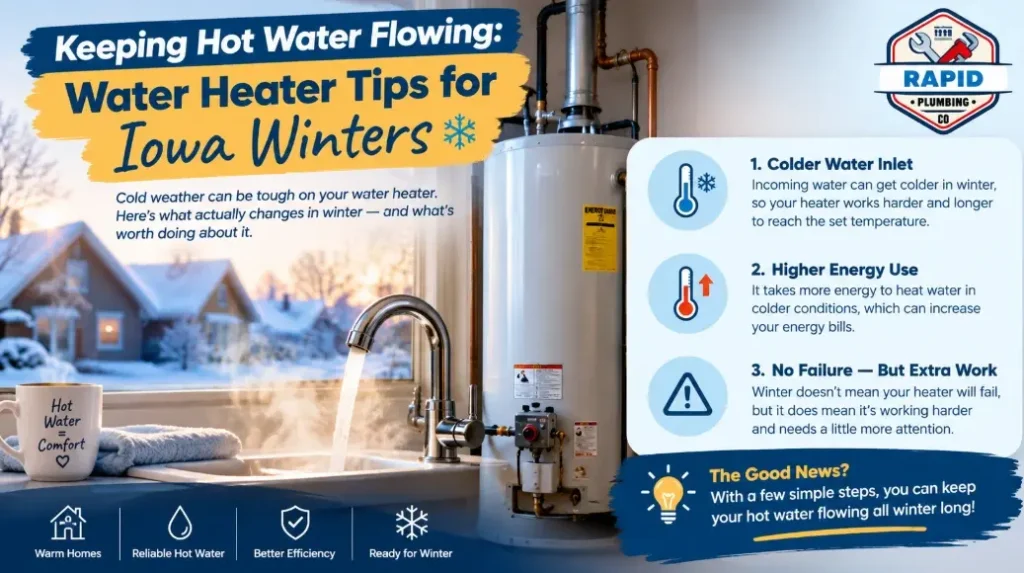
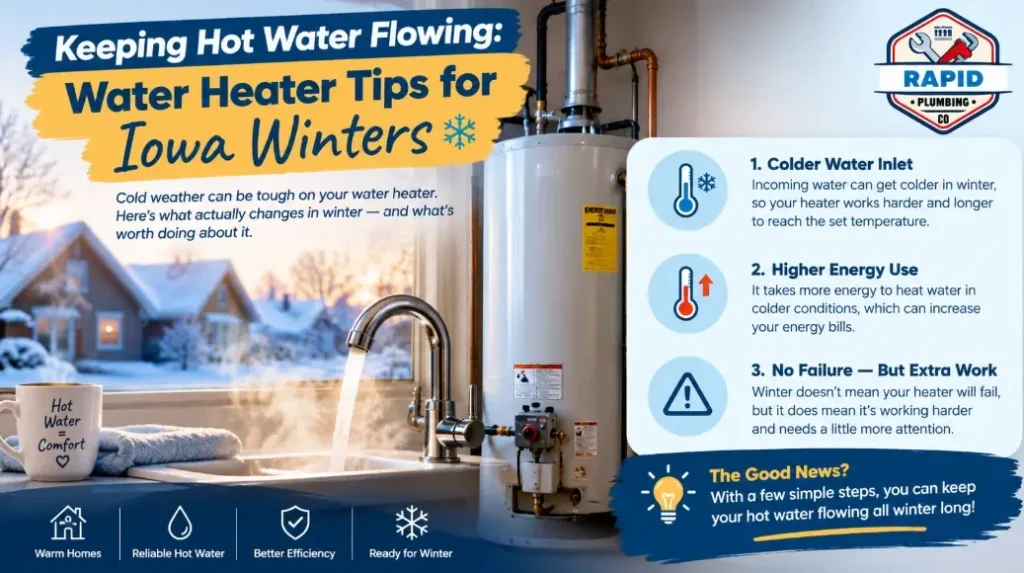
Your water heater isn’t broken in January — it’s working twice as hard. Here’s what actually changes in winter, and what’s worth doing about it.
The short version: in winter your water heater has to heat colder incoming water in a colder room, which means longer recovery, higher energy use, and hot water that seems to run out faster. That’s physics, not failure — but winter is also when a marginal water heater finally gives up. These are the water-heater-specific winter tips for Council Bluffs homes.
This guide covers your water heater specifically. For whole-home winterizing — outdoor spigots, pipe insulation, and preventing frozen pipes throughout the house — see our separate guide on preparing your plumbing for Iowa and Nebraska winters. The two go together, but the water heater deserves its own attention.
Why Your Water Heater Struggles in Council Bluffs Winters
🌡️ The Temperature Math Nobody Explains
In summer, water entering your home might be around 50°F. To reach a typical 120°F setpoint, your heater raises it about 70 degrees.
In an Iowa winter, that same incoming water can arrive closer to 40°F — so the heater now has to raise it roughly 80 degrees or more. Same tank, same burner, noticeably more work.
That extra lift is why the first shower feels fine but the third one doesn’t, and why your winter energy bill climbs even though your habits haven’t changed.
On top of colder water, the room itself gets colder. A tank sitting in an unheated Council Bluffs basement loses heat to the surrounding air faster in January than in July, so the burner or element cycles on more often just to hold temperature — what the industry calls standby loss.
Common Winter Water Heater Symptoms — Normal or Not?
| What You Notice | Normal in Winter? | What It Means |
|---|---|---|
| Hot water runs out faster | Yes | Colder incoming water means longer recovery between uses |
| Longer wait for hot water at the tap | Yes | Cold pipes between the heater and fixture drain heat faster |
| Higher energy bill | Yes | Greater temperature lift plus more standby loss |
| Light condensation on the tank | Usually | Cold water meeting humid basement air during recovery |
| Water pooling at the base | No | Likely a real leak, not condensation — get it inspected |
| Popping or rumbling sounds | No | Sediment buildup, made worse by longer winter run times |
If you’re seeing the bottom two rows, our signs your water heater is about to fail guide covers what to look for next — and if it’s already leaking badly or you’ve lost hot water entirely, see our water heater emergency guide.
Tank Sweating: Condensation or a Leak?
Winter condensation on a water heater is genuinely common and genuinely misdiagnosed. Here’s how to tell the difference:
- Condensation appears as an even film of droplets across the tank surface during or just after a heavy hot water draw, and dries off within an hour or two once the tank recovers.
- A real leak produces water that collects in one spot, keeps coming back after you dry it, and often traces to a specific fitting, the drain valve, or the base of the tank.
The simple test: dry the tank completely, lay down a sheet of paper or cardboard underneath, and check in a few hours. Uniform dampness that disappears is condensation. A wet spot that returns is a leak, and a leaking tank isn’t repairable — it’s a replacement conversation, covered in our water heater repair and installation cost guide.
Winter Behaviour by Water Heater Type
🛢️ Traditional Tank
Longer recovery times and more standby loss. Most likely to “run out” during back-to-back winter showers.
⚡ Tankless
Delivers lower effective flow when incoming water is colder. Built-in freeze protection needs constant power — never cut the breaker.
♻️ Hybrid Heat Pump
Efficiency drops in a cold basement, pushing the unit into electric backup mode more often during deep freezes.
If you own a tankless unit, the freeze-protection point matters more than anything else on this page: those systems rely on electric freeze protection that only works while the unit has power. Switching off the breaker to “save energy” during a cold snap is how tankless heat exchangers crack. Our tankless water heater cost and repair guide covers what that repair runs if it happens.
Hybrid owners should know their unit’s cold-weather behaviour is expected, not a defect — the details are in our hybrid heat pump water heater guide.
Your Pre-Winter Water Heater Checklist
- Flush the tank before winter. Sediment insulates the burner or element from the water, and winter is when that inefficiency costs the most. See how often to flush your water heater for the schedule that fits Council Bluffs’ hard water.
- Check the space around the unit. If your water heater sits near a foundation vent, in a garage, or in an uninsulated corner, make sure the space stays above freezing — the supply lines and relief discharge pipe are the vulnerable parts, not the tank itself.
- Verify the thermostat is at 120°F. Resist the urge to crank it up for winter (see the FAQ below for why).
- Test the T&P relief valve. Longer winter cycles mean more pressure cycling; a stuck relief valve is a safety issue year-round.
- Note the unit’s age. Most tanks last 8-12 years, and hard water shortens that. If yours is past a decade, winter is the worst time to find out — plan ahead using our water heater financing and payment options guide.
Leaving Town for the Holidays? Do This First
Extended winter absences are when small problems become expensive ones. Before you travel:
- Set a tank water heater to its vacation or lowest setting rather than switching it off entirely — an unheated tank in a cold basement gains freeze exposure for very little savings.
- Never cut power to a tankless unit — freeze protection stops working the moment it loses electricity.
- Know where your main water shutoff is. If something does fail while you’re away, the difference between a wet floor and a flooded basement is whether someone can shut the water off — our guide on what to do when a shut-off valve isn’t working is worth reading before you need it.
- Ask a neighbour to check in. A failed water heater in an empty house in January causes far more damage than one discovered the same day.
Winter Water Heater Service Across Council Bluffs
- ❄️ Pre-winter flushing, inspection, and tune-ups
- 🕐 24/7 emergency response — see our same-day water heater service page
- 💲 No after-hours surcharge, even during a cold snap
- ✅ Licensed, bonded & insured plumbers, under the Iowa Plumbing and Mechanical Systems Board
- 🎖️ 10% off for seniors and veterans
- 📝 Permits handled with the City of Council Bluffs Building Division on every replacement — see our water heater permit guide
We service water heaters throughout Council Bluffs, IA 51501 and 51503, including Downtown, Lake Manawa, The Heights, and North Broadway. For everything we install and repair, visit our water heater repair and installation services page.
Get Your Water Heater Winter-Ready
Book a pre-winter flush and inspection across Council Bluffs, IA
📞 Call (712) 355-9187 Schedule Service OnlineFrequently Asked Questions
Why does my water heater run out of hot water faster in winter?
Incoming water is significantly colder in winter — often around 40°F versus roughly 50°F in summer. Your water heater has to raise that water an extra 10-20 degrees to reach the same setpoint, which means longer recovery times between showers and the sensation that hot water runs out faster, even though nothing is broken.
Can a water heater freeze in an unheated Council Bluffs basement?
A water heater in active use rarely freezes because it’s continuously heating, but the supply lines, drain valve, and temperature and pressure relief discharge pipe running to or from it can freeze if the space drops below freezing — particularly in unheated garages, crawl spaces, or uninsulated basement corners near foundation vents.
Why is my water heater sweating in winter?
Condensation forms on a tank when very cold incoming water meets warmer, humid basement air, and it’s most common during long winter recovery cycles. Light sweating that dries up is normal. Persistent moisture, or water pooling at the base, may indicate a genuine leak rather than condensation and should be inspected.
Should I turn up my water heater temperature in winter?
It’s generally not recommended. Raising the thermostat above 120°F increases scald risk and accelerates mineral scale buildup in Council Bluffs’ hard water. If you’re running short on hot water in winter, the better fixes are staggering showers, flushing the tank, or checking whether the unit is sized correctly for your household.
Do tankless water heaters have problems in Iowa winters?
Tankless units handle winter well but deliver a lower effective flow rate when incoming water is colder, since they must raise the temperature further across the same heat exchanger. Most units have built-in freeze protection that requires continuous power, so a tankless unit should never be unplugged or have its breaker switched off during freezing weather.
Sources: U.S. Department of Energy water heater temperature and efficiency guidance · industry standard first-hour rating and recovery-rate principles · Council Bluffs Water Works water quality data (hardness). Incoming water temperatures are seasonal approximations and vary by year, neighbourhood, and depth of service line.