Water Heater Pilot Light Keeps Going Out? Do This Before Anything Else
If your water heater pilot light keeps going out, you are dealing with one of two things: a safety device doing its job, or a part that is wearing out. Either way, the heater is telling you something, and a few of the possible causes involve gas and exhaust, so the first step is not a repair. It is a safety check.
Smell gas near your water heater? Stop reading and do this.
- Leave the house right away. Do not flip light switches, light a flame, or use your phone inside.
- Once you are safely outside, call 911.
- Then call Black Hills Energy’s 24-hour emergency line at 888-890-5554, the natural gas utility serving Council Bluffs.
- Do not try to relight the pilot or touch the gas valve.
Once the gas company says the home is safe, call us to find out why the pilot kept dying. Our guide on what a gas leak smells like explains what to listen and smell for. If a carbon monoxide alarm is sounding, leave and call 911 first, too.
Short answer: the most common reason a gas water heater pilot light keeps going out is a worn, dirty, or out-of-position thermocouple. The rest of the list is a clogged pilot tube, drafts, a blocked air screen or vent, low gas supply, and a failing gas control valve. A thermocouple swap usually costs $150–$300 with a plumber, while a failed gas control valve runs $350–$650. If the flame is yellow, you see soot, or the pilot dies again after two relights, stop and call.
Pilot light won’t stay lit and you need hot water today?
Licensed local plumbers · Upfront pricing · Open 24/7 across Council Bluffs, IA
How a Gas Water Heater Pilot Light Works
A standing pilot is a small, always-on flame at the bottom of your tank. It does two jobs: it lights the main burner when the water cools, and it heats a safety sensor, either a thermocouple or a thermopile. That sensor makes a tiny electrical signal while it is hot, and the signal holds the gas valve open.
If the pilot flame goes out, the sensor cools, the signal stops, and the gas valve shuts. That is why a dead pilot means no hot water, and why the problem is almost never “the flame just got tired.” Something blew it out, starved it, or kept the sensor from reading it. Finding out which one is the whole job. If you have a newer unit with electronic ignition, there is no standing pilot, and our gas vs electric water heater guide covers how those systems differ.
Why Your Water Heater Pilot Light Keeps Going Out: 7 Common Causes
These are listed roughly in the order we see them. Each one is tagged so you know what is reasonable to check yourself and what belongs to a professional.
1. A worn, dirty, or bent thermocouple
Most common · Call for the repairThermocouples wear out. Soot, scale, and age weaken the signal until the gas valve will not stay open. A bent one can also sit too far from the flame to heat up properly. The classic symptom: the pilot lights fine while you hold the knob down, then dies a few seconds after you let go.
The part is cheap. The risk is in working around gas fittings, so most homeowners are better off letting a plumber replace and test it.
2. A clogged pilot tube or orifice
CallDust, lint, and rust flakes can partly block the tiny opening that feeds the pilot. The flame shrinks, turns weak or lazy, and eventually fails to heat the sensor. A healthy pilot is a steady, mostly blue flame that wraps the tip of the thermocouple. A thin, wavering flame is a warning sign.
3. Drafts blowing the flame out
Partly DIY-checkableIf the pilot dies on windy or very cold days, or right after someone opens the garage door, you may have a draft problem. Heaters in garages, utility rooms, and basements are most exposed. Notice when it goes out. If there is a pattern, tell your plumber, because a draft can also point to a bigger airflow issue (see cause 6).
4. A clogged flame arrestor or air intake screen
Newer heaters · Light cleaning, then call if it repeatsGas water heaters built since the early 2000s are designed to resist igniting flammable vapors near the floor. They breathe through a screened air intake at the base. When that screen fills with lint, pet hair, and dust, the burner and pilot can run short of air and shut down. Your owner’s manual shows where the screen is and how to clean it, with the gas control set to Off first.
5. Low or interrupted gas supply
Check the valve, then callThe gas shutoff valve feeding the heater should be open, with the handle in line with the pipe. If that is fine and other gas appliances also act up, the issue may be with supply pressure. That is a job for a plumber, and in some cases the gas utility. Do not adjust gas pressure yourself.
6. Venting or combustion air problems
Safety issue · Stop and callThe heater needs fresh air in and a clear path for exhaust out. A blocked flue, a poorly sloped vent, or competition from a furnace, dryer, bath fan, or kitchen range hood can pull exhaust back into the room instead of up the vent. Tighter homes and cold Iowa winters make this more likely. Signs include a pilot that dies when other appliances run, soot around the draft hood, or a flame that leans or flickers. Backdrafting can put carbon monoxide into the house, so this is not a cause to troubleshoot alone.
7. A failing gas control valve
CallThe gas control valve is the unit with the knob, and it contains the safety solenoid, the thermostat, and the pilot circuit. When it fails, you may see a pilot that will not stay lit even with a fresh thermocouple, or a pilot that burns while the main burner never fires. The valve is the most expensive repair on this list, so on an older tank it is worth comparing against replacement.
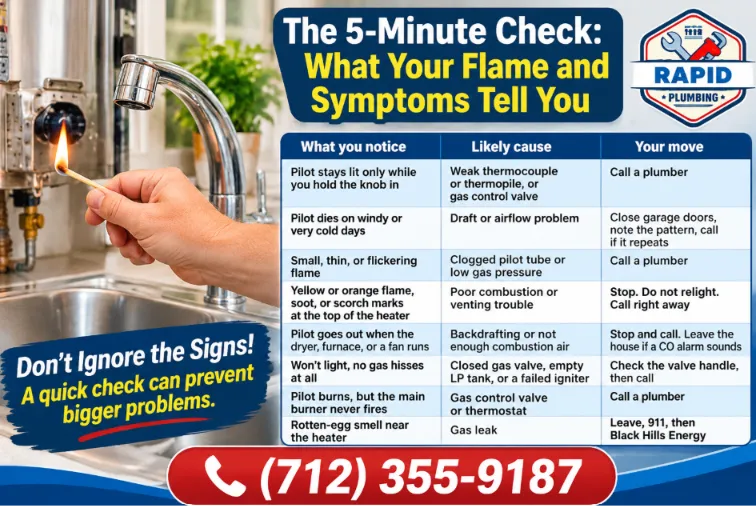
The 5-Minute Check: What Your Flame and Symptoms Tell You
Before you call anyone, a quick look can narrow things down. Look at the pilot through the viewing window, and compare what you see with this table.
| What you notice | Likely cause | Your move |
|---|---|---|
| Pilot stays lit only while you hold the knob in | Weak thermocouple or thermopile, or gas control valve | Call a plumber |
| Pilot dies on windy or very cold days | Draft or airflow problem | Close garage doors, note the pattern, call if it repeats |
| Small, thin, or flickering flame | Clogged pilot tube or low gas pressure | Call a plumber |
| Yellow or orange flame, soot, or scorch marks at the top of the heater | Poor combustion or venting trouble | Stop. Do not relight. Call right away |
| Pilot goes out when the dryer, furnace, or a fan runs | Backdrafting or not enough combustion air | Stop and call. Leave the house if a CO alarm sounds |
| Won’t light, no gas hiss at all | Closed gas valve, empty LP tank, or a failed igniter | Check the valve handle, then call |
| Pilot burns, but the main burner never fires | Gas control valve or thermostat | Call a plumber |
| Rotten-egg smell near the heater | Gas leak | Leave. 911, then Black Hills Energy |
How to Safely Relight the Pilot (and When to Stop Trying)
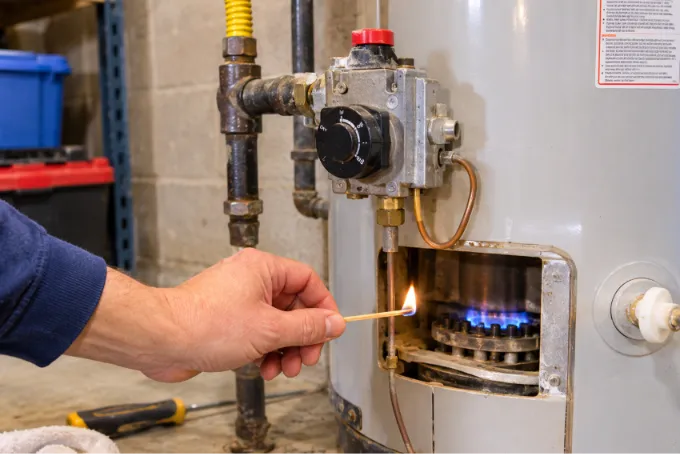
Relighting is reasonable if there is no gas smell and the flame looked normal. Your heater’s label has the exact steps for your model, so follow that first. The general order looks like this:
- Turn the gas control knob to Off and wait at least five minutes so any gas clears.
- Sniff near the floor and around the unit. If you smell gas, stop and go to the safety steps above.
- Turn the knob to Pilot, then press and hold it in.
- While holding, press the igniter button repeatedly (or use a long lighter if your model has no igniter) until the pilot catches.
- Keep holding the knob for 30 to 60 seconds, then release slowly.
- If the pilot stays lit, turn the knob to On and set the temperature.
The two-try rule: if the pilot goes out again after a second careful relight, stop. Repeated relighting only repeats the failure, and it keeps you near a heater that is trying to shut itself off for a reason.
When to Stop and Call a Plumber
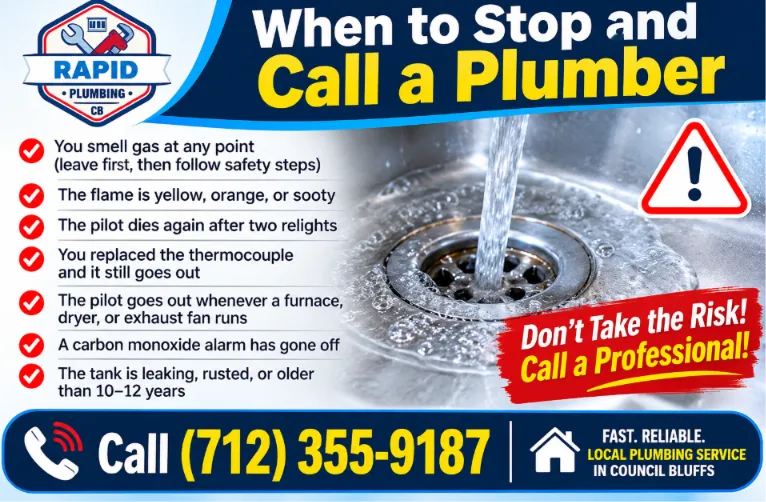
Call us, or any licensed plumber, if any of these apply:
- You smell gas at any point (leave first, then follow the safety steps above)
- The flame is yellow, orange, or sooty, or you see scorch marks near the top of the tank
- The pilot dies again after two relights
- You replaced the thermocouple and it still goes out
- The pilot goes out whenever a furnace, dryer, or exhaust fan runs
- A carbon monoxide alarm has gone off
- The tank is leaking, rusted at the base, or older than about 10 to 12 years (read signs your water heater is about to fail)
A leaking tank is its own problem. See what to do when a water heater leaks from the bottom. For a house with no hot water at all, our no hot water emergency guide walks through the full checklist.
Not sure whether it is a quick fix or a safety problem?
We diagnose the cause first and give you a price before any work starts.
What Pilot Light Repairs Cost in Council Bluffs
Pricing depends on which part has failed and how old the tank is. These are typical ranges for Council Bluffs homes. The final number comes after an on-site diagnosis, and we quote it before starting, in line with our transparent pricing promise.
| Repair | Typical cost |
|---|---|
| Thermocouple or thermopile replacement | $150–$300 |
| Cleaning or replacing the pilot assembly or orifice | $150–$350 |
| Vent or airflow correction | Quoted after inspection |
| Gas control valve replacement | $350–$650 |
| Full gas tank replacement | $1,200–$2,500 |
For the bigger picture, see our water heater repair cost guide.
Repair or replace?
A new thermocouple on a heater under 8 years old is almost always worth doing. On a tank near the end of its life, a gas control valve repair is harder to justify, because the next failure may be the tank itself. If you are leaning toward a new unit, compare water heater replacement in Council Bluffs with the repair quote, and look at tankless vs traditional water heaters while you are deciding.
One thing to know before replacing: the City of Council Bluffs requires a permit for a water heater replacement, and a new gas unit also has to be vented correctly. The City of Council Bluffs Building Division handles permits and inspections, and our post on the water heater permit in Council Bluffs explains what it costs and who files it. You can also confirm a plumber’s state credentials through the Iowa Department of Inspections, Appeals & Licensing.
Why Pilot Lights Go Out More Often in Iowa Winters
Cold weather adds three things at once. Your furnace, dryer, and bath fans run more, and they all pull air from the same house the water heater is breathing from. Garage and utility-room heaters see colder drafts. And your heater works harder because incoming water is colder. If your pilot trouble started with the first real cold snap, airflow is a good suspect. Our water heater winter tips and guide to preparing your plumbing for Iowa and Nebraska winters cover what to check before the deep freeze.
How to Keep the Pilot From Going Out Again
- Keep the area clear. Store nothing against the heater, and keep paint, gasoline, and cleaners well away from it.
- Clean the air intake screen a couple of times a year, following your manual.
- Flush the tank annually. Sediment shortens heater life, and our guides on how often to flush a water heater and how to drain a water heater show how.
- Check the anode rod. Learn what it does in our water heater anode rod guide.
- Book a yearly inspection so the thermocouple, venting, and gas connections get tested before they fail.
- Test your CO alarms every month. Any gas appliance in the home makes them worth having.
What We Do on a Pilot Light Service Call
When you call Rapid Plumbing CB about a water heater pilot light that keeps going out, we do not just relight it and leave. We check the gas connections for leaks, test the thermocouple’s output, inspect the pilot assembly, check the vent and combustion air, and confirm the gas control is working. You get a clear explanation and an upfront price, and if the heater is past repairing, we say so. For urgent calls, see our same-day water heater service, or our emergency plumber page after hours. Our full water heater repair in Council Bluffs page lists everything else we handle, including gas line work.
We serve every part of Council Bluffs, including Downtown Lake Manawa The Heights North Broadway ZIP 51501 ZIP 51503 and the rest of our service areas.
Pilot light keeps going out? Get it diagnosed today.
Serving all of Council Bluffs, IA (51501 and 51503) · Licensed local plumbers · 24/7
Frequently Asked Questions About a Water Heater Pilot Light That Keeps Going Out
Why does my water heater pilot light keep going out?
Most often it is a worn or dirty thermocouple. Other causes are a clogged pilot tube, drafts, a blocked air intake screen or vent, low gas supply, and a failing gas control valve. Watching when it goes out (windy days, when the dryer runs, right after relighting) helps narrow it down.
Is it dangerous if my pilot light keeps going out?
It can be. The pilot going out is the safety system working, but the cause may involve gas or exhaust. A yellow flame, soot, a gas smell, or a pilot that dies when other appliances run are all reasons to stop and call. If you smell gas, leave the house and call 911 and Black Hills Energy.
Why does my pilot light stay lit only while I hold the button?
That usually means the thermocouple or thermopile is not producing a strong enough signal, or the gas control valve is not accepting it. The flame is fine while you override the safety, but nothing holds the valve open after you let go. It is a common, fixable repair, and a good time to call a plumber.
Can I replace a thermocouple myself?
Some homeowners do. The part is inexpensive, but the job sits next to gas fittings, and getting the position, connection, or a leak test wrong can create a hazard. We recommend a licensed plumber, especially if you are not sure the thermocouple is actually the problem.
How much does it cost to fix a pilot light that won’t stay lit?
In Council Bluffs, a thermocouple or thermopile replacement typically runs $150–$300, a pilot assembly repair $150–$350, and a gas control valve $350–$650. If the tank is old, replacement at $1,200–$2,500 may make more sense. We quote before any work starts.
How many times should I relight the pilot?
Once, and a second time if you did it carefully the first time. If it goes out again, stop and have it inspected. Repeated relighting does not fix the cause.
What should I do if I smell gas near my water heater?
Leave immediately without flipping switches or using your phone inside. From a safe distance, call 911, then Black Hills Energy’s 24-hour line at 888-890-5554. Do not attempt to relight the pilot or touch the gas valve.
Related Reading
- No hot water emergency in Council Bluffs: what to check first
- Gas vs electric water heater in Council Bluffs
- Water heater repair and installation services
- Water heater installation in Council Bluffs
Sources: Black Hills Energy natural gas safety guidance · City of Council Bluffs Building Division · Iowa Department of Inspections, Appeals & Licensing · manufacturer instructions on your water heater’s label. This guide is general safety information and does not replace the instructions on your heater or a call to 911 or your gas utility in an emergency. Costs are typical ranges and vary by job.