What Size Water Heater Do I Need? The Short Answer
If you are asking what size water heater do I need, the quick answer is that most Council Bluffs homes land on a 40-gallon, 50-gallon or 75-gallon tank. Household size gets you close, but the number that really settles it is the first hour rating: how much hot water the heater can deliver in the busiest hour of your day.
Quick answer:
- 40 gallons: usually enough for 2 to 3 people, especially with a gas model.
- 50 gallons: the common pick for 3 to 4 people, and the usual starting point for an electric heater.
- 75 gallons: built for 5 or more people, big soaking tubs, or several people showering back to back.
Then check the first hour rating against your own peak hour demand (calculator below).
Not sure which size fits your home?
A licensed Rapid Plumbing CB tech can size it for you, 24/7.
Why Water Heater Sizing Matters
A heater that is too small runs out of hot water in the middle of a shower and works harder every day, which can shorten its life. A heater that is far too big costs more up front and keeps extra water hot all day for no reason. Getting it right is one of the cheapest ways to avoid a second visit. If your current unit is already struggling, read the signs your water heater is about to fail before you shop.
The U.S. Department of Energy says a properly sized heater meets your household’s needs while running more efficiently, and it recommends sizing a storage tank by its first hour rating (see the DOE guide to sizing a new water heater).
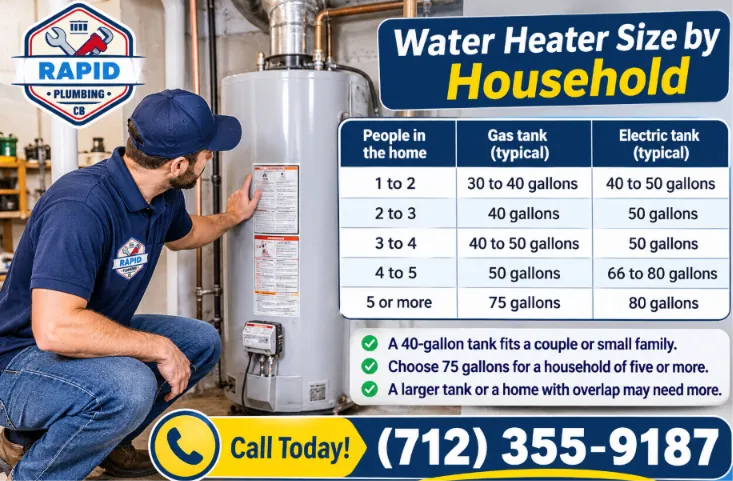
Water Heater Size by Household: 40, 50 or 75 Gallons
Use this table as a starting point. Gas heaters recover faster than electric ones, so a gas tank can often be a size smaller than an electric tank for the same family. If you are still choosing a fuel, read our gas vs electric water heater comparison.
| People in the home | Gas tank (typical) | Electric tank (typical) |
|---|---|---|
| 1 to 2 | 30 to 40 gallons | 40 to 50 gallons |
| 2 to 3 | 40 gallons | 50 gallons |
| 3 to 4 | 40 to 50 gallons | 50 gallons |
| 4 to 5 | 50 gallons | 66 to 80 gallons |
| 5 or more | 75 gallons | 80 gallons |
These are rule-of-thumb starting points, not a guarantee. Other guides use a similar idea of roughly 10 to 15 gallons of tank per person. Two homes with the same headcount can use very different amounts of hot water, which is why the first hour rating matters more than the table.
40 vs 50 gallon water heater
A 40-gallon tank fits a couple or a small family that spreads showers across the day. Step up to 50 gallons if you have teenagers, two bathrooms in use at once, or an electric heater. The jump from 40 to 50 gallons is small in price and size, and it is the upgrade most families never regret.
When a 75-gallon water heater makes sense
Choose 75 gallons for a household of five or more, a large soaking or jetted tub, or a home where laundry, dishes and showers all overlap in the morning. It is taller or wider than a 50-gallon tank, so confirm it will fit before you order one.
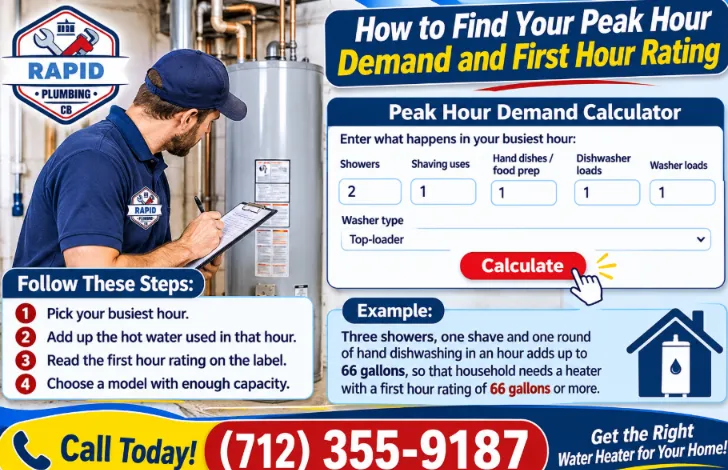
How to Find Your Peak Hour Demand and First Hour Rating
Instead of guessing, you can size your heater in four steps:
- Pick your busiest hour. For most families it is the morning rush or the early evening.
- Add up the hot water used in that hour. The DOE worksheet uses about 20 gallons per shower, 2 for shaving, 3 for hand dishwashing or food prep, 7 for an automatic dishwasher, and 25 gallons for a top-loading washer or 15 for a front-loader.
- Read the first hour rating on the label. New storage heaters carry an EnergyGuide label, and the first hour rating is listed in the top left corner as “Capacity (first hour rating).”
- Choose a model whose first hour rating is at least your peak hour demand.
Peak Hour Demand Calculator
Enter what happens in your busiest hour:
Example from the DOE worksheet: three showers, one shave and one round of hand dishwashing in an hour adds up to 66 gallons, so that household needs a heater with a first hour rating of 66 gallons or more.
Helpful to know: the first hour rating depends on the tank size and on the burner or heating elements. Two 50-gallon tanks can have different ratings, so compare labels, not just gallons.
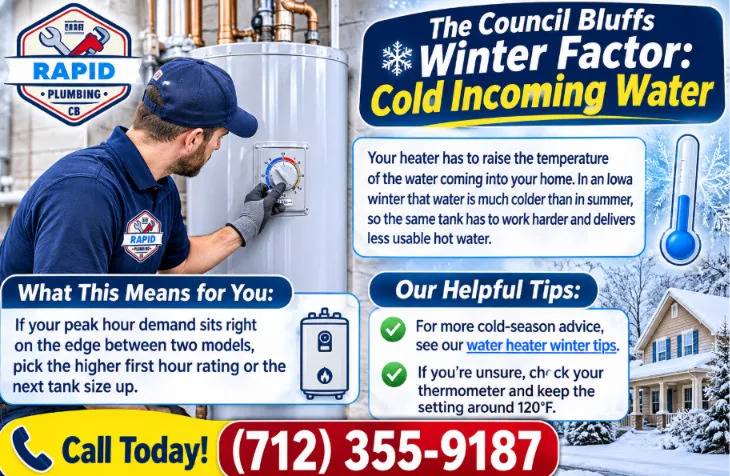
The Council Bluffs Winter Factor: Cold Incoming Water
Your heater has to raise the temperature of the water coming into your home. In an Iowa winter that water is much colder than in summer, so the same tank has to work harder and delivers less usable hot water. Manufacturers such as Rheem suggest planning around roughly 40°F inlet water for northern states, while the DOE says to assume 50°F if you do not know your own number. You can check yours by holding a thermometer under a cold tap.
What this means for you: if your peak hour demand sits right on the edge between two models, pick the higher first hour rating or the next tank size up. It is the difference between a comfortable January morning and a cold shower. For more cold-season advice, see our water heater winter tips.
Mistakes That Lead to the Wrong Water Heater Size
- Copying the old tank. Your family, fixtures and laundry habits may have changed since the last heater went in. A 30-gallon tank that worked years ago may not work now.
- Sizing by gallons only. Ignoring the first hour rating is the most common error.
- Forgetting the space. A bigger tank needs more floor space, clearance and sometimes different venting, gas supply or electrical capacity.
- Ignoring sediment. A heater full of sediment delivers less hot water than its label promises. Learn how often to flush a water heater to protect the capacity you pay for.
- Skipping the supporting parts. A new heater often needs a matching water heater expansion tank and a proper discharge line.
Permits, Code and Installation in Council Bluffs
Swapping to a different size can change venting, gas piping, electrical load and the way the tank is supported. Plumbing and mechanical work in Iowa is regulated, and the state’s Iowa Building and Construction Division oversees plumbing and mechanical systems. For local permit and inspection questions, contact the City of Council Bluffs Building Division before work starts, and read our guide to water heater permits in Council Bluffs.
If you would rather hand it off, our water heater installation in Council Bluffs team will size the unit, haul away the old one and handle the fittings. Replacing an aging unit? Start with our water heater replacement guide, and see the water heater repair cost breakdown to decide between fixing and replacing. Want to know which tank type to buy? Compare tank and tankless water heaters in our dedicated guide.
Frequently Asked Questions About Water Heater Size
What size water heater do I need for a family of four?
A family of four usually does well with a 50-gallon tank, or a 40 to 50-gallon gas model. The better test is your peak hour demand: add up the showers, dishwasher and laundry in your busiest hour and choose a heater with a first hour rating at or above that number.
Is a 40 or 50 gallon water heater better?
A 40-gallon heater suits one to three people. A 50-gallon heater suits three to four people and gives more breathing room during Council Bluffs winters, when incoming water is colder. If you are between the two, compare first hour ratings and lean toward the higher one.
Is a 75 gallon water heater too big for a house?
Not for a household of five or more, or one with a large tub. For two or three people it is usually more than you need, and it takes more floor space. Confirm it fits your utility room and that the venting, gas and electrical supply can support it.
What is a first hour rating on a water heater?
It is the number of gallons of hot water a storage heater can supply in one hour, starting with a full tank of hot water. You can find it on the EnergyGuide label, and your goal is a rating that is at least equal to your peak hour demand.
Does cold winter water change what size I need?
Yes. Colder incoming water means the heater must raise the temperature further, which reduces how much hot water you get in an hour. If you are close to the line between two sizes, choose the larger tank or higher first hour rating.
Can I install a bigger water heater than my old one?
Often yes, but only if it fits and the venting, gas line or electrical circuit can handle it. A licensed plumber should confirm this, and you should ask the City of Council Bluffs Building Division about permit requirements before the swap.
Does water heater size affect how long it lasts?
A heater that is too small works harder than it should and can fail earlier. A correctly sized heater is not shortened by its size, and regular maintenance such as flushing and checking the water heater anode rod helps it reach its full lifespan.
Get the right size the first time
Rapid Plumbing CB sizes, installs and removes your old heater. Same-day service may be available.