Water Heater Expansion Tank: What It Is and What It Does
A water heater expansion tank is a small pressurized tank that usually sits on the cold water line just above or beside your heater. Its job is simple. When the heater warms a full tank of water, that water expands, and the expansion tank gives the extra volume somewhere to go. Without that cushion, the pressure has nowhere to go except into your pipes, fixtures and the heater itself.
If you live in Council Bluffs and wonder whether you need a water heater expansion tank, the honest answer is that it depends on whether your plumbing is a closed system. This guide shows you how to tell, which warning signs to watch for, and what to confirm before anyone installs one.
If your cold water reaches the heater through a backflow preventer, a check valve, or a pressure reducing valve with a built-in check, your plumbing is a closed system and you generally need a water heater expansion tank (or another approved way to control thermal expansion). Confirm the local requirement with the Council Bluffs Building Division before a replacement.
Not sure if your heater needs an expansion tank?
Our licensed, insured Council Bluffs plumbers can check your system pressure and tell you straight.
Call (712) 355-9187How Thermal Expansion Builds Pressure in Your Plumbing
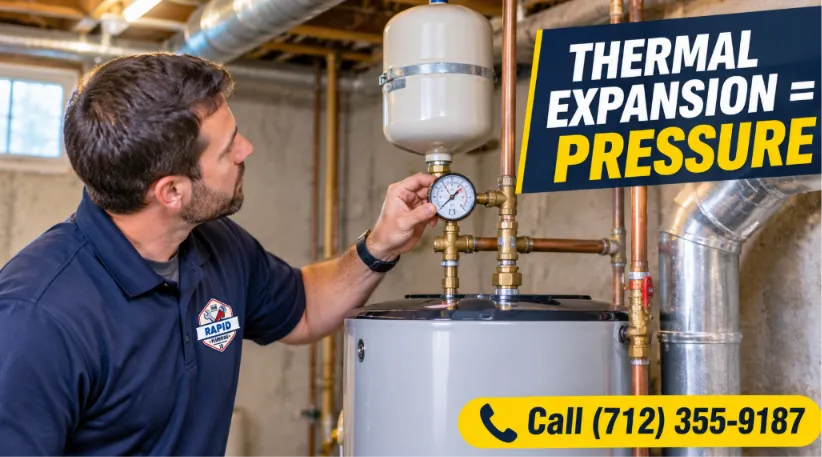
Water takes up more space when it is hot. A commonly cited figure is about 1.7% more volume when water goes from roughly 40°F to 140°F. That sounds small, but in a 50-gallon heater it adds up to close to a gallon of extra water every time the heater runs a heating cycle.
In an open system, that extra water simply pushes back toward the street main and nobody notices. In a closed system, it cannot, so the pressure rises inside your pipes. Over time that stress shows up as a dripping relief valve, noisy pipes, failing fixture seals and a shorter heater life.
Open vs. Closed Plumbing Systems: Why a Water Heater Expansion Tank Matters
Older homes often had nothing on the water service that blocked reverse flow, so expanding water could drift back into the main. Many homes now have a one-way device somewhere on the supply side. Common examples are:
- A backflow preventer or dual check valve near the meter
- A check valve on the cold water line
- A pressure reducing valve with a built-in check (see our guide on a pressure reducing valve failing in Council Bluffs)
Any one of these traps expanding water and turns your plumbing into a closed system. That is why a house that “never needed” an expansion tank can suddenly need one after a meter change, a new valve or a new heater.
Not sure what is installed where your service line enters the home? Council Bluffs Water Works can answer questions about the service connection, and a plumber can inspect the piping inside your home.
Do You Need a Water Heater Expansion Tank in Council Bluffs?
Use this table as a starting point. It is a general guide, not a substitute for an on-site check.
| Your situation | Do you likely need an expansion tank? |
|---|---|
| Backflow preventer or check valve on the water supply | Yes. This is a closed system. |
| Pressure reducing valve with a built-in check | Yes. It acts like a check valve. |
| Relief valve drips after hot water use | Test pressure first. A tank may be the fix. |
| Truly open system with no one-way device | Possibly not, but have it verified. |
| Tankless water heater | Follow the manufacturer’s instructions and local code. |
What the plumbing code says
Iowa’s state plumbing code is built on the Uniform Plumbing Code. That code’s thermal expansion section (608.3 in the 2018 edition) calls for an expansion tank or other approved device when a water system has a check valve, backflow preventer or similar device that stops building pressure from dissipating back into the main. You can read the state’s adopted plumbing code rules for the current edition. Edition numbers and local amendments change, so the Council Bluffs Building Division is the right place to confirm what an inspector will look for on your job.
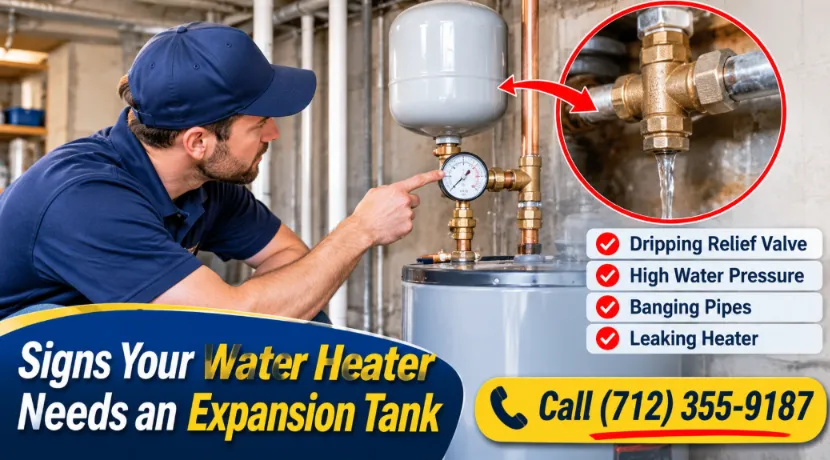
Signs Your Water Heater Needs an Expansion Tank
A missing or failed expansion tank rarely announces itself loudly. Watch for these clues:
- A dripping relief valve. Repeated small discharges after heating cycles often point to pressure spikes, not a bad valve. Read our guide on a water heater relief valve leaking before replacing the valve.
- High water pressure. Plumbing codes generally cap household pressure around 80 psi. A gauge reading that jumps well above that after the heater runs is a red flag.
- Banging or knocking pipes. Pressure swings can add to the problem. See common noisy pipes causes for other possibilities.
- Dripping faucets or running toilets that keep coming back after repairs.
- A heater that leaks or fails early. Review the signs your water heater is about to fail.
A simple pressure test you can do
- Screw a water pressure gauge onto an outdoor hose bibb or a laundry connection.
- Read it when no water has been used for a while. That is your static pressure.
- Run hot water for several minutes so the heater fires, then turn everything off and read it again.
- A big climb between the two readings suggests thermal expansion in a closed system.
How to Tell if Your Expansion Tank Has Failed
If you already have a tank, it can still be the problem. Inside is a rubber diaphragm over an air cushion, and when that diaphragm fails the tank fills with water and stops cushioning anything. Tap the tank. The top should sound hollow and the bottom should sound full. If it sounds full all over, or water comes out of the air valve on top, the tank is waterlogged and needs replacing.
Safety first. Do not press the air valve while the system is hot or under pressure, and keep your face away from it. If you are unsure, let a licensed plumber handle it. Never block or cap a relief valve.
Where a Water Heater Expansion Tank Goes and How It Is Sized
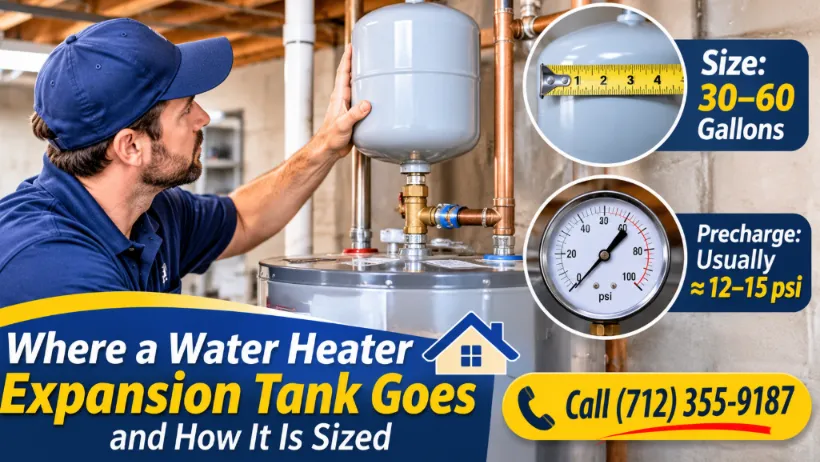
The tank is installed on the cold water supply to the heater, on the house side of any check valve, backflow preventer or pressure reducing valve. It should be properly supported, not left hanging from a small pipe stub. Two details matter most:
- Size. It depends on heater capacity and water pressure. Many homes with a 30 to 60 gallon heater use a roughly 2-gallon tank, while larger heaters use bigger ones. Follow the manufacturer’s sizing chart.
- Precharge. The air side must be set to match your home’s static water pressure before it goes in. A tank installed at the wrong pressure will not protect anything.
A well pressure tank is not a substitute. They are built for different jobs, so make sure the part is a listed thermal expansion tank for potable water.
Expansion Tank Lifespan and Replacement
An expansion tank does not last forever. Many last somewhere around 5 to 10 years depending on pressure and tank quality. If your water heater is being swapped, ask whether the tank is being replaced too, since an old tank on a new heater can fail early. If you are comparing options, our page on water heater replacement in Council Bluffs explains what a replacement job includes, and our water heater installation in Council Bluffs page covers new installs. Routine care helps too, such as the water heater flushing schedule and checking the water heater anode rod.
Permits and Who Should Install It
Replacing a water heater generally involves a plumbing permit, and adding or changing the supply-side piping for an expansion tank is part of that work. Our guide to water heater permit rules in Council Bluffs walks through the basics, and the Building Division can confirm what applies to your address. We recommend a licensed plumber for this job, because the tank has to be sized, pre-charged, supported and tied in on the correct side of the one-way device.
Common Expansion Tank Myths
- “My old heater never had one.” The heater may have been on an open system. A new meter, valve or backflow device can change that.
- “The relief valve handles it.” A relief valve is a last-resort safety device, not a pressure-control device. Letting it open over and over is a warning sign.
- “A pressure reducing valve replaces the tank.” The two do different jobs and often work together.
- “Any tank will do.” The size and the precharge both matter.
Water Heater Expansion Tank FAQs
Do all water heaters need an expansion tank?
Not all of them. Storage water heaters on a closed plumbing system generally need thermal expansion control. A system that is open to the main may not. A plumber can confirm which you have.
Is a water heater expansion tank required in Iowa?
Iowa’s state plumbing code is based on the Uniform Plumbing Code, which calls for an expansion tank or other approved device on closed systems. Local amendments and edition changes apply, so confirm with the Council Bluffs Building Division.
Why is my water heater relief valve dripping?
Often it is pressure from thermal expansion, though a worn valve or very high supply pressure can also cause it. Test your pressure before replacing parts.
Do tankless water heaters need an expansion tank?
A tankless unit has no storage tank to expand, but a closed system can still raise pressure. Follow the manufacturer’s instructions and local code. See our tankless water heater page for more.
How long does an expansion tank last?
Many last about 5 to 10 years. A failed diaphragm fills the tank with water and ends its usefulness, so it should be checked when the heater is serviced.
Can I install an expansion tank myself?
It involves cutting into the cold line, sizing the tank, setting the precharge and supporting it. A permit may also apply. We recommend a licensed plumber. You can also see our water heater repair in Council Bluffs page.
How much does it cost to add an expansion tank?
Cost depends on tank size, access and whether other work is needed. For related pricing, see our water heater repair cost in Council Bluffs guide, or call for a quote.
Get your water heater pressure checked today
Relief valve dripping or pipes banging? Rapid Plumbing CB serves Council Bluffs, IA. For urgent problems, see our emergency plumber page or call now.
Call Now: (712) 355-9187Explore more water heater help on our water heater services in Council Bluffs page.