
Grease Trap Cleaning Frequency for Council Bluffs Restaurants: The Short Answer
Grease trap cleaning frequency is not one number for every kitchen. A small indoor trap behind a busy fryer line can need attention every week, while a large buried interceptor may only need pumping every few months. What matters most is how full the device is, not the calendar. This guide explains the difference between the two devices, how the 25% rule works, and what to confirm with the city before you set a schedule for your Council Bluffs restaurant.
Typical ranges used by utilities elsewhere:
Indoor grease trap: about weekly to monthly, and sooner if it reaches 25% full.
Outdoor grease interceptor: about monthly to quarterly, and sooner if it reaches 25% full.
These are general ranges, not Council Bluffs rules. The city sets the minimum that applies to you, so confirm it with the City of Council Bluffs Water Pollution Control Plant before you lock in a contract.
Grease Trap vs Grease Interceptor: What Is the Difference?
People use the two names as if they mean the same thing, but they are different pieces of equipment. A grease trap is a small device inside the building, usually close to the kitchen sinks. A grease interceptor is a larger, multi-compartment tank that is normally buried outside. Both do the same job: grease floats, solids settle, and the cleaner water in the middle continues to the sewer.
| Feature | Grease trap | Grease interceptor |
|---|---|---|
| Location | Inside, near the sinks | Outside, usually underground |
| Size | Small, holds little grease | Much larger, holds far more grease and solids |
| Fills up | Quickly | Slowly |
| Typical schedule | Weekly to monthly | Monthly to quarterly |
| Who services it | Staff for small units, otherwise a hauler | A licensed pumping company |
This is also why a restaurant can follow its cleaning schedule perfectly and still have a backup. If the trap is too small for the kitchen it serves, it will always fill faster than the schedule expects. The right size depends on the fixtures and the menu, which is one reason to talk to the city before you replace a device.
The 25% Rule: How to Know Your Trap Is Full
Many Iowa cities use the 25% rule to decide when a grease trap or interceptor must be cleaned. The floating grease and the settled solids together should never take up more than 25% of the liquid depth in the device. Whatever your calendar says, a device that has reached that level is due now.
Quick example: if the liquid in your interceptor is 40 inches deep, 25% is 10 inches. When the grease layer on top plus the sludge on the bottom add up to 10 inches, it needs pumping.
Do not open or climb into a buried interceptor yourself. The tank can hold dangerous gases. Ask your pumping company to measure the layers at every visit and write the numbers on the service report. After a few visits you will see how fast your kitchen fills the tank, and you can set a schedule based on facts.
Grease Trap Cleaning Frequency by Kitchen Type
Two restaurants with the same trap can need very different schedules. These are starting points to adjust after you measure at each pump-out, not fixed rules.
| Kitchen | Why it fills | What to expect |
|---|---|---|
| Fryer-heavy: wings, fish, fast food | Large amounts of oil reach the sinks and floor drains | Shortest intervals, often the low end of the range |
| Full-service dinner restaurant | Mixed menu, high dishwashing volume | Mid-range, with busier weekends filling faster |
| Bar with a small menu | Limited cooking, mostly dishware | Longer intervals, but still inspect regularly |
| Coffee shop or bakery | Butter, batter and dairy residue | Longer intervals, but never skip inspections |
What speeds up your schedule
- High meal counts, holiday weekends and catering events.
- Food scraps going down the sink instead of into the trash.
- A dishwasher or garbage disposal connected to a small trap. Some cities restrict this, so ask before you connect one.
- A trap or interceptor that is too small for the kitchen.
Kitchen drains slowing down? Call before the backup.
Our team handles commercial kitchen drain problems around Council Bluffs, from slow lines to full backups.
Call Now: (712) 355-9187What Council Bluffs Requires: Check Before You Guess
Online directories often claim that “Iowa law” sets one cleaning rule for every restaurant. That is not reliable, because grease rules are written by each city. The Iowa DNR pretreatment program page lists Council Bluffs among the Iowa cities with a local pretreatment program, which means the city’s wastewater staff handle this locally.
The right contact is the City of Council Bluffs Water Pollution Control Plant, listed at 18452 Applewood Rd with a phone number of (712) 328-4642. The Council Bluffs Public Works directory also lists the wastewater plant and the Public Works office. Ask them these questions before you decide anything:
- Does my type of restaurant need a grease trap or an interceptor?
- What is the minimum cleaning interval, and does the 25% rule apply?
- What records must I keep, and who may inspect them?
- Can the dishwasher or garbage disposal connect to my grease device?
- Are enzymes or other additives allowed?
If you plan to install, move or replace a grease device, that is plumbing work that may need a permit. Our guide to the Council Bluffs plumbing permit process is a good place to start.
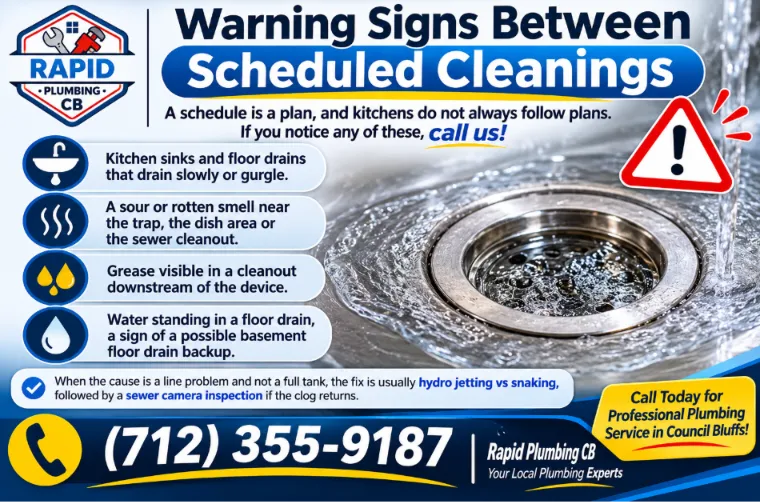
Warning Signs Between Scheduled Cleanings
A schedule is a plan, and kitchens do not always follow plans. If you notice any of these, call your pumping company and your plumber instead of waiting for the next visit:
- Kitchen sinks and floor drains that drain slowly or gurgle.
- A sour or rotten smell near the trap, the dish area or the sewer cleanout.
- Grease visible in a cleanout downstream of the device.
- Water standing in a floor drain, a sign of a possible basement floor drain backup.
When the cause is a line problem and not a full tank, the fix is usually hydro jetting vs snaking, followed by a sewer camera inspection if the clog returns. In older downtown buildings, a repeated blockage can point to the building’s own pipes, which our older downtown buildings drain backup guide covers. For an overflow during service hours, call an emergency plumber in Council Bluffs.
Keep a Cleaning Log for Every Service
A written log protects you in an inspection and tells you if your schedule is working. Keep it near the kitchen office and ask your pumping company to fill in the same details every time.
- Date of service and the company that did the work.
- Which device was serviced: indoor trap, outdoor interceptor, or both.
- How full it was, with the grease and solids depth if measured.
- The amount removed and where it was taken.
- Any damage noticed: cracked lid, worn baffle or gasket, slow outlet.
Ways to Lower Your Grease Trap Cleaning Frequency
You cannot skip pump-outs to save money, but you can make each one last longer. Scrape plates into the trash before washing, use sink strainers, and pour used fryer oil into a covered oil container instead of the drain. Wipe greasy pans with a paper towel before they reach the dish sink.
Avoid relying on additives to “dissolve” grease. Some cities prohibit them, and grease that is only moved along the pipe can settle further down the sewer. For the same reason, read why chemical drain cleaners damage pipes before pouring any product into a commercial drain.
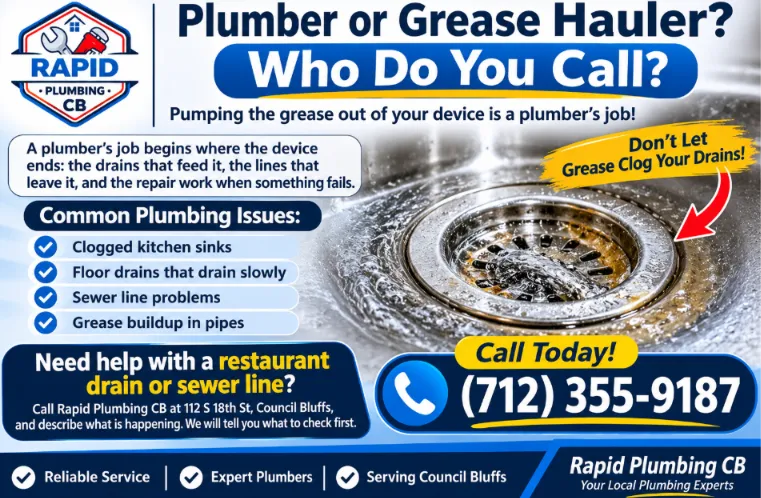
Plumber or Grease Hauler: Who Do You Call?
Pumping the grease out of the device is normally a hauler’s job. A plumber’s job begins where the device ends: the drains that feed it, the lines that leave it, and the repair work when something fails. If a blockage keeps coming back after a pump-out, the problem is in the pipes, and that is a plumbing call. If your question is about commercial kitchen pipes, our guide to commercial plumbing for Council Bluffs restaurants explains what we look at, and the residential vs commercial plumber difference page explains why the work is different from a house.
Restaurants also deal with other building plumbing, such as commercial restroom plumbing maintenance, and the sewer pipe outside the building can be a separate responsibility, so see who is responsible for the sewer line in Council Bluffs. For the full list of what we handle, visit our plumbing services in Council Bluffs page, or read about drain cleaning in Council Bluffs and sewer line repair. A business in the Downtown area can also start from our Downtown Council Bluffs plumbing page. Cooking at home instead? The kitchen sink keeps clogging guide is the better fit.
Grease Trap Cleaning Frequency: Frequently Asked Questions
How often should a restaurant clean its grease trap?
Small indoor grease traps fill fast, so many utilities set a minimum of about once a week, and cleaning sooner whenever the trap reaches the 25% limit. Your real grease trap cleaning frequency depends on trap size, menu and volume. Council Bluffs sets its own minimum, so confirm the exact rule with the city.
How often should a grease interceptor be pumped?
Large outdoor interceptors are typically pumped on a monthly to quarterly schedule, or sooner when the grease and solids reach 25% of the liquid depth. A fryer-heavy kitchen may need monthly service, while a low-volume cafe may stretch toward quarterly. Ask the city which minimum applies to your building.
What is the 25% rule for grease traps?
The 25% rule says the floating grease plus the settled solids should never take up more than 25% of the liquid depth in the trap or interceptor. In a 40-inch deep tank, that is about 10 inches combined. Many Iowa cities use this rule, but you should confirm Council Bluffs rules with the Water Pollution Control Plant.
Does Council Bluffs require restaurants to have a grease trap or interceptor?
Iowa DNR lists Council Bluffs among the Iowa cities that run a local pretreatment program, and the city’s Water Pollution Control Plant handles wastewater compliance. Grease rules are set city by city, so call the plant at (712) 328-4642 before you buy, move or remove any grease device.
Can I use enzymes or hot water to clean a grease trap?
Some Iowa cities prohibit enzymes, emulsifying chemicals and hot water as a grease control method because they can push grease farther down the sewer. Ask Council Bluffs before relying on any additive. Chemical drain cleaners also damage pipes and are not a substitute for pumping.
What is the difference between a grease trap and a grease interceptor?
A grease trap is a small device inside the building, usually near the sinks. A grease interceptor is a larger, multi-compartment tank, usually buried outside. The interceptor holds far more grease and solids, so it is pumped less often than a trap.
Does a plumber or a grease hauler clean the grease trap?
Pump-outs are normally done by a grease hauler or pumping company. A plumber handles the pipes around the device: slow kitchen drains, backups, hydro jetting, camera inspection and repairs to the lines that feed and leave the trap.
Need help with a restaurant drain or sewer line?
Call Rapid Plumbing CB at 112 S 18th St, Council Bluffs, and describe what is happening. We will tell you what to check first.
Call (712) 355-9187